
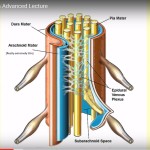
Courtesy: Douglas Gillard, BS, DC, Spine Researcher http://chirogeek.com/
Viscoelastic Properties of Bone

Courtesy: Mock FRCS Cardiff, Saqib Masud FRCS, John Davies FRCS
Understanding the Stress and Strain Curve
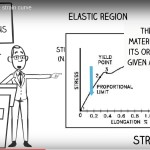
Courtesy: Harry Benjamin Laing MRCS, Ortho M8, FRCS(Tr and Orth Tutorials)
Salenius and Vankka Graph
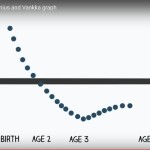
Courtesy:Harry Benjamin Laing, MRCS Ortho M8 FRCS(Tr and Orth) Tutorials https://www.ncbi.nlm.nih.gov/pubmed/1112851
Margins in Tumour Resection

Courtesy: Harry Benjamin Laing Ortho M8 FRCS(Tr and Orth) tutorials
Case discussions on Hand and Wrist Trauma
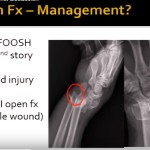
Courtesy: Saqib Rehman Director of Orthopaedic Trauma Temple University Philadelphia USA
Case discussions on Distal Tibia and ankle fractures
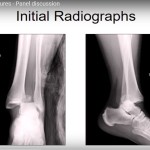
Courtesy: Saqib Rehman Director of Orthopaedic Trauma Temple University Philadelphia USA
Panel Discussion on Post traumatic deformity and Nonunion
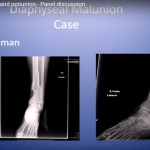
Courtesy: Saqib Rehman MD Director of Orthopaedic Trauma Temple University Philadelphia Pennsylvania USA
Decision making in Humeral shaft fractures
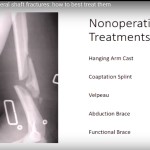
Courtesy: Saqib Rehman MD Director of Orthopaedic Trauma Temple University Philadelphia Pennsylvania USA
Anterior Sternoclavicular Joint Dislocation
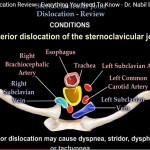
Classification and Management Anatomy of the Sternoclavicular Joint The sternoclavicular joint is a saddle-shaped synovial joint. It is formed by the articulation between: Medial end of the clavicle Manubrium of the sternum First costal cartilage Stabilizing Structures Key stabilizing structures of the sternoclavicular joint include: Anterior and posterior joint capsule Intra-articular fibrocartilaginous disk Interclavicular ligament […]
MRI Anatomy of the Shoulder
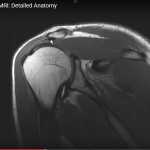
Courtesy: Dr Jean Jose MD, Associate Chief, Musculoskeletal Radiology Section, Associate Professor of Clinical Radiology, University of Miami School of Medicine, Florida, USA MRI Anatomy of the Shoulder Overview The shoulder is a highly mobile and complex joint composed of: Scapula Clavicle Humerus Clinical Importance Understanding shoulder MRI anatomy is essential for evaluating: Rotator […]
Osseous tissue Cell anatomy and Matrix physiology

Courtesy: Prof Knoppy Bone has Cellular and Noncellular composition Four types of cells are found in bones: Osteoprogenitor cells, Osteoblasts, Osteocytes and Osteoclasts Osteoblasts are involved in bone deposition The Osteoclasts are large multinucleate Giant cells with a ruffled border, and are involved in bone absorption. Bone has orgnanic and inorganic component. Organic component consists […]
Growth Plate Layers
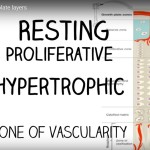
? Courtesy: Harry Benjamin Laing MRCS Ortho M8, FRCS(Tr and Orth) Tutorials Growth Plate (Physis) The growth plate (physis) is the cartilaginous region responsible for longitudinal bone growth in children. Zones of the Growth Plate 1. Resting (Reserve) Zone Located closest to the epiphysis. Contains small, inactive chondrocytes. Serves as a reservoir of cells […]
Physeal Zones and Abnormalities
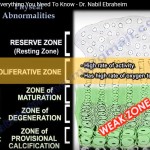
Courtesy: Prof Nabil Ebraheim, University of Toledo, Ohio, USA This video describes the different physeal zones & their abnormalities. Growth plate has 3 zones- Reserve zone, proliferative zone & hypertrophic zone. Hypertrophic zone is again divided into zone of maturation , zone of degeneration & zone of provisional calcification. Reserve zone is the area where […]
MRI Anatomy of the Wrist

Courtesy: Dr Jean Jose MD, Associate Chief, Musculoskeletal Radiology Section, Associate Professor of Clinical Radiology, University of Miami School of Medicine, Florida, USA MRI Anatomy of the Wrist Overview The wrist is a complex anatomical region consisting of: Multiple bones Tendons Ligaments Neurovascular structures Clinical Importance MRI of the wrist is essential for evaluating: […]