
Courtesy: Harry Benjamin Laing MRCS
Ortho M8, FRCS(Tr and Orth) Tutorials
Growth Plate (Physis)
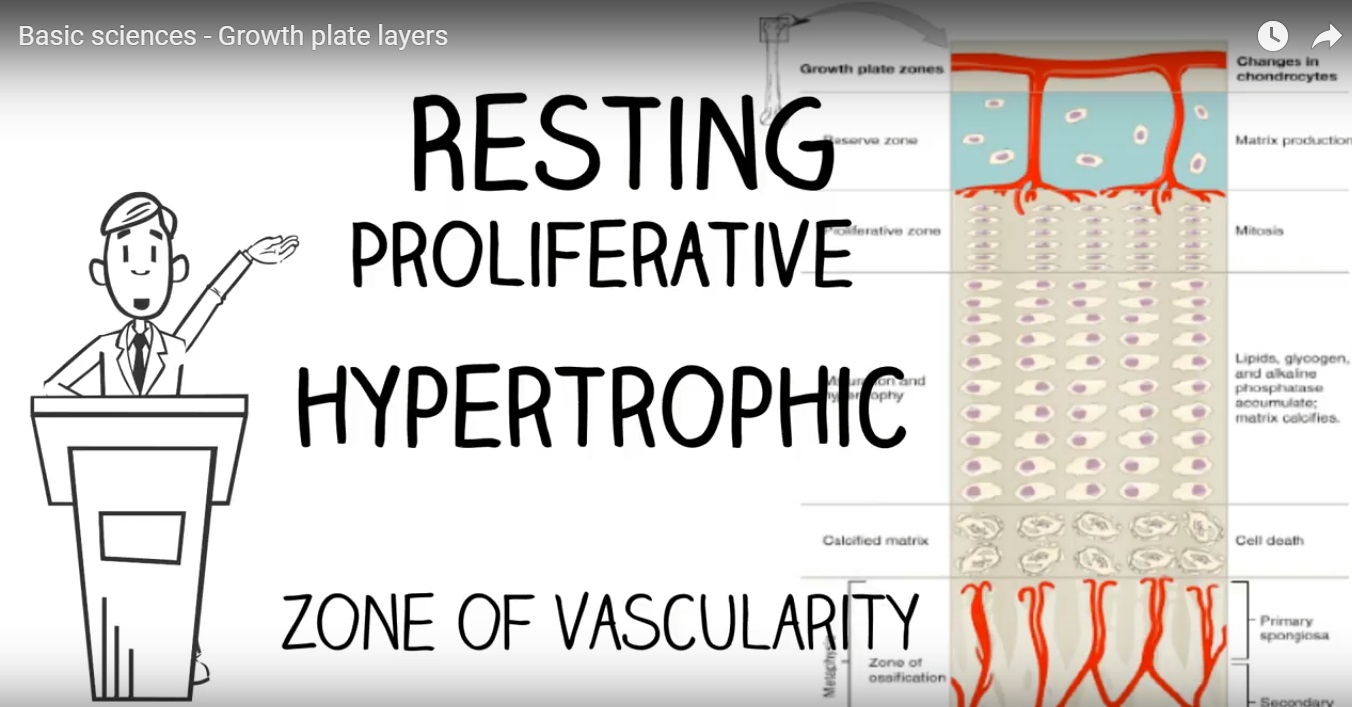
The growth plate (physis) is the cartilaginous region responsible for longitudinal bone growth in children.
Zones of the Growth Plate
1. Resting (Reserve) Zone
- Located closest to the epiphysis.
- Contains small, inactive chondrocytes.
- Serves as a reservoir of cells for future growth.
- Anchors the growth plate to the epiphysis.
2. Proliferative Zone
- Chondrocytes undergo rapid mitosis.
- Cells are arranged in longitudinal columns.
- Responsible for producing new cartilage and contributing to bone lengthening.
3. Hypertrophic Zone
- Chondrocytes enlarge significantly.
- Weakest part of the growth plate and the most common site of physeal injury.
- Divided into:
- Zone of Maturation
- Zone of Degeneration
- Zone of Calcification
4. Zone of Vascular Invasion (Ossification)
- Blood vessels invade the calcified cartilage.
- Osteoblasts lay down new bone.
- Cartilage is replaced by bone, completing endochondral ossification.
Sequence of Endochondral Ossification
Resting Zone – Proliferative Zone – Hypertrophic Zone (Maturation – Degeneration – Calcification) – Vascular Invasion/Ossification
Key Examination Points
- The hypertrophic zone is the weakest portion of the physis.
- Most Salter–Harris fractures pass through the hypertrophic zone.
- Longitudinal bone growth occurs primarily through the proliferative and hypertrophic zones.
- Blood vessels enter from the metaphyseal side during ossification.
Leave a Reply