
Courtesy: Dr. James Hui, Dr Ashok Shyam, Ortho TV
TENS for Pediatric Forearm Fractures
Basic Principle
- TENS uses two pre-bent elastic nails.
- The nails provide symmetrical bracing and three-point fixation within the medullary canal.
- The construct provides translational, axial, and rotational stability.
- Controlled micromotion promotes callus formation and secondary bone healing.
Indications
- Age >10 years, where tolerance for angulation, rotation, and displacement is minimal.
- Unstable both-bone forearm fractures.
- Failed closed reduction.
- Selected open fractures.
- Polytrauma.
Biomechanical Principle
- The nails act as internal splints.
- Opposing elastic forces stabilize the fracture.
- Three-point fixation helps prevent angulation and rotation.
- The final construct should maintain interosseous membrane tension and preserve pronation and supination.
Reduction Principles
- Achieve adequate reduction before nail insertion.
- Correct both angulation and rotation.
- Maintain the reduction during nail insertion.
- Traction and rotational maneuvers can assist reduction.
Nail Configuration
- Avoid the corkscrew phenomenon, caused by excessive nail rotation and loss of control.
- Aim for a C-shaped bend in each nail.
- Maintain balanced elastic forces.
- Nail diameter should be approximately 40% of the canal diameter for each nail.
- Combined nail fill should be approximately 80%.
Radius Fixation
- Preferred entry is through the distal radius.
- Entry can be at the radial styloid or through a dorsal approach.
- Advance the nail from distal to proximal.
- Protect the superficial radial nerve.
- Avoid injury to the APL and EPB tendons.
Ulna Fixation
- Preferred entry is through the proximal ulna.
- Distal entry is an alternative.
- The nail may be advanced proximally to distally or distally to proximally.
- For proximal entry, use the lateral/radial side.
- This helps create a balanced “see-saw” effect.
Operative Technique
Entry
- Make a small incision at the entry site.
- Protect superficial nerves and tendons.
Opening the Canal
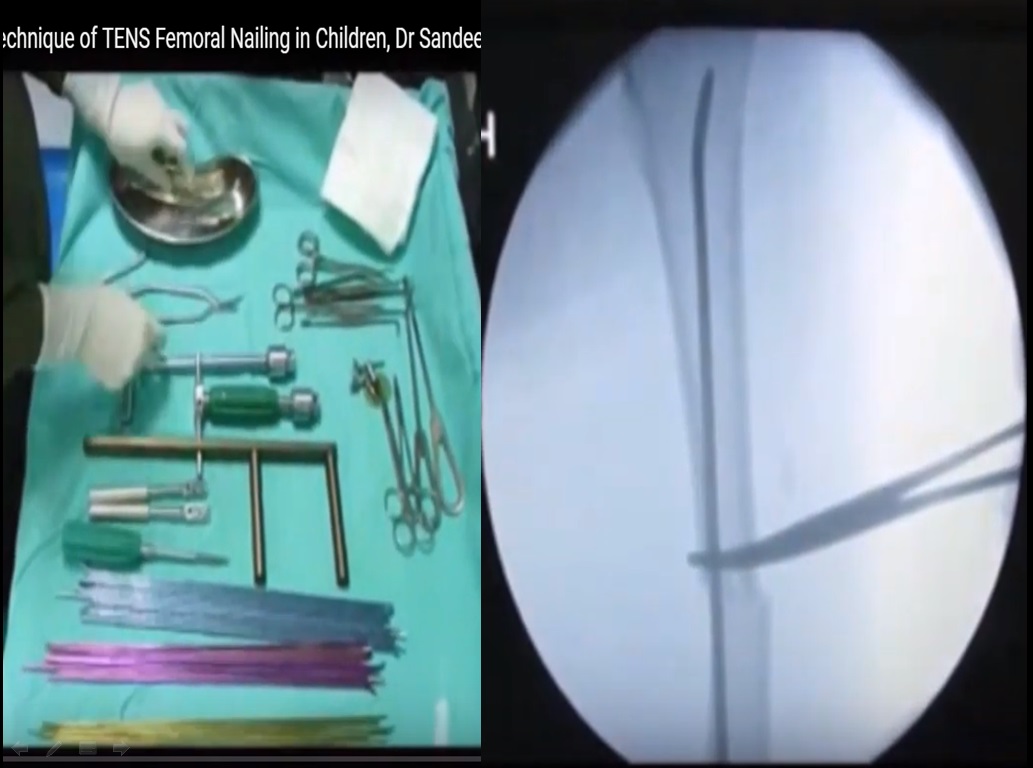
- Use an awl to create the entry hole.
- The entry should be as perpendicular as possible to the cortex.
Nail Preparation
- Pre-bend the nail into a C-shaped curvature.
- The apex of the bend should correspond approximately to the fracture site.
Nail Insertion
- Advance the nail gently.
- Avoid cortical perforation.
- Use controlled rotational movements.
- Fluoroscopy can guide insertion.
Fracture Reduction
- Use traction and rotation to assist reduction.
- Maintain alignment while advancing the nail.
Final Position
- Both nails should cross the fracture.
- The nails should provide stable fixation.
- Maintain the appropriate C-shaped configuration.
Nail End Management
- Cut the nail, leaving a small length outside the cortex.
- Bend and bury the end to minimize soft-tissue irritation.
Technical Tips
- Gentle handling reduces the risk of cortical perforation.
- Correct nail contouring is essential.
- Avoid excessively large incisions.
- Use appropriately matched nail sizes.
- Preserve forearm rotation throughout the procedure.
Complications
- Entry-site irritation.
- Infection.
- Nerve injury, particularly superficial radial nerve injury.
- Tendon irritation.
- Nail migration.
- Malunion.
- Refracture after nail removal.
Outcome Principle
- Successful TENS depends on adequate reduction, appropriate nail size, correct nail contouring, and balanced biomechanics.
- The final construct should provide elastic stability while preserving forearm rotation.
Exam Pearls
- TENS = two pre-bent nails + three-point fixation.
- Each nail – 40% of canal diameter.
- Combined fill – 80%.
- C-shaped nail configuration = balanced elastic forces.
- Avoid the corkscrew phenomenon.
- Preserve the interosseous space and forearm rotation.
- Superficial radial nerve = important risk at the distal radial entry.

Leave a Reply