
Courtesy: Sandeep Patwardhan, Ashok Shyam, IORG and OrthoTV
TENS Nailing for Femoral Fractures in Children
Indications
- Age 5–12 years.
- Weight <45–50 kg.
- Transverse fractures.
- Short oblique fractures.
- Minimally comminuted fractures.
- Midshaft fractures are the ideal indication.
Relative Contraindications
- Highly comminuted fractures.
- Very proximal or distal fractures.
- Heavier children >50 kg.
- Long oblique or length-unstable fracture patterns.
Principle
- TENS provides elastic stable intramedullary fixation.
- Two pre-bent nails create a balanced spindle construct.
- The construct provides three-point fixation.
- Stability combined with controlled micromotion promotes callus formation.
- TENS works best in length-stable fractures.
Nail Selection
- Each nail diameter = 0.4 × the narrowest canal diameter.
- Two nails together should fill approximately 80% of the canal.
- Use equal-sized nails on both sides.
Preoperative Setup
- General anesthesia.
- Supine position on a radiolucent table.
- C-arm aligned with the surgeon.
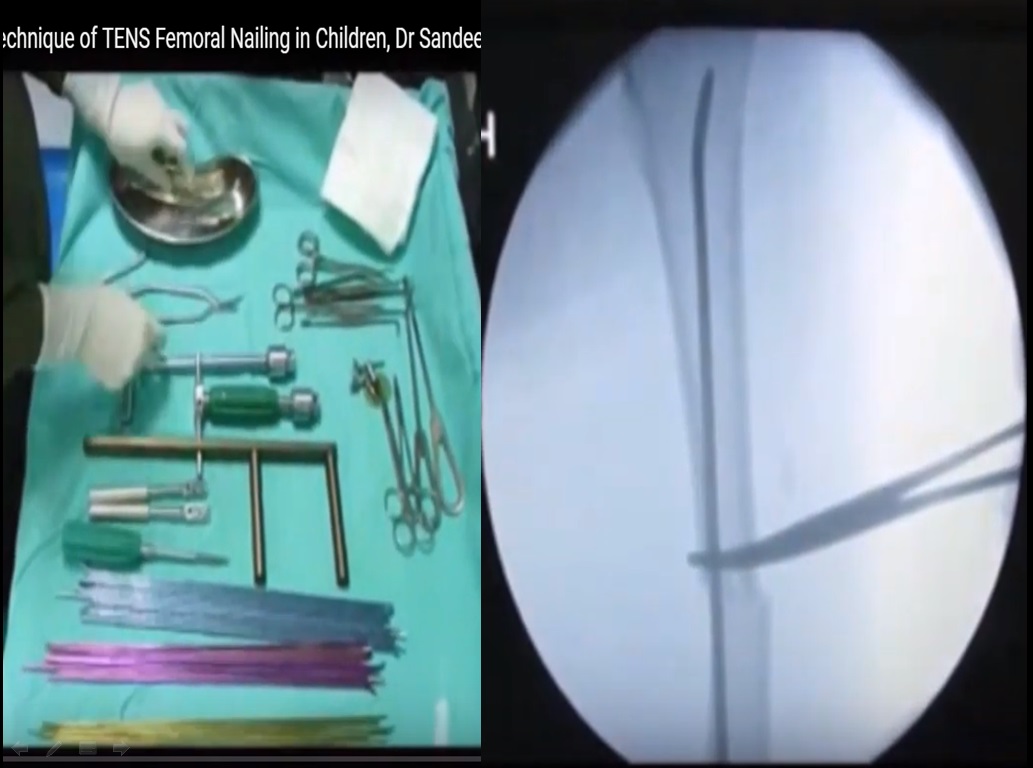
- Required instruments include nails, awl, T-handle, bending tools, hammer, and inserter/extractor.
Surgical Technique
Reduction
- Achieve alignment using traction.
Nail Bending
- Bend both nails symmetrically.
- The apex of the bend should correspond to the fracture level.
- The nail should have a hockey-stick configuration.
- Height of the bend = approximately 3 × canal diameter.
Entry Point
- Use medial and lateral entry points.
- Entry points are approximately 2 cm proximal to the distal femoral physis.
- Position the entry slightly posteriorly to reduce the risk of joint irritation.
- Avoid injury to the physis.
Nail Insertion
- Insert the first nail and advance it toward the fracture.
- Insert the second nail in the same manner.
- Use gentle oscillating movements rather than forceful advancement.
Crossing the Fracture
- Reduce the fracture.
- Pass the easier nail first.
- Then pass the second nail.
- Rotation can assist passage.
- Slight withdrawal and redirection may be required.
Final Position
- The nails should diverge proximally.
- The lateral nail should reach toward the greater trochanter.
- The medial nail should reach toward the femoral neck region.
- Avoid physeal injury.
Seating and Cutting
- Cut the nails, leaving approximately 1 cm outside the cortex.
- Avoid leaving long, bent nail ends because they can cause irritation.
- Seat the nails flush with the cortex using a tamp.
Final Check
- Confirm alignment on AP and lateral views.
- Check rotational alignment carefully.
- Confirm stability.
Biomechanics
- The opposing elastic forces provide axial stability.
- They also provide rotational control.
- The construct is most effective in length-stable fractures.
Postoperative Protocol
- Plaster immobilization is usually not required.
- Knee mobilization can begin around day 2–3.
- Partial weight bearing can begin around day 3–4.
- Progress weight bearing over approximately 3–4 weeks.
- Good callus formation is expected by around 6 weeks.
- Union is expected at approximately 3 months.
Implant Removal
- Removal is generally around 6–9 months.
- Ideally, removal should occur before 18 months.
- If extraction is difficult, the nail can be bent approximately 90° using a hollow tube and then extracted.
Complications
- Malalignment, including varus, valgus, and rotational deformity.
- Nail irritation at the entry site.
- Knee stiffness.
- Infection.
- Refracture after nail removal.
- Limb length discrepancy.
Exam Pearls
- Best age: 5–12 years.
- Best fracture: Transverse midshaft fracture.
- Nail diameter: 40% of the canal diameter for each nail.
- Combined canal fill: Approximately 80%.
- Two nails: Equal size and symmetrically bent.
- Key principle: TENS works best for length-stable fractures.
- Always avoid physeal injury.
Leave a Reply