
Courtesy: Sally Hobson, Hull ROyal Infirmary, Hull, UK
Stulberg Classification (Based on Femoral Head Shape and Congruence)
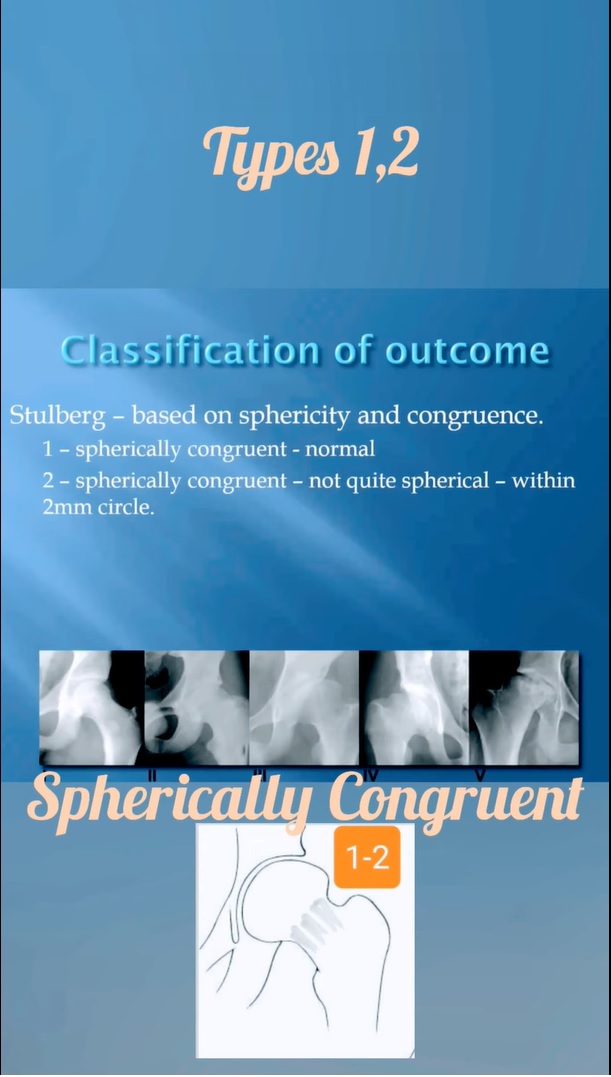
This classification evaluates the shape of the femoral head and its congruence with the acetabulum on radiographs after healing.
Type I – Spherically Congruent (Normal)
- Femoral head: Completely normal and spherical.
- Acetabulum: Normal.
- Joint congruence: Perfect congruence between femoral head and acetabulum.
- Outcome: Excellent hip function with minimal risk of osteoarthritis.
Type II – Spherically Congruent (Nearly Normal)
- Femoral head: Slightly irregular but still nearly spherical.
- Assessment:
- Mose (Moses) sphericity circles are drawn over the femoral head on X-ray.
- If the femoral head contour deviates >2 mm outside the circle, it is considered not perfectly spherical.
- Joint congruence: Still congruent.
- Outcome: Good prognosis.
Type III – Aspherical but Congruent
- Femoral head: Clearly aspherical.
- Acetabulum: Adapts to the abnormal femoral head shape.
- Joint congruence: Maintained despite deformity.
- Outcome: Moderate risk of early degenerative changes.
Type IV – Markedly Aspherical Congruent
- Femoral head: Severe deformity with flattening of more than 1 cm in the weight-bearing area.
- Acetabulum: Also becomes deformed to match the femoral head.
- Joint congruence: Still congruent but abnormal.
- Outcome: Higher chance of early osteoarthritis.
Type V – Aspherical Incongruent
- Femoral head: Severely deformed.
- Acetabulum: Does not match the femoral head shape.
- Joint congruence: Incongruent hip joint.
- Outcome: Poor prognosis with early degenerative arthritis.
Key Point:
- Types I–II: Good prognosis (spherical congruence).
- Types III–IV: Aspherical but congruent (moderate prognosis).
- Type V: Aspherical incongruent (poor prognosis).


Leave a Reply