
Courtesy: Amr Abdelgawad, Maimonaides Medical Centre, Brooklyn, New York, USA
LEGG-CALVÉ-PERTHES DISEASE
Introduction
Perthes disease is a pediatric hip disorder characterized by:
- Avascular necrosis of the femoral head
in a skeletally immature child.
The condition is typically:
- Self-limiting
with a disease course lasting approximately:
- 24 months
Despite eventual healing, the femoral head may heal in a deformed shape, leading to long-term hip problems.
Epidemiology
Age Group
Perthes disease most commonly affects children between:
- 4–8 years of age
Gender Distribution
It is more common in:
- Boys than girls
with an approximate ratio of:
- 4:1
Bilateral Involvement
Bilateral disease occurs in approximately:
- 10% of cases
When bilateral, the stages are usually:
- Asymmetric
Symmetrical bilateral involvement should raise suspicion for alternative diagnoses.
Pathophysiology
Vascular Disruption
The disease begins with:
- Interruption of blood supply to the femoral head
leading to:
- Bone necrosis
Revascularization Phase
As blood supply returns:
- Bone resorption occurs
- Structural weakness develops
This may result in:
- Collapse of the femoral head
Healing and Remodeling
Over time, the femoral head undergoes:
- Reossification
- Remodeling
The final shape may range from:
- Near-normal spherical head
- Flattened or mushroom-shaped deformity
Stages of Perthes Disease
The disease progresses through four main stages.
1. Necrosis Stage
Initial interruption of blood supply causes:
- Femoral head ischemia
2. Fragmentation Stage
Bone resorption leads to:
- Fragmentation
- Structural weakening
- Risk of collapse
3. Reossification Stage
New bone formation begins during healing.
4. Remodeling Stage
The femoral head remodels gradually over time.
The final shape determines long-term outcome.
Clinical Presentation
Limp
The most common presentation is:
- Painless or painful limp
Pain
Pain may occur in the:
- Hip
- Groin
- Thigh
Importantly, pain may be referred to the:
- Knee
which can delay diagnosis.
Range of Motion
Children commonly develop:
- Reduced hip abduction
- Limited internal rotation
Flexion Deformity
A flexion contracture may develop and can be assessed using:
- Thomas test
Imaging
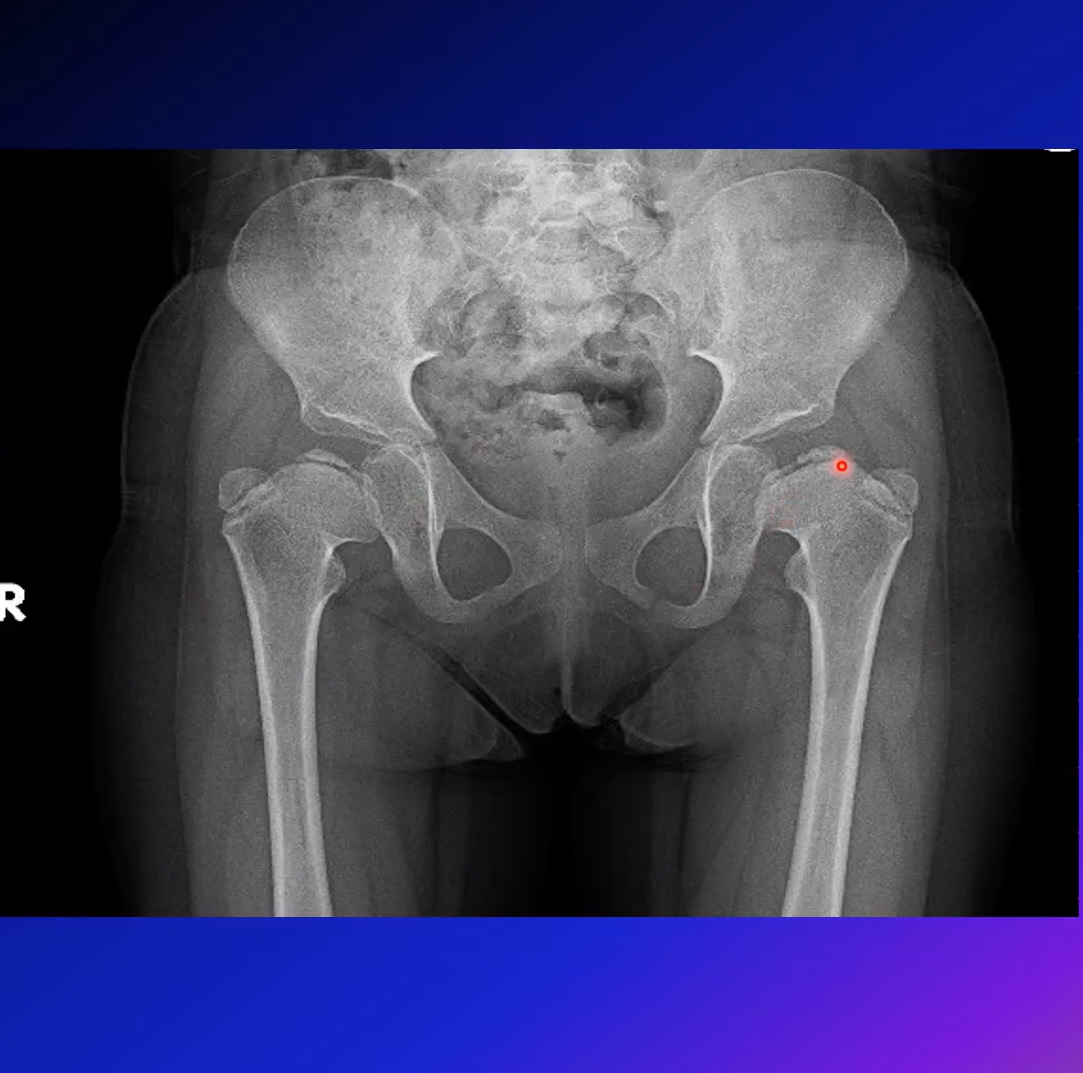
Early Radiographic Findings
Early findings may include:
- Subchondral fracture
also known as the:
- Crescent sign
Progressive Changes
As the disease progresses, imaging may demonstrate:
- Femoral head collapse
- Fragmentation
- Loss of sphericity
Late Findings
During healing, the femoral head may appear:
- Oval
- Enlarged
- Mushroom-shaped
Residual deformity influences long-term prognosis.
Differential Diagnosis
Conditions that may mimic Perthes disease include:
- Epiphyseal dysplasia
- Metabolic bone disorders
- Other causes of femoral head collapse
Important Clinical Point
Bilateral symmetric involvement is:
- Not typical for Perthes disease
and should prompt evaluation for alternative diagnoses.
Treatment Principles
Main Goal
The primary treatment goal is to:
- Maintain a spherical femoral head
Containment Principle
Successful management depends on:
- Keeping the femoral head contained within the acetabulum
This promotes more normal remodeling during healing.
Management Based on Age
Children Younger Than 6 Years
Younger children generally have:
- Better remodeling potential
- Better prognosis
Conservative Treatment
Non-operative treatment commonly includes:
- NSAIDs
- Activity modification
- Physiotherapy
- Range-of-motion exercises
Most younger children are treated conservatively.
Non-Surgical Containment Methods
Additional measures may include:
- Abduction exercises
- Petrie casting
to improve containment.
Children Older Than 6 Years
Older children have:
- Higher risk of femoral head deformity
and are more likely to require surgery.
Surgical Management
Femoral Osteotomy
Femoral varus osteotomy may improve:
- Femoral head containment
within the acetabulum.
Pelvic Osteotomy
Pelvic procedures may also be used to:
- Improve acetabular coverage
in selected patients.
Prognostic Factors
Better Prognosis
Associated with:
- Younger age
- Minimal femoral head collapse
- Good containment
- Preserved range of motion
Worse Prognosis
Associated with:
- Older age at presentation
- Severe collapse
- Loss of containment
- Femoral head deformity
Complications
Potential long-term complications include:
- Femoral head deformity
- Hip stiffness
- Limb length discrepancy
- Early osteoarthritis
Residual deformity strongly influences adult hip function.
Key Clinical Pearls
- Perthes disease is avascular necrosis of the femoral head in children.
- Boys aged 4–8 years are most commonly affected.
- Knee pain may be the presenting symptom.
- The disease progresses through necrosis, fragmentation, reossification, and remodeling stages.
- Containment of the femoral head is the key treatment principle.
- Younger children generally have a better prognosis.
- Bilateral symmetrical disease is atypical and should prompt further evaluation.
Final Take-Home Message
Perthes disease is a self-limiting pediatric hip disorder caused by temporary loss of blood supply to the femoral head.
Although healing occurs over time, femoral head deformity may result if containment is not maintained.
Early diagnosis, preservation of hip motion, and maintenance of femoral head containment are essential for achieving the best long-term outcomes and reducing the risk of early degenerative arthritis.

Leave a Reply