
Courtesy: Dr Sally Hobson, Hull Royal Infirmary, Hull, UK
Herring (Lateral Pillar) Classification
This classification is based on the preservation of the lateral pillar of the femoral head epiphysis on anteroposterior radiographs during the fragmentation stage.
Type A
- Lateral pillar height: 100% preserved (no loss of height).
- Femoral head: Maintains normal height and structure.
- Prognosis: Excellent outcome.
Type B
- Lateral pillar height: More than 50% of the original height is maintained.
- Femoral head: Some collapse but lateral pillar is largely preserved.
- Prognosis: Good to fair outcome.
Type B/C Border Group (Modification)
- Introduced in the modified Herring classification.
- Features are intermediate between Type B and Type C.
- Lateral pillar: Around 50% height remaining, but with narrowing or early collapse.
- Prognosis: Variable; worse than B but better than C.
Type C
- Lateral pillar height: Less than 50% preserved (more than half lost).
- Femoral head: Severe collapse of the lateral pillar.
- Prognosis: Poor outcome, high risk of deformity and early osteoarthritis.
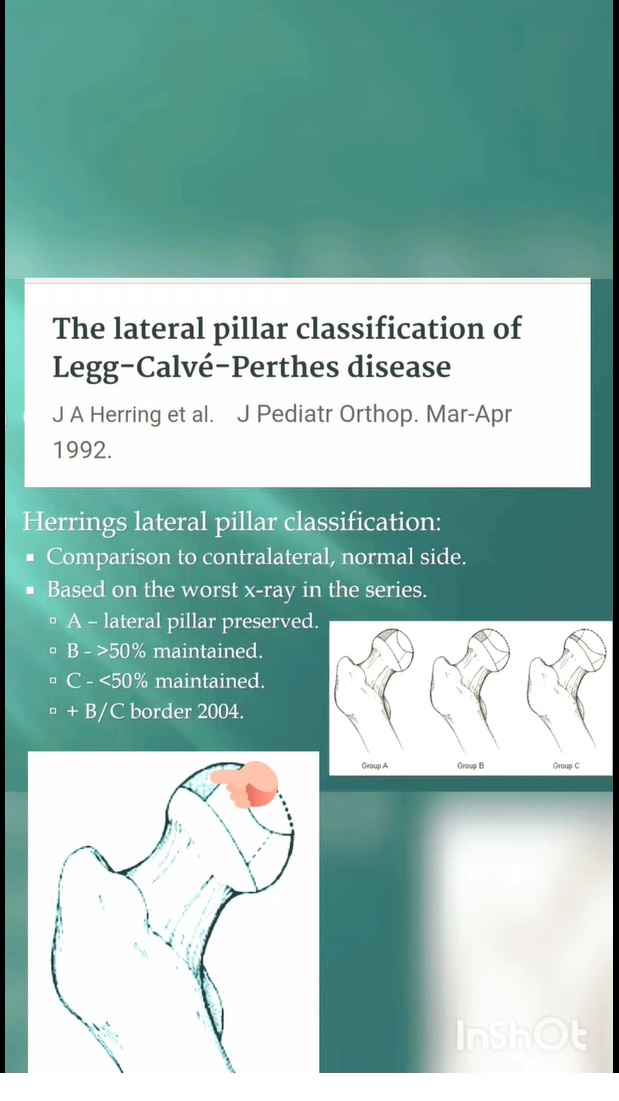
Herring Classification for Perthe’s Disease
Herring Lateral Pillar Classification
Group A: No involvement of the lateral pillar.
Group B: At least 50% of lateral pillar height maintained.
Group C: Less than 50% of lateral pillar height maintained.
To designate borderline groups between B and C the B/C border group was included.
- B/C1: lateral pillar more than 50% width, but < 2 to 3 mm width
- B/C2: lateral pillar more than 50% width, but little ossification
- B/C3: lateral pillar more than 50% width, but depressed relative to central column.

Leave a Reply