• Skip to main content
  • Skip to secondary menu
  • Skip to primary sidebar
OrthopaedicPrinciples.com

OrthopaedicPrinciples.com

Integrating Principles and Evidence

Integrating Principles and Evidence

  • Home
  • Editorial Board
  • Our Books
    • Evidence Based Orthopaedic Principles
  • Courses
  • Exams
  • Reviews
  • Live Program
  • Contact

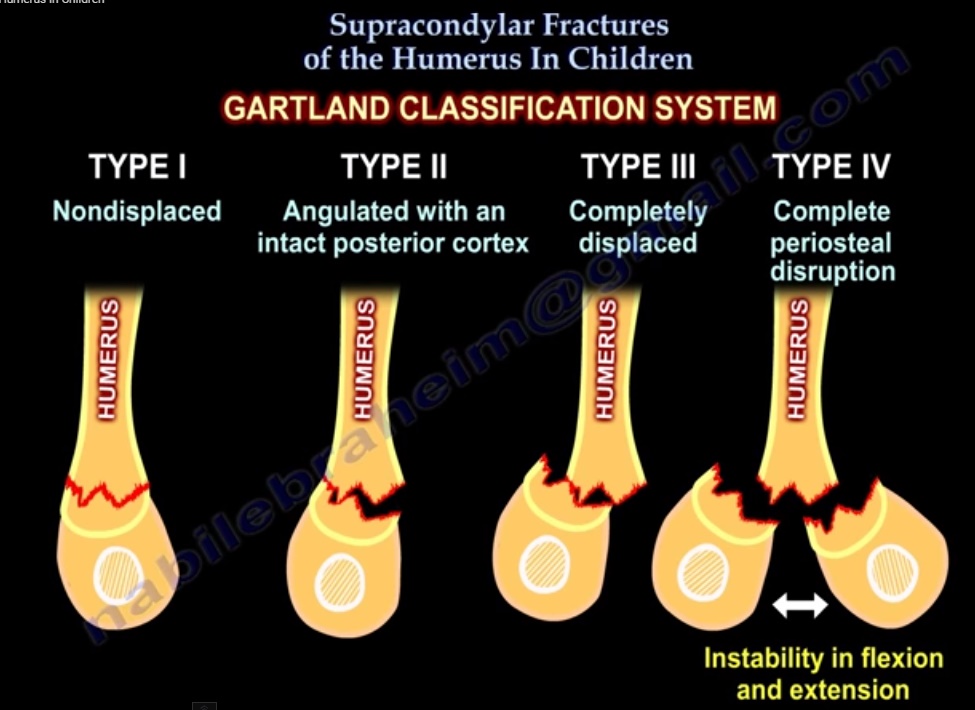
Pediatric Supracondylar Fractures of the humerus

Courtesy: Prof Nabil Ebraheim, University of Toledo, Ohio, USA

Supracondylar Fracture of the Humerus

Types

Extension type

  • Most common, accounting for approximately 95 percent of cases.

Flexion type

  • Uncommon.

Mechanism of Injury

Extension type

  • Fall on an outstretched hand.

Flexion type

  • Fall on a flexed elbow.

Nerve Injuries

Extension type

  • The anterior interosseous nerve, a branch of the median nerve, is the most commonly injured.
  • Inability to make the “OK” sign due to pinch grip weakness.
  • Most injuries are neuropraxias and recover with conservative treatment.

Flexion type

  • The ulnar nerve is the most commonly injured.
  • Sensory loss over the medial one and a half fingers.
  • Weakness of the interosseous muscles.

Iatrogenic injury

  • Ulnar nerve injury may occur during medial pin insertion.

Management

Standard treatment

  • Closed reduction and percutaneous pinning (CRPP).

Preoperative assessment

  • Assess brachial artery pulse.
  • Assess capillary refill.
  • Perform a complete neurological examination.

Pin Configuration

Lateral pinning

  • Two or three divergent lateral pins.
  • Lower risk of ulnar nerve injury.

Cross pinning

  • One medial and one lateral pin.
  • Greater mechanical stability.
  • Increased risk of ulnar nerve injury.

Medial pin technique

  • Insert the medial pin through a small incision under direct vision to protect the ulnar nerve.

Implant Removal

  • K wires are usually removed after approximately 3 weeks.

Complications

Cubitus varus

  • Most common complication.
  • Caused by malunion.
  • Primarily a cosmetic deformity.
  • Functional impairment is usually minimal.
  • Corrective osteotomy may be required for severe deformity.

Volkmann ischemic contracture

  • Most serious complication.
  • Results from brachial artery compression.
  • Tight casting and excessive elbow hyperflexion are common causes.
  • Muscle ischemia leads to fibrosis and fixed flexion deformity of the hand.

Exam Pearls

  • Extension type is the most common supracondylar fracture.
  • The anterior interosseous nerve is the most commonly injured nerve.
  • Volkmann ischemic contracture is the most serious complication.
  • Cubitus varus is the most common late deformity.
  • Closed reduction and percutaneous pinning is the treatment of choice for displaced fractures.
Post Views: 1,906

Related Posts

  • Vascular Injury in Supracondylar Humerus Fractures

    Courtesy: Prof Nabil Ebraheim, University of Toledo, Ohio, USA

  • Supracondylar Fractures in Children

    Courtesy: Prof Nabile Ebrahiem, University of Toledo, Ohio, USA Supracondylar Fracture of the Humerus in…

  • Vascular Injury in Supracondylar Humerus Fractures

    Courtesy: Prof Nabil Ebraheim, University of Toledo, Ohio, USA

Reader Interactions

Leave a Reply

Your email address will not be published. Required fields are marked *

Primary Sidebar

Follow Us

instagram slideshare

Categories

  • -Applied Anatomy
  • -Approaches
  • -Basic Sciences
  • -Cartilage & Meniscus
  • -Classifications
  • -Examination
  • -Foot and Ankle
  • -Foot and Ankle Trauma
  • -FRCS(Tr and Orth) tutorials
  • -Gait
  • -Hand and Wrist
  • -Hand and Wrist Trauma
  • -Hand Infections
  • -Hip and Knee
  • -Hip Preservation
  • -Infections
  • -Joint Reconstruction
  • -Knee Arthroplasty
  • -Knee Preservation
  • -Metabolic Disorders
  • -Oncology
  • -OrthoBiologics
  • -OrthoPlastic
  • -Paediatric Orthopaedics
  • -Paediatric Trauma
  • -Patellofemoral Joint
  • -Pelvis
  • -Peripheral Nerves
  • -Principles
  • -Principles of Surgery
  • -Radiology
  • -Rheumatology
  • -Shoulder and Elbow
  • -Shoulder and Elbow Arthroplasty
  • -Spine Deformity
  • -Spine Oncology
  • -Spine Trauma
  • -Spine, Pelvis & Neurology
  • -Sports Ankle and Foot
  • -Sports Elbow
  • -Sports Knee
  • -Sports Medicine
  • -Sports Medicine Hip
  • -Sports Shoulder
  • -Sports Wrist
  • -Statistics
  • -Technical Tip
  • -Technology in Orth
  • -Trauma
  • -Trauma (Upper Limb)
  • -Trauma Life Support
  • -Trauma Reconstruction
  • Book Shelf
  • Book Shelf Medical
  • Careers
  • Case Studies and Free Papers
  • DNB Ortho
  • Evidence Based Orthopaedic Principles
  • Evidence Based Orthopaedics
  • Exam Corner
  • Fellowships
  • Guest Editor
  • Guest Reviews
  • Image Quiz
  • Instructional Course Lectures
  • Journal Club
  • MCQs
  • Meetings and Courses
  • MS Ortho
  • Multimedia
  • News and Blog
  • Plaster Techniques
  • Podcasts
  • Public Health
  • Rehabilitation
  • Research
  • Shorts and Reels
Copyright@orthopaedicprinciples.com. All right rerserved.