
Courtesy: Prof Nabil Ebraheim, University of Toledo, Ohio, USA
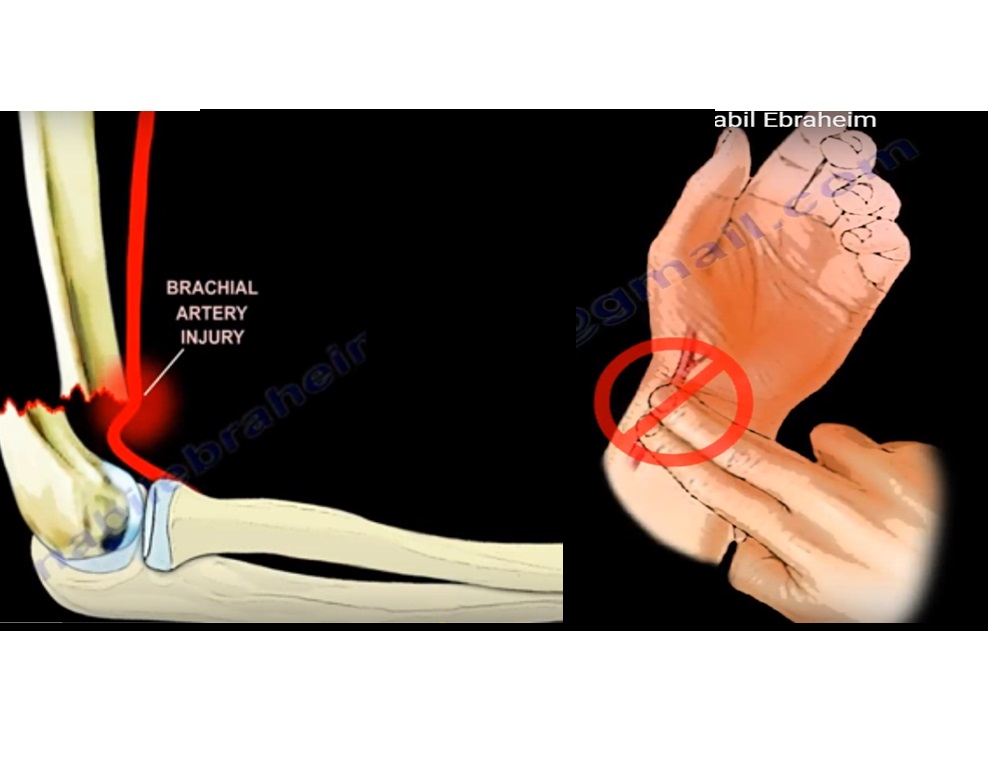
Supracondylar Humerus Fracture with Pulseless Hand
Incidence and Cause
- Occurs in approximately 10–20% of displaced supracondylar fractures.
- Usually results from brachial artery injury.
- The brachial artery may be kinked, stretched, or entrapped by the fracture.
- Median nerve or anterior interosseous nerve injury may be associated.
Important Associations
Median nerve / anterior interosseous nerve
- Loss of the “OK sign”.
- Median or AIN palsy with a pulseless hand is an important warning sign for vascular injury.
Ulnar nerve
- More commonly associated with flexion-type fractures.
Nerve injuries
- Most are neuropraxias and recover spontaneously with time.
Clinical Assessment
Pulse
- Assess the radial pulse.
- Compare the injured limb with the opposite limb.
Perfusion
- Assess pain.
- Assess pallor.
- Assess pulselessness.
- Assess paresthesia.
- Assess paralysis.
- Check capillary refill.
- Capillary refill greater than 2 seconds is abnormal.
- Assess skin temperature.
- A cold limb suggests poor perfusion.
- Assess swelling and edema.
- Increasing analgesic requirement may indicate compartment syndrome.
Types of Pulseless Hand
Pulseless and poorly perfused hand
- Pale and cold hand.
- This is an emergency.
Pulseless but well-perfused hand
- Warm and pink hand.
- Management remains controversial.
Initial Management
- Apply gentle traction.
- Flex the elbow approximately 30–45 degrees.
- Apply a posterior splint.
- This may restore the pulse by relieving arterial kinking or compression.
Pulseless and Poorly Perfused Hand
- Proceed to immediate emergency surgery.
- Perform urgent fracture reduction and pin fixation.
- Reassess the circulation after reduction.
- If the hand remains pulseless and poorly perfused, perform open vascular exploration.
- Brachial artery repair may be required.
- Vein grafting may be necessary depending on the vascular injury.
Pulseless but Pink Hand
- Perform urgent closed reduction and percutaneous pinning.
- Observe closely for 24–48 hours.
- Perform serial neurovascular examinations.
Monitor for
- Loss of perfusion.
- Increasing pain.
- Anxiety.
- Agitation.
- Increasing analgesic requirement.
- Compartment syndrome.
- If perfusion deteriorates, proceed to immediate exploration.
Important Points
- Approximately 50–70% of patients may regain the pulse after fracture reduction.
- Avoid angiography before reduction because it can delay definitive treatment.
- Median nerve or AIN injury associated with a pulseless hand should raise suspicion of vascular injury.
Compartment Syndrome
- More common with Type III supracondylar fractures.
- Prolonged ischemia is a major concern.
- If ischemia persists for more than 6 hours, fasciotomy may be required.
Exam Summary
Pulseless + pink hand
- Reduce and pin.
- Observe closely.
Pulseless + pale hand
- Reduce and pin urgently.
- If perfusion does not return, explore the brachial artery.
Pulse returns after reduction
- Continue close observation.
No pulse after reduction
- If the hand remains poorly perfused, explore the artery.
High-Yield Pearls
- Pink pulseless hand = reduce, pin and watch closely.
- Pale pulseless hand = emergency reduction and vascular assessment/exploration.
- Always compare vascular status with the contralateral limb.
- AIN palsy presents with inability to make the “OK” sign.


Leave a Reply