
Courtesy: Sports Science Solutions, Lecture on Classification of Joints
Classification and Function of Joints
Overview
- Joints (articulations) are points where two or more bones meet
- Functions:
- Allow movement
- Provide stability
Basis of Classification
- Structure (type of tissue connecting bones)
- Function (degree of movement allowed)
Skeletal System and Joints
Total Bones
- 206 bones
Divisions of Skeleton
Axial Skeleton (80 bones)
- Skull
- Vertebral column
- Ribs
- Sternum
Appendicular Skeleton (126 bones)
- Upper limbs
- Lower limbs
- Shoulder girdle
- Pelvic girdle
Joints are formed where these bones meet
Structural Classification of Joints
Types
- Fibrous joints
- Cartilaginous joints
- Synovial joints
1. Fibrous Joints
Characteristics
- Connected by fibrous tissue
- Minimal or no movement
Types
Suture
- Short fibrous connections
- Found in skull
- Movement: None (synarthrotic)
Syndesmosis
- Connected by ligaments
- Example:
- Distal tibiofibular joint
- Movement: Slight (amphiarthrotic)
Gomphosis
- Peg-in-socket joint
- Example:
- Tooth in alveolar socket
- Movement: None (synarthrotic)
2. Cartilaginous Joints
Characteristics
- Bones connected by cartilage
Types
Synchondrosis
- Hyaline cartilage
- Examples:
- Growth plate
- First rib–sternum
- Movement: None
Symphysis
- Fibrocartilage
- Examples:
- Intervertebral discs
- Pubic symphysis
- Movement: Slight
3. Synovial Joints
Characteristics
- Joint cavity present
- Contains synovial fluid
- Freely movable
Function
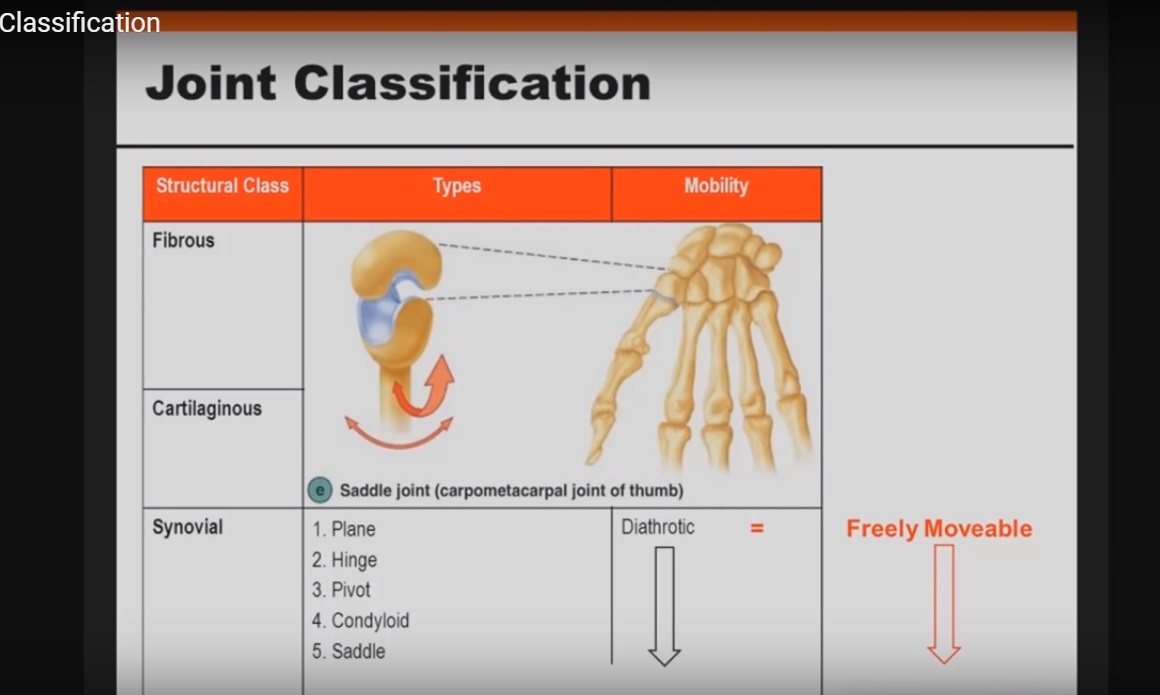
- Diarthrotic (freely movable)
Types of Synovial Joints
Plane Joint
- Gliding movement
- Example:
- Intercarpal joints
Hinge Joint
- Movement in one plane
- Example:
- Elbow joint
Pivot Joint
- Rotation around axis
- Example:
- Proximal radioulnar joint
Condyloid Joint
- Oval surface articulation
- Example:
- Metacarpophalangeal joints
Saddle Joint
- Concave + convex surfaces
- Example:
- Thumb carpometacarpal joint
Ball and Socket Joint
- Multidirectional movement
- Examples:
- Shoulder joint
- Hip joint
Functional Classification of Joints
1. Synarthrotic
- No movement
- Examples:
- Skull sutures
- Gomphosis
2. Amphiarthrotic
- Slight movement
- Examples:
- Distal tibiofibular joint
- Pubic symphysis
3. Diarthrotic
- Freely movable
- Examples:
- Synovial joints
Axis-Based Classification of Synovial Joints
Nonaxial
- No rotation around axis
- Example:
- Plane joints
Uniaxial
- Movement in one axis
- Examples:
- Hinge joints
- Pivot joints
Movements
- Flexion/extension
- Rotation
Biaxial
- Movement in two axes
- Examples:
- Condyloid
- Saddle joints
Movements
- Flexion/extension
- Abduction/adduction
- Circumduction
Multiaxial
- Movement in three axes
- Example:
- Ball and socket joints
Movements
- Flexion/extension
- Abduction/adduction
- Circumduction
- Rotation
Examples of Joint Classification
Distal Tibiofibular Joint
- Structural: Fibrous
- Type: Syndesmosis
- Function: Slight movement
Pubic Symphysis
- Structural: Cartilaginous
- Type: Symphysis
- Function: Slight movement
Shoulder Joint
- Structural: Synovial
- Type: Ball and socket
- Function: Freely movable
- Axis: Multiaxial
Summary Points
- Joints are classified by:
- Structure
- Function
- Structural types:
- Fibrous
- Cartilaginous
- Synovial
- Functional types:
- Synarthrotic
- Amphiarthrotic
- Diarthrotic
- Synovial joints further classified by:
- Axis of movement
Leave a Reply