
Definition
-
Chondrosarcoma is a malignant primary bone tumor characterized by the production of a cartilaginous matrix by malignant cells.
-
It is the second most common non-hematologic primary malignancy of bone, after osteosarcoma.
Incidence
-
Overall incidence is approximately half that of osteosarcoma.
-
Occurs worldwide with no significant racial predilection.
Age Distribution
-
Primary chondrosarcoma:
-
Peak incidence between forty and sixty years of age
-
-
Secondary chondrosarcoma:
-
Peak incidence between twenty-five and forty-five years of age
-
-
Overall, chondrosarcoma has a broad age distribution.
Sex Distribution
-
Shows a slight male predominance.
Common Anatomical Sites
-
Predominantly affects the proximal skeleton.
-
Most frequent locations include:
-
Pelvis (most common)
-
Proximal femur
-
Proximal humerus
-
-
Rare in the hand; however, when malignant bone tumors occur in the hand, chondrosarcoma is the most common type.
Clinical Features
-
Progressive, gradually increasing pain is the most common presenting symptom.
-
A palpable mass may be present, particularly in superficial locations.
-
Tumors are often slow growing, with symptoms present for several years before diagnosis.
-
Pain in the absence of fracture helps distinguish low-grade chondrosarcoma from enchondroma.
Incidentally Detected Lesions
-
Many patients are referred for incidentally discovered cartilaginous lesions.
-
Asymptomatic cartilaginous lesions on imaging are far more likely to represent enchondromas.
-
Primary chondrosarcoma is extremely rare as an incidental, asymptomatic finding.
Secondary Chondrosarcoma
-
Develops from preexisting benign cartilage lesions.
-
Common associations include:
-
Multiple enchondromas (Ollier disease)
-
Maffucci syndrome
-
Multiple hereditary exostoses
-
Risk of Malignant Transformation
-
Ollier disease: approximately twenty-five percent risk by forty years of age
-
Maffucci syndrome: higher risk than Ollier disease
-
Multiple hereditary exostoses: approximately five percent lifetime risk
-
Solitary osteochondroma: approximately one percent risk
Other Associated Conditions
-
Synovial chondromatosis
-
Chondromyxoid fibroma
-
Periosteal chondroma
-
Chondroblastoma
-
Prior radiation therapy
-
Fibrous dysplasia
Radiographic Features
-
Medullary-based lesion with a cartilaginous matrix.
-
Characteristic calcification patterns include:
-
Punctate calcifications
-
Popcorn calcifications
-
Comma-shaped calcifications
-
-
Compared with enchondroma, chondrosarcoma more commonly demonstrates:
-
Cortical destruction
-
Endosteal scalloping
-
Periosteal reaction
-
Associated soft-tissue mass
-
Role of Computed Tomography and Magnetic Resonance Imaging
-
Computed tomography:
-
Excellent for detecting endosteal erosion and cortical destruction
-
-
Magnetic resonance imaging:
-
Best for assessing soft-tissue extension
-
Evaluates cartilage cap thickness
-
-
A cartilage cap thickness greater than two centimeters in a skeletally mature patient is highly suggestive of secondary chondrosarcoma.
Site-Specific Interpretation
-
In the hand, radiographically aggressive features may still represent a benign enchondroma.
-
Similar aggressive features in the pelvis or proximal femur are highly suggestive and often diagnostic of chondrosarcoma.
Histopathology – Conventional Chondrosarcoma
-
Malignant chondrocytes embedded in abundant cartilaginous matrix.
-
Malignant osteoid is absent; its presence suggests chondroblastic osteosarcoma.
-
Diagnosis requires careful correlation of clinical presentation, imaging, and histology.
Histologic Features Favoring Malignancy
-
Increased cellularity
-
Enlarged, plump nuclei
-
Frequent binucleated cells
-
Permeative growth pattern
-
Entrapment of preexisting bony trabeculae
Diagnostic Challenges
-
Differentiation between low-grade chondrosarcoma and enchondroma can be difficult on biopsy alone.
-
Larger tissue samples improve diagnostic accuracy.
-
Clinical context, lesion size, anatomical site, and radiographic features are essential for correct diagnosis.
Histologic Subtypes (Less Than Twenty Percent)
-
Dedifferentiated chondrosarcoma
-
Clear cell chondrosarcoma
-
Mesenchymal chondrosarcoma
Dedifferentiated Chondrosarcoma
-
Composed of a high-grade sarcoma adjacent to a low-grade chondrosarcoma.
-
High-grade component most commonly resembles:
-
Osteosarcoma
-
Fibrosarcoma
-
Malignant fibrous histiocytoma
-
-
Radiographs typically show a highly aggressive radiolucent area adjacent to a classic cartilage tumor.
Clear Cell Chondrosarcoma
-
Low-grade malignant tumor.
-
Composed of clear cells with associated giant cells.
-
Strong predilection for the epiphysis, particularly the proximal femur.
-
Can mimic chondroblastoma or giant cell tumor radiographically and histologically.
Mesenchymal Chondrosarcoma
-
High-grade malignancy composed of small round blue cells.
-
Contains islands of well-differentiated cartilage.
-
Characteristic hemangiopericytomatous “staghorn vessel” pattern.
-
Radiographic appearance is aggressive or nonspecific.
Treatment of Low-Grade Chondrosarcoma
-
Extended intralesional curettage with adjuvants is controversial but accepted in selected cases.
-
Appropriate only when the lesion is confined to the medullary canal.
-
Lesions with soft-tissue extension should be treated as high-grade tumors.
Treatment of High-Grade Chondrosarcoma
-
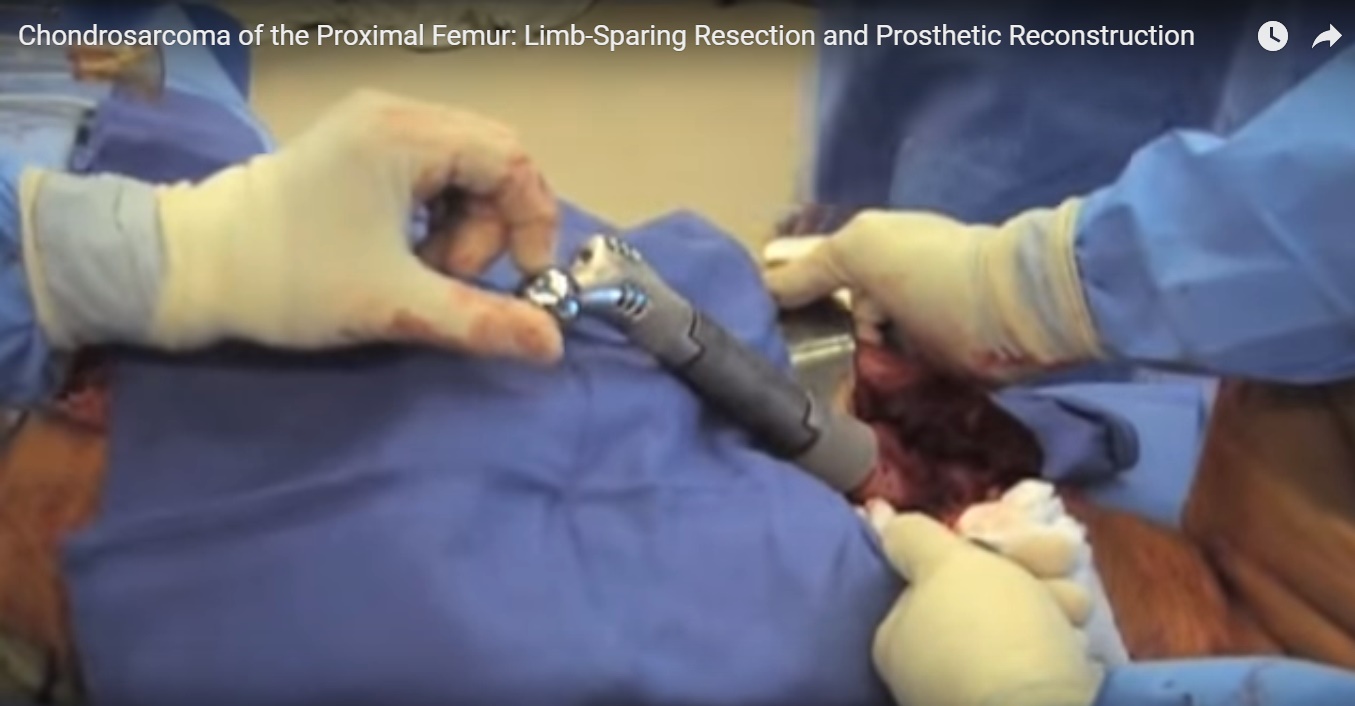
Wide or radical surgical resection, with amputation when necessary.
-
Cartilage cells tolerate transplantation well, creating a high risk of contamination.
-
In expendable bones, primary wide resection without prior biopsy may be considered.
Local Recurrence and Metastasis
-
Local recurrence after adequate wide resection occurs in less than ten percent of cases.
-
Recurrence is managed with repeat wide resection or amputation.
-
Pulmonary metastases are treated with surgical resection when feasible.
Role of Chemotherapy and Radiation Therapy
-
No established role in conventional chondrosarcoma.
-
Chemotherapy is used in:
-
Dedifferentiated chondrosarcoma
-
Mesenchymal chondrosarcoma
-
-
Radiation therapy is reserved for palliation in unresectable or symptomatic cases.
Prognosis
-
Prognosis depends primarily on tumor grade, size, and anatomical location.
-
Low-grade chondrosarcoma:
-
Greater than ninety percent ten-year survival
-
-
High-grade conventional chondrosarcoma:
-
Approximately twenty to forty percent ten-year survival
-
-
Dedifferentiated chondrosarcoma:
-
Approximately ten to twenty-five percent five-year survival
-
Follow-Up
-
Chondrosarcomas are slow growing, and recurrence may occur years or even decades later.
-
Recurrent tumors often demonstrate higher histologic grade.
-
Long-term surveillance is essential and should include:
-
Imaging of the primary site
-
Regular chest imaging to detect pulmonary metastases
-

Leave a Reply