
Courtesy: Mary Lloyd Ireland M.D.
Associate Professor
University of Ketucky
Lexington, KY, USA
Biomechanics of Gait
Overview
- Understanding gait biomechanics is essential for:
- Walking
- Running
- Return to sports after injury
Clinical Importance
- Restoration of normal foot and ankle motion is critical for:
- Functional recovery
- Normal gait pattern
Basic Gait Cycle
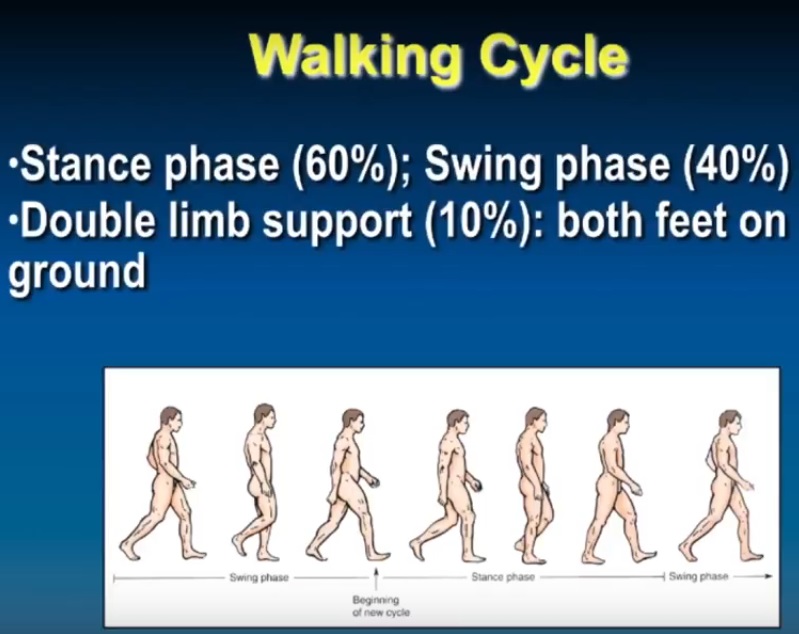
Phases
| Phase | Percentage |
|---|---|
| Stance Phase | ~60% |
| Swing Phase | ~40% |
Double Limb Support
- Both feet on ground
- ~10% of gait cycle
Walking vs Running
| Feature | Walking | Running |
|---|---|---|
| Double support | Present | Absent |
| Forces | Lower | Higher |
| Ground reaction force | Moderate | High |
Phases of the Gait Cycle
- Heel contact (initial contact)
- Forefoot contact
- Midstance
- Heel off
- Toe off (propulsion)
- Swing phase
Foot and Ankle Biomechanics
Key Joints
- Ankle joint
- Subtalar joint
- Transverse tarsal joint
Oblique Axis of the Ankle
Effect of Movement
| Movement | Effect |
|---|---|
| Plantarflexion | Inward deviation |
| Dorsiflexion | Outward deviation |
Significance
- Allows rotational movement between foot and leg
Tibial Rotation with Foot Motion
| Foot Motion | Tibial Movement |
|---|---|
| Dorsiflexion | Internal rotation |
| Plantarflexion | External rotation |
Subtalar Joint Mechanics
Axis
- ~45° to horizontal
Coupled Movements
| Tibial Rotation | Subtalar Motion |
|---|---|
| Internal rotation | Eversion |
| External rotation | Inversion |
Transverse Tarsal Joint
Components
- Talonavicular joint
- Calcaneocuboid joint
Function
- Adapts foot to ground
Behavior
| Foot Position | Function |
|---|---|
| Pronation | Flexible |
| Supination | Rigid |
Windlass Mechanism
Mechanism
- Toe dorsiflexion – plantar fascia tightens
Effect
- Elevates longitudinal arch
- Converts foot into rigid lever
Function
- Essential for push-off
Stance Phase Biomechanics
Interval 1: Heel Strike – Foot Flat
Function
- Shock absorption
Movements
| Structure | Motion |
|---|---|
| Ankle | Plantarflexion |
| Subtalar | Eversion |
| Tibia | Internal rotation |
| Foot | Pronation |
Effect
- Flexible foot
Interval 2: Foot Flat – Heel Off
Function
- Stability
Movements
| Structure | Motion |
|---|---|
| Ankle | Dorsiflexion |
| Subtalar | Inversion |
| Tibia | External rotation |
Effect
- Foot transitions to rigidity
Interval 3: Heel Off – Toe Off
Function
- Propulsion
Movements
| Structure | Motion |
|---|---|
| Ankle | Plantarflexion |
| Subtalar | Inversion |
| Tibia | External rotation |
| Foot | Supination |
Windlass Role
- Stabilizes arch
- Enables push-off
Body Weight Distribution
- Rapid increase after heel strike
- Peak load may exceed 100% body weight
- Decreases toward toe-off
Key Biomechanical Patterns
Early Stance (DIEP)
| Structure | Motion |
|---|---|
| Tibia | Internal rotation |
| Talus | Eversion |
| Foot | Pronation |
Push-Off Phase (PERS)
| Structure | Motion |
|---|---|
| Tibia | External rotation |
| Talus | Inversion |
| Foot | Supination |
Important Concept
- Talus moves opposite to foot and tibia
Gait as a Controlled Fall
- Walking = continuous forward fall
- Balance maintained by alternating limb support
Clinical Gait Assessment
Methods
- Visual observation
- Treadmill analysis
- Video recording
- Gait lab analysis
Hip Mechanics in Gait
Normal Finding
- Pelvis tilts upward on opposite side during stance
Abnormality
- Suggests:
- Trendelenburg gait
Biomechanics of Running
| Feature | Running |
|---|---|
| Gait cycle | Shorter |
| Stance phase | Reduced |
| Double support | Absent |
| Ground reaction force | Up to 3× body weight |
| Joint motion | Increased (~50%) |
Key Concepts
- Foot must alternate between:
- Flexibility – shock absorption
- Rigidity – propulsion
- Coordination required between:
- Ankle
- Subtalar joint
- Transverse tarsal joint
Clinical Insight
- Loss of motion in these joints – abnormal gait
Nice its very help ful