
Courtesy: Prof Nabile ebraheim, Chairman, Department of Orthopaedic Surgery and Trauma, University of Toledo, Ohio, United States.
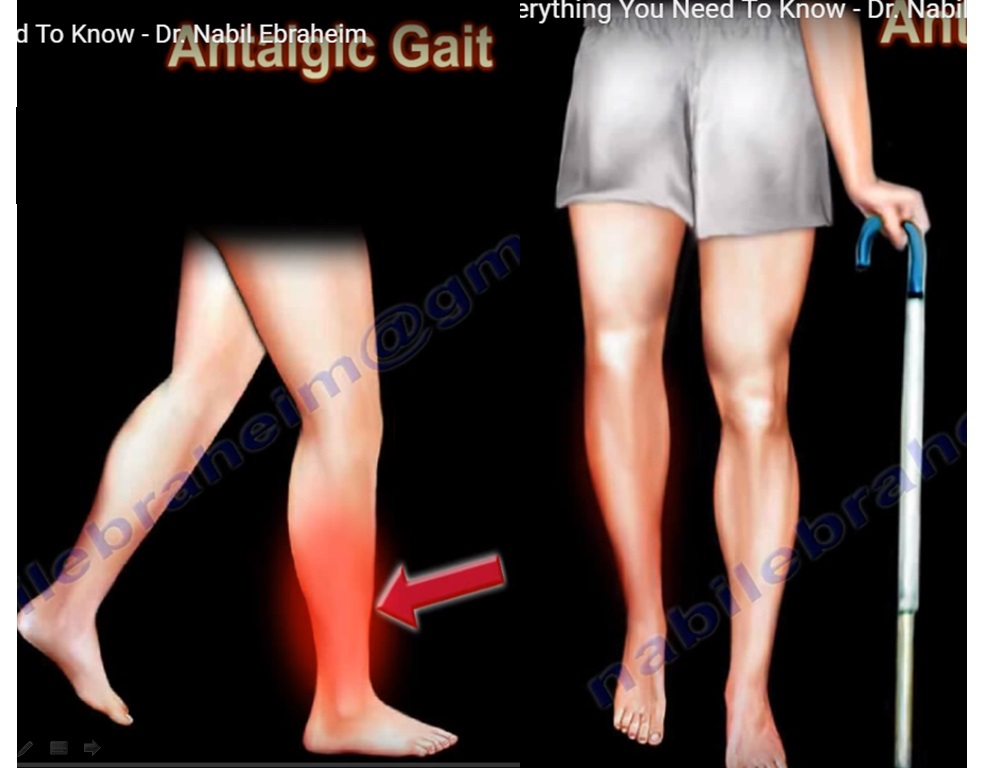
Antalgic Gait (Painful Gait)
Definition
- Antalgic gait is a pain-avoidance gait pattern
- The patient alters walking to:
- Minimize pain in the affected limb
Key Concept
- The patient does not want to spend time on the affected leg
Key Features
1. Shortened Stance Phase
- Affected limb:
- Spends less time on the ground
- Rapid weight shift to:
- Unaffected limb
2. Compensatory Swing Phase
- Affected limb:
- Increased swing phase (quickly lifted off ground)
- Normal limb:
- May have shortened swing phase
- Prepares early for weight acceptance
3. Trunk and Body Position
- Trunk may:
- Lean away from painful limb
Effect
- Reduces loading on affected side
- Decreases pain
Walking Aid
- Cane used on:
- Opposite side of painful limb
Benefit
- Reduces joint load
- Improves stability
Common Causes
Hip Pathology
- Osteoarthritis
- Fracture
- Bursitis
Knee Pathology
- Osteoarthritis
- Meniscal injury
- Ligament injury
Foot and Ankle Conditions
- Sprains
- Plantar fasciitis
- Fractures
Spine / Radicular Causes
- Lumbar disc herniation
- Radicular pain
Symptoms
- Pain during weight-bearing
- Guarding behavior
- Limping
- Faster transfer of weight to normal limb
Clinical Pearls
- Cane should be used on:
- Opposite side of affected limb
- Antalgic gait is:
- Not a disease
- A compensatory mechanism
- Always:
- Identify and treat the underlying cause of pain
Final Concept
- Antalgic gait is the most common abnormal gait, reflecting underlying pain in the lower limb or spine


Leave a Reply