
Courtesy: Michael Sussman, MD, Portland, Oregon and global helo
Introduction to Clinical Gait Analysis
Overview
- Clinical gait analysis focuses on understanding normal walking patterns
- Essential for:
- Identifying abnormalities
- Planning treatment
Core Principle
- Understanding normal gait = key to diagnosing abnormal gait
Clinical Importance
- Gait abnormalities are often the primary functional issue in many conditions
- Especially important in:
- Neurological disorders
- Pediatric orthopaedics
Example: Cerebral Palsy (Spastic Diplegia)
Observed Gait Abnormalities
- Internal foot progression (in-toeing)
- Lack of heel strike
- Possible causes:
- Ankle plantarflexion
- Knee flexion
- Increased lumbar lordosis
- Arms abducted for balance
Preserved Features
- Reciprocal gait pattern
- Reasonable muscle strength
Standard Clinical Evaluation Approach
1. History Taking
- From patient or parents
2. Physical Examination
- Musculoskeletal assessment
- Neurological evaluation
3. Special Investigations
- Imaging (e.g., X-ray)
- Laboratory tests
4. Diagnosis
- Formulate differential diagnoses
5. Treatment Planning
- Select appropriate intervention
Importance of Gait Examination
- Often underemphasized in routine examination
- Should be a core component of assessment
Key Point
- Systematic gait evaluation helps identify:
- Correctable abnormalities
Understanding the Gait Cycle
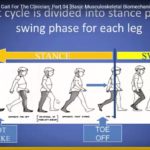
- Walking is a repetitive cycle
- Each step resembles the previous one
Muscle Activity in Gait
Concentric Contraction
- Muscle shortens while producing force
Eccentric Contraction
- Muscle lengthens while controlling movement
Scientific Characteristics of Gait
1. Normal Gait is Well Defined
- Mature gait develops by ~7 years
2. Gait is Repetitive
- Steps are consistent at steady speed
3. Abnormal Gait is Also Repetitive
- Seen in:
- Spastic diplegia
- Hemiplegia
Exceptions
- Inconsistent gait patterns:
- Ataxia
- Dystonia
Computer-Based Gait Analysis
Advantages
- Objective measurement
- Tracks changes over time
- Assesses treatment outcomes
Limitation
- Not available in most clinical settings
Visual Gait Analysis
Strengths
- Real-time assessment
- Easily accessible
Limitations
- Good perception
- Poor long-term memory for details
Gait Scoring Systems
Example
- Edinburgh Visual Gait Score
Purpose
- Document abnormalities
- Compare:
- Before vs after treatment
- Over time
Analogy: Understanding Through Observation
- Gait analysis is like interpreting a piece of art
Example Artwork
- The Anatomy Lesson of Dr. Nicolaes Tulp by Rembrandt van Rijn
Lesson
- Deeper knowledge improves:
- Observation
- Interpretation
Key Takeaways
- Understanding normal gait is essential
- Use a systematic clinical approach
- Gait becomes mature by ~7 years
- Abnormal gait patterns are often consistent and measurable



Leave a Reply