• Skip to main content
  • Skip to secondary menu
  • Skip to primary sidebar
OrthopaedicPrinciples.com

OrthopaedicPrinciples.com

Integrating Principles and Evidence

Integrating Principles and Evidence

  • Home
  • Editorial Board
  • Our Books
    • Evidence Based Orthopaedic Principles
  • Courses
  • Exams
  • Reviews
  • Live Program
  • Contact

Toddler Fracture


Toddler Fracture (Tibial Spiral Fracture)

Definition

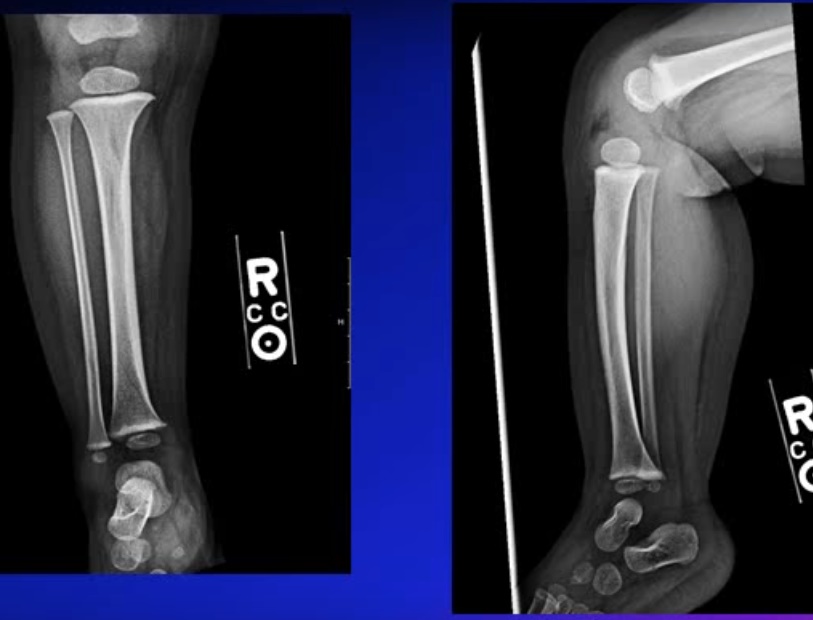
  • Spiral fracture of the distal one-third of the tibia.
  • Occurs due to a low-energy rotational or twisting injury.
  • Typically occurs in children aged 1–3 years.
  • Usually non-displaced.
  • The fibula is usually intact.

Mechanism

  • Sudden torsional force.
  • May occur while twisting during play.
  • May follow a minor fall.
  • May occur while tripping during walking or running.
  • There may be no clear history of trauma.

Clinical Presentation

  • Acute limp or refusal to walk.
  • The child may still bear partial weight.
  • Minimal swelling.
  • Usually no deformity.
  • The history may be trivial or absent.

Important Clinical Sign

  • Pain on passive external rotation of the foot is highly suggestive of toddler fracture.
  • This can be particularly useful when the initial X-ray is normal.

Examination

  • Diffuse tibial tenderness.
  • The child may cry when the leg is handled.
  • External rotation of the foot produces severe pain.

X-ray Findings

Early X-ray

  • May be normal.
  • May show a faint spiral fracture line in the distal tibia.
  • The fracture may be best seen on the AP view.
  • The lateral view may be normal.

Delayed X-ray

  • At 2–3 weeks, periosteal reaction and callus formation may become visible.
  • Sometimes this is the only radiological evidence of the fracture.

Important Diagnostic Principle

  • Toddler fracture is primarily a clinical diagnosis.
  • A negative initial X-ray does not exclude the fracture.

Differential Diagnosis of a Limping Toddler

Infection

  • Osteomyelitis.
  • Septic arthritis.
  • Look for fever, a toxic appearance, and raised inflammatory markers.

Trauma-related Causes

  • Plantar puncture wound.
  • Retained foreign body.

Malignancy

  • Acute leukemia.
  • Clues include night pain, systemic symptoms, and pallor.

Clinical Tip

  • Pain with passive external rotation of the foot favors toddler fracture.

Treatment

  • Standard treatment is an above-knee (long-leg) cast.
  • Duration is approximately 3 weeks.
  • The cast controls rotation and helps prevent displacement.

Prognosis

  • Healing is usually excellent.
  • Complications are rare.
  • Complete recovery is expected.

Exam Pearls

  • Spiral fracture of distal tibia in a toddler.
  • Age: 1–3 years.
  • Minimal or unnoticed trauma.
  • Fibula usually intact.
  • Initial X-ray may be normal.
  • External rotation pain is the key clinical sign.
  • Treat according to clinical suspicion even when the initial X-ray is negative.
toddler

Courtesy: Dr Amr Abdelgawad
University of Texas, USA

Post Views: 2,336

Related Posts

  • Osteochondritis Dissecans Knee

    Courtesy: Mininder Kocher, Ashok SHyam, IORG, OrthoTV

  • Pilon Fracture

    Courtesy: International Foot and Ankle Course, Chennai

  • Fifth Metatarsal fracture

    Courtesy: Prof Amr Abdelgawad, Associate Professor, Texas Tech University, USA Anatomy 5th metatarsal base: Insertion…

Reader Interactions

Leave a Reply

Your email address will not be published. Required fields are marked *

Primary Sidebar

Follow Us

instagram slideshare

Categories

  • -Applied Anatomy
  • -Approaches
  • -Basic Sciences
  • -Cartilage & Meniscus
  • -Classifications
  • -Examination
  • -Foot and Ankle
  • -Foot and Ankle Trauma
  • -FRCS(Tr and Orth) tutorials
  • -Gait
  • -Hand and Wrist
  • -Hand and Wrist Trauma
  • -Hand Infections
  • -Hip and Knee
  • -Hip Preservation
  • -Infections
  • -Joint Reconstruction
  • -Knee Arthroplasty
  • -Knee Preservation
  • -Metabolic Disorders
  • -Oncology
  • -OrthoBiologics
  • -OrthoPlastic
  • -Paediatric Orthopaedics
  • -Paediatric Trauma
  • -Patellofemoral Joint
  • -Pelvis
  • -Peripheral Nerves
  • -Principles
  • -Principles of Surgery
  • -Radiology
  • -Rheumatology
  • -Shoulder and Elbow
  • -Shoulder and Elbow Arthroplasty
  • -Spine Deformity
  • -Spine Oncology
  • -Spine Trauma
  • -Spine, Pelvis & Neurology
  • -Sports Ankle and Foot
  • -Sports Elbow
  • -Sports Knee
  • -Sports Medicine
  • -Sports Medicine Hip
  • -Sports Shoulder
  • -Sports Wrist
  • -Statistics
  • -Technical Tip
  • -Technology in Orth
  • -Trauma
  • -Trauma (Upper Limb)
  • -Trauma Life Support
  • -Trauma Reconstruction
  • Book Shelf
  • Book Shelf Medical
  • Careers
  • Case Studies and Free Papers
  • DNB Ortho
  • Evidence Based Orthopaedic Principles
  • Evidence Based Orthopaedics
  • Exam Corner
  • Fellowships
  • Guest Editor
  • Guest Reviews
  • Image Quiz
  • Instructional Course Lectures
  • Journal Club
  • MCQs
  • Meetings and Courses
  • MS Ortho
  • Multimedia
  • News and Blog
  • Plaster Techniques
  • Podcasts
  • Public Health
  • Rehabilitation
  • Research
  • Shorts and Reels
Copyright@orthopaedicprinciples.com. All right rerserved.