
Courtesy:
Dr Vijay Shetty, Consultant Orthopaedic Surgeon, Specialist in Hip Arthroscopy and Joint Reconstruction, Hiranandani Hospital, Powai, Mumbai, India
Introduction
- PRP injections are commonly performed in an outpatient setting.
- Proper documentation of indication and patient details is important because:
- PRP indications are still evolving.
- Data collection supports future research.
PRP Preparation System
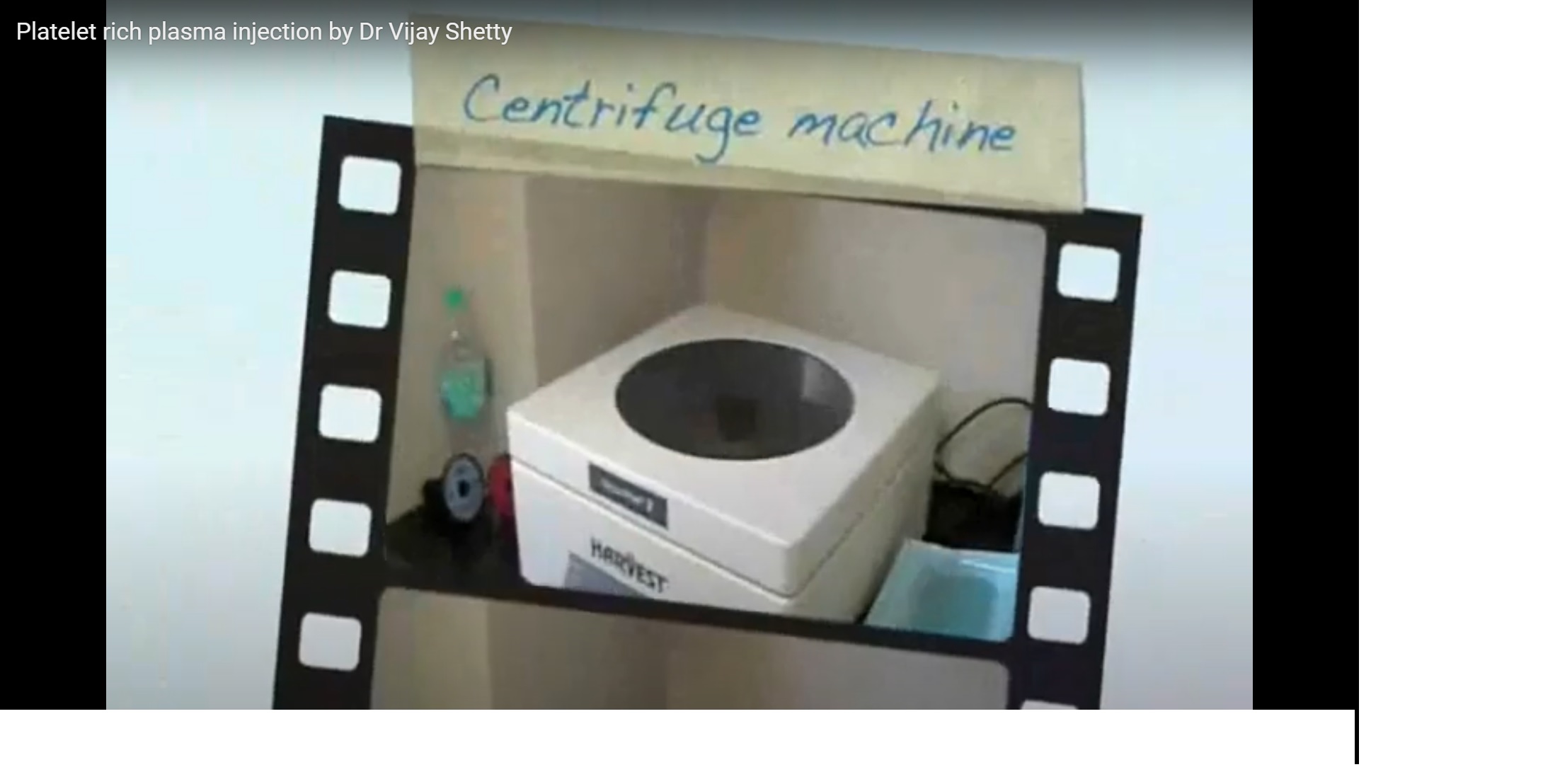
- The procedure described uses a commercial PRP preparation kit.
- Example: Harvest Technologies PRP kit.
Components of the Kit
The kit contains two main chambers:
- Processing chamber
- Used for centrifugation and blood separation.
- PRP collection chamber
- Used for collecting the final platelet-rich plasma concentrate.
Anticoagulation
- Anticoagulant Citrate Dextrose (ACD-A) is used.
- Purpose:
- Prevents clot formation during blood processing.
- Preserves platelet integrity.
Blood Collection
- Blood is drawn from a suitable peripheral vein in the patient’s arm.
- The blood is collected in a pre-filled syringe containing ACD-A.
Typical Blood Volumes
Depending on the PRP kit used:
- 20 mL system
- 60 mL system
After collection:
- The blood sample may be analyzed if required for baseline parameters.
Transfer to Processing Chamber
- The collected blood is slowly dispensed into the processing chamber.
- The disposable processing unit is then placed into a centrifuge machine.
- The centrifuge must be properly balanced before spinning.
Centrifugation Process
The centrifugation typically involves two phases:
- Soft Spin
- Initial spin separates blood into layers.
- Hard Spin
- Further concentrates platelets.
Total centrifugation time:
- Approximately 15 minutes.
Blood Layer Separation
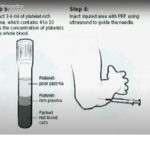
After centrifugation, three layers can be visualized:
Top Layer
- Platelet-Poor Plasma (PPP)
- Yellow in color.
Middle Layer
- Platelet-Rich Plasma (PRP).
Bottom Layer
- Red Blood Cells (RBCs).
Isolation of PRP
- The platelet-poor plasma (PPP) from the top layer is carefully removed using a syringe.
- A small amount of PPP is intentionally left behind.
Purpose:
- Allows resuspension of the platelet pellet.
Resuspension of Platelets
- The platelet concentrate is resuspended by gentle mixing.
- This step is repeated 3–4 times.
Purpose:
- Ensures platelets do not remain adhered to the chamber walls.
- Produces a uniform platelet suspension.
Platelet Concentration
The final PRP preparation contains:
- Platelet concentrations approximately 5–6 times baseline levels.
This concentrate contains:
- Platelets
- Growth factors
- Cytokines involved in tissue healing.
Laboratory Analysis
- A small sample of PRP is sometimes sent to the laboratory for:
- Platelet count
- Quality verification.
Injection Procedure
Local Anaesthesia
- A small amount of local anesthetic may be injected before the procedure.
Reasons:
- PRP injections often require large-bore needles.
- Helps reduce procedural discomfort.
PRP Administration
- The prepared PRP concentrate is injected into the affected area.
- The injection site depends on the clinical condition being treated.
Common targets include:
- Tendons
- Ligaments
- Joints
- Muscle injuries.
Post-Injection Care
After injection:
- An occlusive dressing is applied.
- Patients are discharged with:
- Analgesics for 1–2 days
- Advice regarding expected pain.
Patient Counseling
Patients should be informed about:
- Temporary pain at the injection site
- Mild swelling or discomfort for a short duration after injection.
These symptoms are typically self-limiting.
what are the indications and contraindications of PRP injection……
How much amount of blood to be extracted and what amount injected in knee.