
Courtesy: Dr PN Gupta, Govt Medical College, Chandigarh
Radial Neck Fractures in Children
Treatment Options
- Closed reduction.
- Percutaneous reduction and fixation.
- Intramedullary reduction and fixation (Metaizeau technique).
- Open reduction as the final option.
Principles of Closed Reduction
- Most radial neck fractures are displaced posterolaterally.
- Apply varus stress at the elbow.
- Apply thumb pressure over the radial head.
- Successful reduction depends on preservation of the periosteal hinge.
Intramedullary Pinning (Metaizeau Technique)
Principle
- Flexible intramedullary nail is inserted through the distal radius.
- Nail is advanced to the radial head fragment.
- Rotation of the nail reduces the fracture.
- Considered the gold standard technique.
Limitation
- Fractures angulated more than 40 to 45 degrees may not allow the nail to engage the radial head fragment.
- Reduction should be achieved before advancing the intramedullary nail.
Techniques to Facilitate Reduction
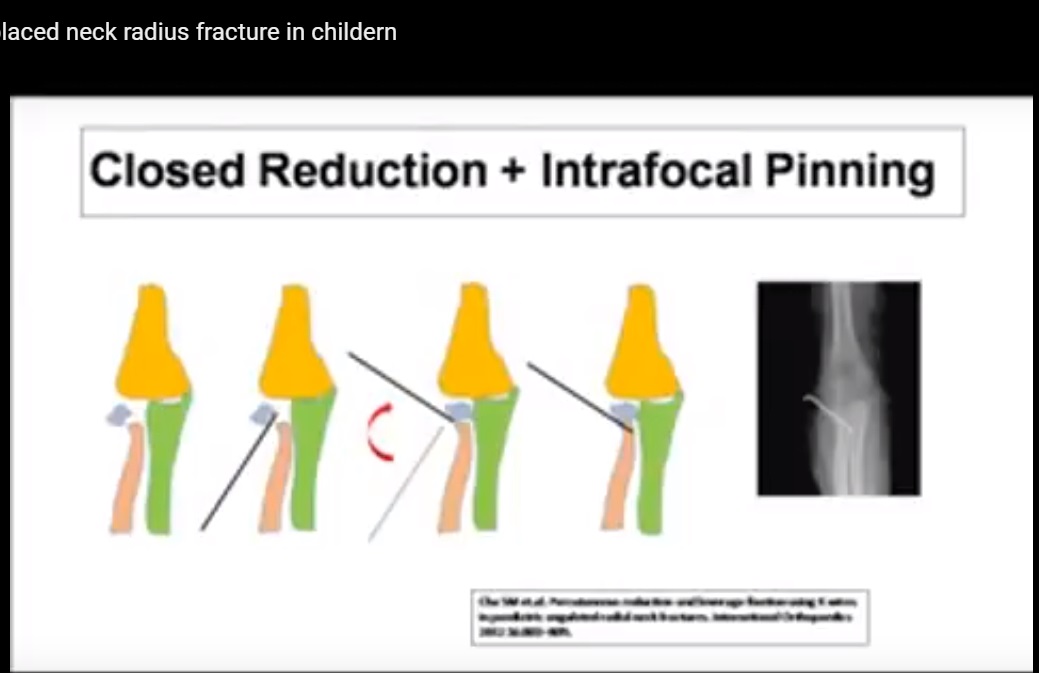
Joystick technique
- Insert a blunt K wire into the radial head fragment.
- Manipulate the fragment using the K wire as a joystick.
- Perform intramedullary fixation after satisfactory reduction.
Leverage technique
- Insert a K wire into the fracture site.
- Use the wire as a lever to elevate the radial head onto the shaft.
- Stabilize with an intramedullary nail or K wire.
Modified intramedullary K wire technique
- Useful in small children with a narrow radial canal.
- Use a K wire with a 15 degree bend at the tip.
- Create the canal using a blunt wire.
- Advance the bent sharp K wire into the radial head fragment.
Pitfalls
- Avoid repeated attempts at closed reduction when the radial head is completely displaced.
- Fractures without a periosteal hinge are unlikely to reduce closed.
- These injuries usually require open reduction.
Procedures to Avoid
- Avoid transcapitellar pinning.
- It increases the risk of physeal injury.
- It may damage the articular cartilage.
- It is associated with postoperative elbow stiffness.
Additional Fixation
- Supplementary K wires may be required if instability persists after intramedullary fixation.
- Additional fixation is particularly useful when the radial head fragment is small or lacks metaphyseal support.
Key Takeaways
- Most pediatric radial neck fractures displace posterolaterally.
- Achieve fracture reduction before intramedullary pinning whenever possible.
- Metaizeau intramedullary pinning remains the gold standard technique.
- Joystick and leverage techniques are valuable when reduction is difficult.
- Avoid transcapitellar pinning because of the high complication rate.
- Reserve open reduction for fractures that cannot be managed by closed or percutaneous techniques.

Leave a Reply