
Courtesy Dr Bo LIU, Dr Ashok Shyam, Ortho TV
Introduction
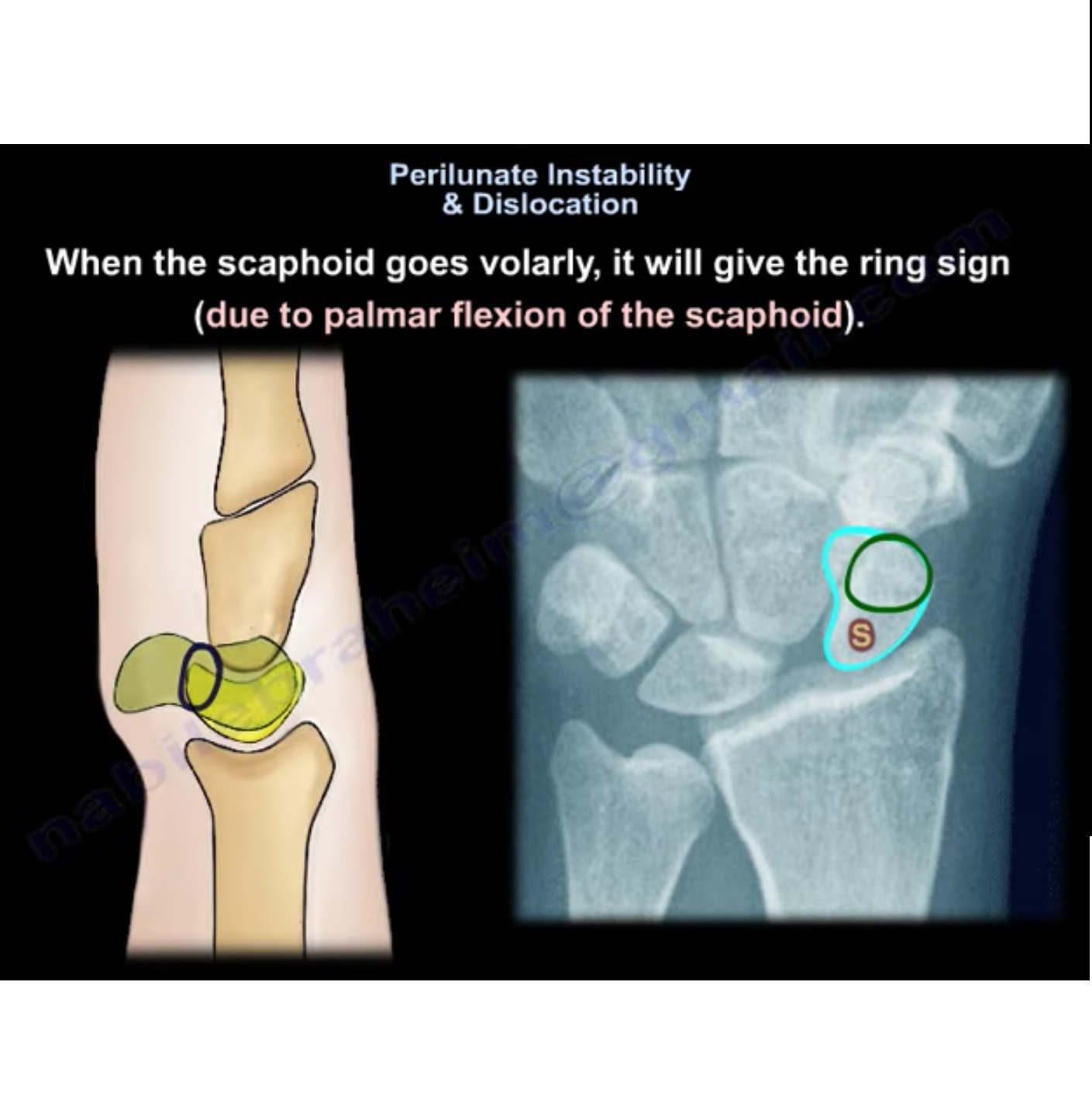
Perilunate injuries are uncommon but severe carpal injuries that can lead to significant functional impairment.
Types of Perilunate Injuries
- Perilunate fracture-dislocations (commonly involving scaphoid fractures)
- Pure ligamentous injuries involving:
- Scapholunate (SL) ligament
- Lunotriquetral (LT) ligament
Clinical Impact
- Severe carpal instability
- Long-term functional limitation if not treated appropriately
Classification of Perilunate Injuries
Mayfield Classification
Describes progressive ligamentous disruption:
| Stage | Injury |
|---|---|
| Stage I | Scapholunate ligament injury |
| Stage II | Capitolunate disruption |
| Stage III | Lunotriquetral ligament injury |
| Stage IV | Lunate dislocation |
Conventional Management
Emergency Management
- Immediate closed reduction
- Assessment for median nerve compression
Definitive Surgical Treatment
Options
- Open reduction and internal fixation (ORIF)
Surgical Approaches
- Dorsal approach
- Volar approach
- Combined approach
Goals of Surgery
- Fix fractures (e.g., scaphoid)
- Repair ligaments
- Restore carpal alignment
Limitations of Open Surgery
Clinical Outcomes
Even with proper treatment:
- Reduced range of motion
- Decreased grip strength
- Persistent stiffness
Recovery Timeline
- Return to heavy activity: 6 months
- Full rehabilitation: up to 12 months
Drawbacks
- Extensive soft tissue dissection
- Capsular and ligament damage
- Increased scar formation
- Potential compromise of vascularity (especially scaphoid)
Importance of Preserving Wrist Motion
High-Demand Patients
- Athletes
- Manual laborers
- Individuals requiring fine wrist function
Require optimal motion preservation
Arthroscopic Management
Concept
- Arthroscopic-assisted reduction and fixation
- Minimally invasive approach
- Direct visualization of intra-articular structures
Historical Development
- Introduced by Guillaume Herzberg (2008)
- Initially considered:
- Technically demanding
- Limited evidence
Recent Evidence
- Increasing success reported
- Studies demonstrate:
- Improved functional outcomes
- Better recovery profiles
Closed Reduction Strategy
Recommended Approach
- Attempt one careful closed reduction
Avoid
- Repeated forceful blind attempts
Risk of:
- Cartilage damage
- Further ligament injury
Arthroscopic-Assisted Reduction (AAR)
Indication
- Failed closed reduction
Technique
- Wrist traction tower
- Arthroscopic probe/elevator
- Controlled reduction under visualization
Advantages
- Precise manipulation
- Reduced risk of cartilage injury
- Identification of obstacles to reduction
Causes of Failed Closed Reduction
- Interposed carpal bones
- Displaced scaphoid fracture
- Capitate blocking reduction
Arthroscopy allows direct identification and correction
Arthroscopic Fixation of Scaphoid Fractures
Limitations of Conventional Fixation
- Malreduction risk
- Persistent pain
- Nonunion or delayed union
Advantages of Arthroscopy
- Direct visualization
- Anatomical reduction
- Accurate screw placement
Management of Ligament Injuries
Common Injuries
- Scapholunate ligament
- Lunotriquetral ligament
Arthroscopic Benefits
- Direct visualization
- Accurate reduction
- Percutaneous K-wire stabilization
Arthroscopic Ligament Augmentation
Technique
- Use extended 3–4 portal
- Insert suture anchors into lunate
- Tie sutures over dorsal capsule
Purpose
- Reinforce dorsal SL complex
- Improve stability
Clinical Scenarios
1. Trans-Scaphoid Perilunate Injury
Management
- Closed reduction
- Arthroscopic evaluation
- Percutaneous scaphoid fixation
- Ligament stabilization
Outcome
- Union at ~3 months
- Good functional recovery
- Minimal scarring
2. Pure Ligamentous Injury
Example
- Lunate dislocation without fracture
Management
- Arthroscopic reduction
- Stabilization of:
- SL interval
- LT interval
Advantages of Arthroscopic Treatment
- Minimal soft tissue trauma
- Preservation of vascularity
- Reduced stiffness
- Smaller scars
- Faster rehabilitation
Clinical Outcomes
- Better range of motion
- Improved functional scores
- Faster return to activity
Limitations
- Technically demanding
- Visualization challenges:
- Bleeding
- Hematoma
- Requires significant surgical expertise
Current Evidence
Short-Term Results
- Improved motion
- Good patient satisfaction
- Functional improvement
Limitation
- Long-term outcomes still under evaluation
Practical Recommendations
Emergency Care
- Perform urgent closed reduction
- Assess median nerve
Avoid
- Repeated blind reductions
Definitive Options
- Open surgery
- Arthroscopic-assisted techniques
Conclusion
Arthroscopic management of perilunate injuries is:
- Feasible and promising
- Provides:
- Better motion
- Faster recovery
- Minimal tissue trauma
Leave a Reply