• Skip to main content
  • Skip to secondary menu
  • Skip to primary sidebar
OrthopaedicPrinciples.com

OrthopaedicPrinciples.com

Integrating Principles and Evidence

Integrating Principles and Evidence

  • Home
  • Editorial Board
  • Our Books
    • Evidence Based Orthopaedic Principles
  • Courses
  • Exams
  • Reviews
  • Live Program
  • Contact

Osteoclast function and Roles

Courtesy: Prof Nabil Ebraheim, University of Toledo, Ohio, USA

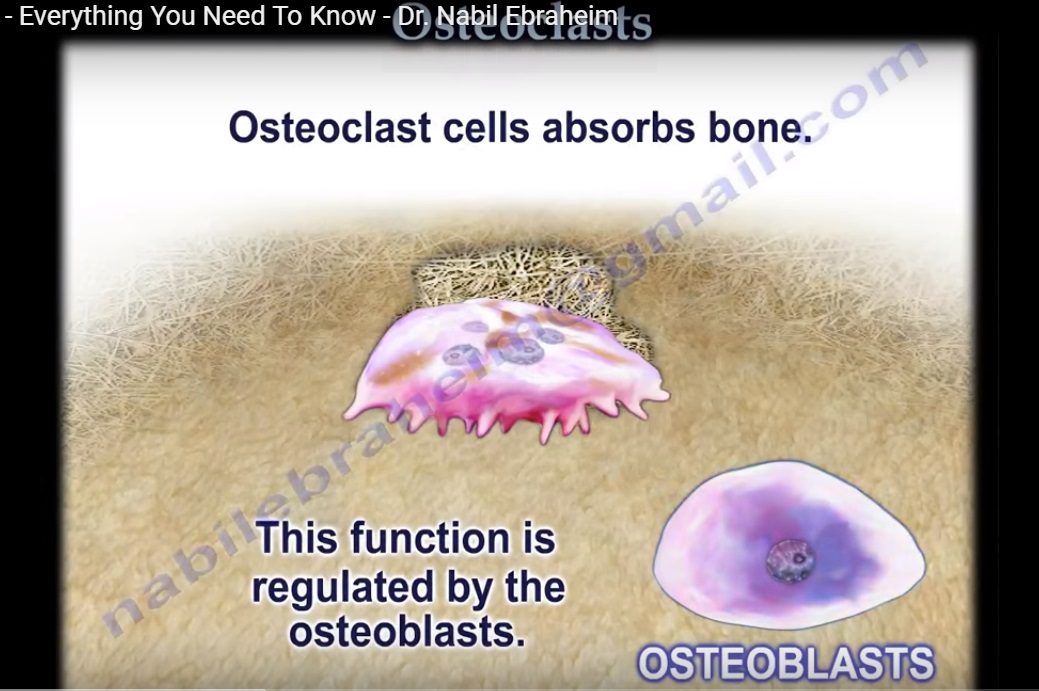
  • Osteoclast is a large multinucleated cell. It has 15- 20 nuclei.
  • Its origin is from the fusion of macrophages /monocytes.
  • As many as 50 of cells fuse to form a giant osteoclast.
  • Osteoclast absorbs bone. Its function is regulated by osteoblast.
  • Life span is of few days. It may take 100-150 osteoblast to replace the bone that has been removed by one osteoclast. It has lots of mitochondria
  • Osteoclast is found against the bone surface in a hollow depression called howship lacunae. The howship lacunae is the site of bone resorption where the ruffled border meets the bone surface.
  • It secretes 2 enzymes
  • Cathepsin- it absorbs the osteoid . Mutation of the gene that codes the enzyme causes pycnodystosis.
  • TRAP- dissolves the hydroxyappatite crystals.


How resorption occur?

  • Osteoclast attaches to the bone by 2 proteins.
  • Integrin is on the osteoclast and Vitronectin is on the bone.
  • They lock to each other creating a sealing zone.
  • Then osteoclasts create an acidic environment by producing hydrogen atoms through carbonic anhydrase , which demineralise the bone.
  • This occurs by sealing the space and lowering the pH level, thus increasing the solubility of the hydroxyappatite crystals.
  • Matrix is degraded by the cathepsin B.

What is clear zone?

  • Osteoclast bind to bone through cell attachment utilizing anchoring protein. Clear zone is cytoplasmic area presenting the adhering plasma membrane.
  • Osteoclast has 2 centres on its surfaces
    1.Calcitonin receptor- inhibits osteoclast
    2. RANK receptors- stimulate osteoclast. RANK ligand comes from osteoblast and tumor cells.
  • RANK ligand which bind to osteoclast will stimulate the differentiation and activation of osteoclast and increase bone resorption.RANK ligand function is inhibiting osteoprotegerin[OPG].The balance between OPG and RANK L is important.

Osteoclast inhibition
1. Calcitonin
2. IL-10
3. Denosumab
4. Bisphosphonates

Osteoclast stimulation and activation
1.RANK L
2.IL-1
3. Macrophage colony stimulating factor
Osteoclast function

Post Views: 3,789

Related Posts

  • Osteoclast and its Functions

    Courtesy; Prof Nabil Ebraheim, University of Toledo, Ohio, USA The bone has two important cells…

  • Anatomy, Function and Dysfunction of Rhomboid Muscles

    Courtesy: Prof Nabil Ebraheim, University of Toledo, Ohio, USA ANATOMY, FUNCTION AND DYSFUNCTION OF RHOMBOID…

  • Anatomy and function of Rotator Cuff Muscles

    Courtesy: Prof Nabil Ebraheim, University of Toledo, Ohio, USA

Reader Interactions

Leave a Reply

Your email address will not be published. Required fields are marked *

Primary Sidebar

Follow Us

instagram slideshare

Categories

  • -Applied Anatomy
  • -Approaches
  • -Basic Sciences
  • -Cartilage & Meniscus
  • -Classifications
  • -Examination
  • -Foot and Ankle
  • -Foot and Ankle Trauma
  • -FRCS(Tr and Orth) tutorials
  • -Gait
  • -Hand and Wrist
  • -Hand and Wrist Trauma
  • -Hand Infections
  • -Hip and Knee
  • -Hip Preservation
  • -Infections
  • -Joint Reconstruction
  • -Knee Arthroplasty
  • -Knee Preservation
  • -Metabolic Disorders
  • -Oncology
  • -OrthoBiologics
  • -OrthoPlastic
  • -Paediatric Orthopaedics
  • -Paediatric Trauma
  • -Patellofemoral Joint
  • -Pelvis
  • -Peripheral Nerves
  • -Principles
  • -Principles of Surgery
  • -Radiology
  • -Rheumatology
  • -Shoulder and Elbow
  • -Shoulder and Elbow Arthroplasty
  • -Spine Deformity
  • -Spine Oncology
  • -Spine Trauma
  • -Spine, Pelvis & Neurology
  • -Sports Ankle and Foot
  • -Sports Elbow
  • -Sports Knee
  • -Sports Medicine
  • -Sports Medicine Hip
  • -Sports Shoulder
  • -Sports Wrist
  • -Statistics
  • -Technical Tip
  • -Technology in Orth
  • -Trauma
  • -Trauma (Upper Limb)
  • -Trauma Life Support
  • -Trauma Reconstruction
  • Book Shelf
  • Book Shelf Medical
  • Careers
  • Case Studies and Free Papers
  • DNB Ortho
  • Evidence Based Orthopaedic Principles
  • Evidence Based Orthopaedics
  • Exam Corner
  • Fellowships
  • Guest Editor
  • Guest Reviews
  • Image Quiz
  • Instructional Course Lectures
  • Journal Club
  • MCQs
  • Meetings and Courses
  • Multimedia
  • News and Blog
  • Plaster Techniques
  • Podcasts
  • Public Health
  • Rehabilitation
  • Research
  • Shorts and Reels
Copyright@orthopaedicprinciples.com. All right rerserved.