• Skip to main content
  • Skip to secondary menu
  • Skip to primary sidebar
OrthopaedicPrinciples.com

OrthopaedicPrinciples.com

Integrating Principles and Evidence

Integrating Principles and Evidence

  • Home
  • Editorial Board
  • Our Books
    • Evidence Based Orthopaedic Principles
  • Courses
  • Exams
  • Reviews
  • Live Program
  • Contact

Anatomy and function of Rotator Cuff Muscles


Courtesy: Prof Nabil Ebraheim, University of Toledo, Ohio, USA


Rotator Cuff Muscles

Overview

  • The rotator cuff is a group of four muscles:
    • Supraspinatus
    • Infraspinatus
    • Teres Minor
    • Subscapularis
  • Common Features:
    • All muscles originate from the scapula
    • Insert into the proximal humerus
    • Function to stabilize the shoulder joint

1. Supraspinatus

Origin & Insertion

  • Origin: Supraspinous fossa of the scapula
  • Insertion: Superior facet of the greater tubercle of the humerus

Function

  • Initiates abduction of the arm
  • Helps stabilize the humeral head

Nerve Supply

  • Suprascapular nerve (C5, C6)
  • Arises from the superior trunk of the brachial plexus

Clinical Significance

  • Tear leads to:
    • Inability to abduct the shoulder

Clinical Tests

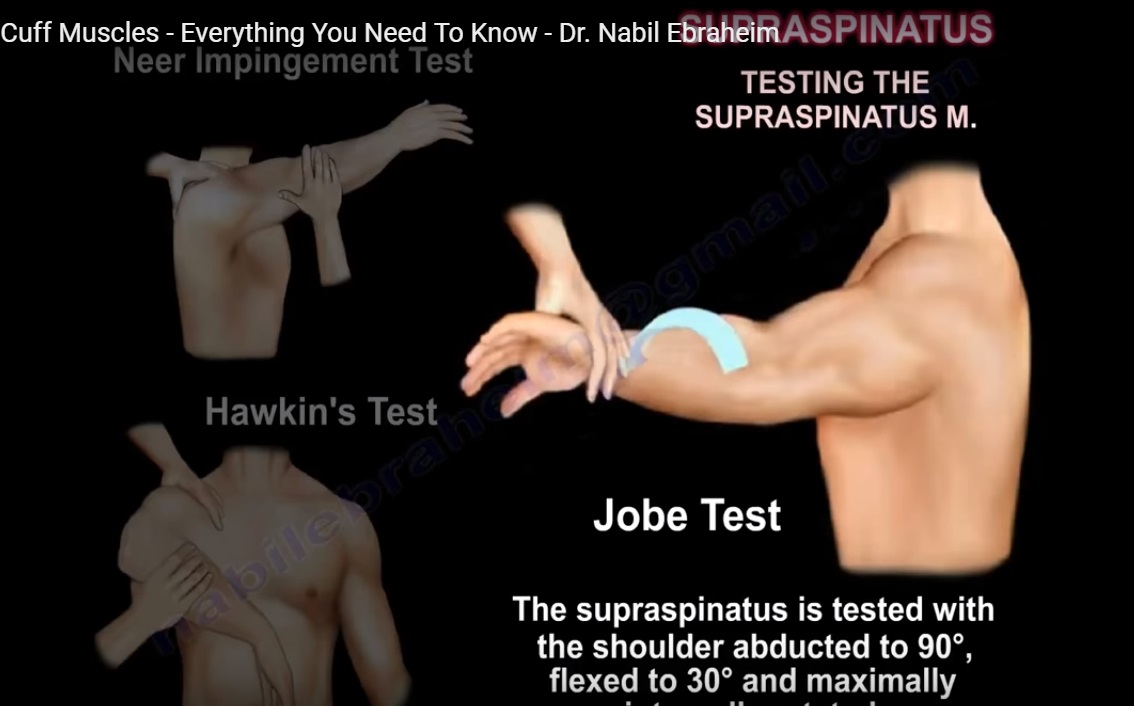
  • Neer Impingement Test
  • Hawkins Test
  • Jobe’s (Empty Can) Test
    • Shoulder abducted to 90°
    • Flexed to 30°
    • Internally rotated
    • Downward resistance applied

2. Infraspinatus

Origin & Insertion

  • Origin: Infraspinous fossa of the scapula
  • Insertion: Middle facet of the greater tubercle of the humerus

Function

  • Primary external rotator of the arm
  • Assists in shoulder stabilization

Nerve Supply

  • Suprascapular nerve (C5, C6)

Clinical Significance

  • Tear results in:
    • Weakness in external rotation

Clinical Tests

  • External Rotation Against Resistance
  • External Rotation Lag Test
    • Arm placed in full external rotation
    • Positive if patient cannot maintain position

3. Teres Minor

Origin & Insertion

  • Origin: Lateral border of the scapula
  • Insertion: Greater tubercle of the humerus

Function

  • Assists in external rotation of the arm
  • Works with infraspinatus

Nerve Supply

  • Axillary nerve (C5, C6)
  • From the posterior cord of the brachial plexus

Clinical Tests

  • Hornblower’s Test
    • Arm held in 90° abduction
    • Positive if arm falls into internal rotation

4. Subscapularis

Origin & Insertion

  • Origin: Subscapular fossa
  • Insertion:
    • Lesser tubercle of the humerus
    • Anterior shoulder capsule

Function

  • Internal rotation of the arm
  • Assists in adduction
  • Stabilizes the shoulder joint

Nerve Supply

  • Upper and Lower Subscapular Nerves (C5, C6, C7)
  • From the posterior cord

Clinical Tests

  • Lift-Off Test
    • Inability to lift hand off lower back ? positive
  • Lag Sign
    • Inability to maintain hand away from back
  • Belly Press Test
    • Positive if:
      • Wrist flexes OR
      • Elbow drops posteriorly

Clinical Significance

  • Tear leads to:
    • Weak internal rotation
    • Difficulty with hand-behind-back movements

Summary

  • Rotator cuff muscles are essential for:
    • Shoulder stability
    • Arm rotation and movement
  • Each muscle has:
    • Specific function
    • Distinct clinical tests
  • Early diagnosis of tears is crucial for optimal shoulder function
Anatomy and function of Rotator Cuff Muscles

Post Views: 16,397

Related Posts

  • Examination of Rotator cuff muscles

    Courtesy: Prof Nabil Ebraheim, University of Toledo, Ohio, USA

  • Rotator Cuff: Anatomy and Injury

    Courtesy: Prof Nabil Ebraheim, University of Toledo, Ohio, USA

  • Massive Rotator Cuff Tears

Reader Interactions

Leave a Reply

Your email address will not be published. Required fields are marked *

Primary Sidebar

Follow Us

instagram slideshare

Categories

  • -Applied Anatomy
  • -Approaches
  • -Basic Sciences
  • -Cartilage & Meniscus
  • -Classifications
  • -Examination
  • -Foot and Ankle
  • -Foot and Ankle Trauma
  • -FRCS(Tr and Orth) tutorials
  • -Gait
  • -Hand and Wrist
  • -Hand and Wrist Trauma
  • -Hand Infections
  • -Hip and Knee
  • -Hip Preservation
  • -Infections
  • -Joint Reconstruction
  • -Knee Arthroplasty
  • -Knee Preservation
  • -Metabolic Disorders
  • -Oncology
  • -OrthoBiologics
  • -OrthoPlastic
  • -Paediatric Orthopaedics
  • -Paediatric Trauma
  • -Patellofemoral Joint
  • -Pelvis
  • -Peripheral Nerves
  • -Principles
  • -Principles of Surgery
  • -Radiology
  • -Rheumatology
  • -Shoulder and Elbow
  • -Shoulder and Elbow Arthroplasty
  • -Spine Deformity
  • -Spine Oncology
  • -Spine Trauma
  • -Spine, Pelvis & Neurology
  • -Sports Ankle and Foot
  • -Sports Elbow
  • -Sports Knee
  • -Sports Medicine
  • -Sports Medicine Hip
  • -Sports Shoulder
  • -Sports Wrist
  • -Statistics
  • -Technical Tip
  • -Technology in Orth
  • -Trauma
  • -Trauma (Upper Limb)
  • -Trauma Life Support
  • -Trauma Reconstruction
  • Book Shelf
  • Book Shelf Medical
  • Careers
  • Case Studies and Free Papers
  • DNB Ortho
  • Evidence Based Orthopaedic Principles
  • Evidence Based Orthopaedics
  • Exam Corner
  • Fellowships
  • Guest Editor
  • Guest Reviews
  • Image Quiz
  • Instructional Course Lectures
  • Journal Club
  • MCQs
  • Meetings and Courses
  • Multimedia
  • News and Blog
  • Plaster Techniques
  • Podcasts
  • Public Health
  • Rehabilitation
  • Research
  • Shorts and Reels
Copyright@orthopaedicprinciples.com. All right rerserved.