
Courtesy: Prof Nabil Ebraheim, University of Toledo, Ohio, USA
Cervical Disc Herniation and Radiculopathy
Introduction
Cervical disc herniation is a common cause of neck pain and upper limb radiculopathy. Herniated disc material compresses a cervical nerve root, leading to characteristic motor, sensory, and reflex abnormalities.
Accurate diagnosis depends on correlating:
- Dermatome
- Myotome
- Reflex changes
Common Levels
The most commonly affected cervical disc levels are:
- C6–C7
- C5–C6
These account for the majority of cervical radiculopathy cases.
Clinical Presentation
Symptoms
Typical symptoms include:
- Neck pain
- Radiating pain into the ipsilateral upper limb
- Numbness
- Paresthesia
- Weakness
Aggravating Factors
Symptoms may worsen with:
- Coughing
- Sneezing
- Neck movement
These maneuvers increase intradiscal and nerve root pressure.
Key Clinical Principle
Each cervical nerve root has:
- A motor function
- A sensory distribution
- A corresponding reflex
Accurate localization requires correlation of all three.
Nerve Root Level-wise Findings
C4 Nerve Root (C3–C4 Disc)
Sensory Distribution
- Shoulder region
Motor Function
- Diaphragm function via the phrenic nerve
Clinical Relevance
Severe involvement may affect respiration.
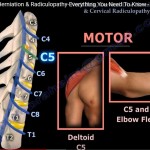
C5 Nerve Root (C4–C5 Disc)
Sensory Distribution
- Lateral shoulder
Motor Function
- Deltoid
- Elbow flexion
Reflex
- Biceps reflex
C6 Nerve Root (C5–C6 Disc)
Sensory Distribution
- Thumb
- Index finger
Motor Function
- Wrist extension
- Elbow flexion
Reflex
- Brachioradialis reflex
C7 Nerve Root (C6–C7 Disc)
Sensory Distribution
- Middle finger
Motor Function
- Triceps
- Wrist flexion
- Finger extension
Reflex
- Triceps reflex
C8 Nerve Root (C7–T1 Disc)
Sensory Distribution
- Ring finger
- Little finger
- Medial forearm
Motor Function
- Finger flexion
- Grip strength
Reflex
- No reliable reflex
T1 Nerve Root (T1–T2 Disc)
Sensory Distribution
- Medial arm
Motor Function
- Interossei muscles
- Finger abduction and adduction
Reflex Summary
| Nerve Root | Reflex |
|---|---|
| C5 | Biceps |
| C6 | Brachioradialis |
| C7 | Triceps |
| C8 | No reliable reflex |
Clinical Localization Tips
C6 Radiculopathy
Typical findings:
- Thumb and index finger numbness
- Wrist extension weakness
C7 Radiculopathy
Most common cervical radiculopathy.
Typical findings:
- Middle finger numbness
- Triceps weakness
- Reduced triceps reflex
C8 Radiculopathy
Typical findings:
- Weak grip strength
- Finger flexion weakness
C5 Radiculopathy
Typical findings:
- Shoulder weakness
- Deltoid weakness
- Reduced biceps reflex
Important Cervical Spine Rule
In the cervical spine:
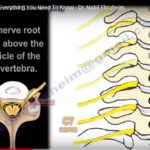
- A disc herniation usually compresses the lower exiting root
Example:
- C6–C7 disc herniation affects the C7 root
This is called the lower root rule.
Red Flag Signs
Important warning signs include:
- Progressive weakness
- Myelopathic features
- Respiratory involvement
- Bilateral neurological symptoms
- Gait disturbance
Management Overview
Conservative Treatment
First-line treatment includes:
- NSAIDs
- Physiotherapy
- Activity modification
- Cervical posture correction
Most patients improve without surgery.
Indications for Surgery
Surgical treatment may be required for:
- Persistent symptoms beyond 6–12 weeks
- Progressive neurological deficit
- Significant motor weakness
- Cervical myelopathy
Key Clinical Pearls
- Most common cervical disc levels: C5–C6 and C6–C7
- Most common radiculopathy: C7
- Middle finger numbness suggests C7 involvement
- Thumb and index finger symptoms suggest C6 involvement
- Biceps reflex corresponds mainly to C5
- Triceps reflex corresponds mainly to C7
- There is no reliable reflex for C8 radiculopathy
- Always correlate dermatome, myotome, and reflex findings for accurate localization


Leave a Reply