
Courtesy: Kaye Wilkins MD and Lynn Staheli MD
Monteggia fracture-dislocation in Children
Definition
- A Monteggia lesion consists of:
- Ulna fracture (or plastic deformation)
- Radial head dislocation
Important Note
- Term “Monteggia lesion” is preferred:
- Includes both fracture and dislocation components
Historical Background
- Classified by José Luis Bado (1954)
- Bado classification:
- Most widely used clinically
Bado Classification
Type I (Most Common)
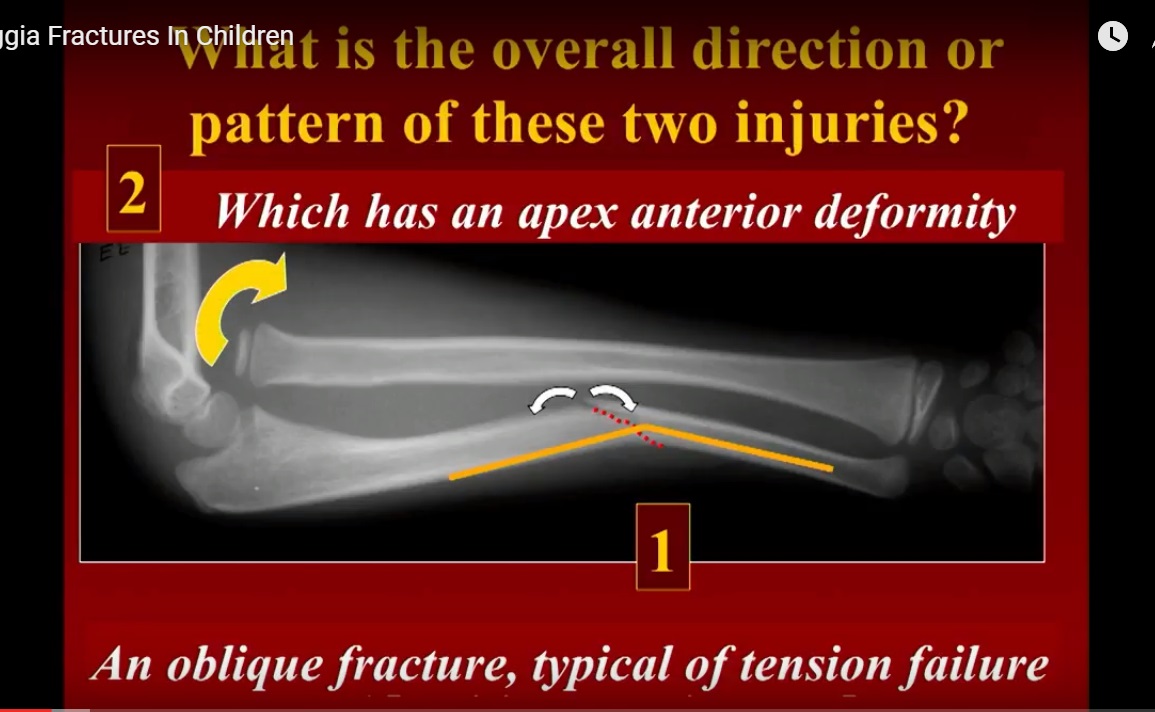
- Anterior radial head dislocation
- Ulna:
- Apex anterior angulation
Mechanism
- Hyperextension injury
Key Concept
- Greenstick fracture:
- Failure on tension side
Type II (Rare)
- Posterior radial head dislocation
- Ulna:
- Posterior angulation
Mechanism
- Flexion injury
Type III
- Lateral / anterolateral radial head dislocation
- Ulna:
- Proximal metaphyseal fracture
Mechanism
- Varus force on extended elbow
Important Risk
- High risk of:
- Posterior interosseous nerve injury
Type IV (Very Rare)
- Fracture of both:
- Radius
- Ulna
- Associated with:
- Anterior radial head dislocation
Monteggia Equivalents
Definition
- Variant injuries where:
- Radial head alignment abnormal
- But no obvious dislocation
Examples
- Radial neck fracture + ulnar injury
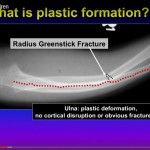
- Plastic deformation of ulna
Key Principle (Most Important)
“Treat the ULNA first”
Goals
- Restore:
- Alignment
- Length
Result
- Radial head usually reduces spontaneously
Mechanism of Injury (Tompkins Theory)
Three Stages
- Elbow hyperextension
- Radial head dislocation
- Ulna fails under tension — fracture
Management Principles
Step 1: Reduce Ulna
- Correct angulation
- Restore length
Methods
- 3-point molding
- Intramedullary fixation if unstable
Step 2: Reduce Radial Head
- Usually reduces after ulnar correction
If Not Reduced
- Type I – Flexion
- Type II – Extension
- Type III – Valgus force
Step 3: Maintain Reduction
Immobilization
- Long arm cast
Position by Type
| Type | Position |
|---|---|
| Type I | Flexion + supination |
| Type II | Extension |
| Type III | Extension + valgus |
| Type IV | Often surgical |
Operative Indications
- Failure to reduce ulna
- Failure to reduce radial head
- Unstable fracture
- Plastic deformation not correctable
- Soft tissue interposition
Why Radial Head May Not Reduce
Most Common Cause
- Annular ligament interposition
Other Causes
- Capsule
- Bone fragments
- Rare:
- Nerve entrapment
Complications
Most Common
- Missed radial head dislocation
Other Complications
- Malunion of ulna
- Re-dislocation
- Loss of pronation–supination
- Nerve injury (especially Type III)
- Chronic dislocation
Chronic Monteggia Lesion
Indications for Surgery
- Age <12 years
- Pain or deformity
- Loss of motion
- Progressive valgus deformity
Treatment Steps
- Ulnar osteotomy (correct deformity)
- Reduce radial head
- ± Annular ligament reconstruction
High-Yield Exam Points
- Type I – Most common
- Type III – Highest nerve injury risk
- Always check:
- Radiocapitellar alignment
Core Principle
- Ulna reduction = key step
Most Common Complication
- Missed diagnosis
Important Insight
- Plastic deformation:
- Subtle but clinically critical
Final Message
- Successful management requires:
- Early recognition
- Accurate ulnar alignment
- Confirmation of stable radial head reduction
Leave a Reply