
Courtesy: Dr Amr Abdelgawad, University of Texas, El Paso, USA
Definition
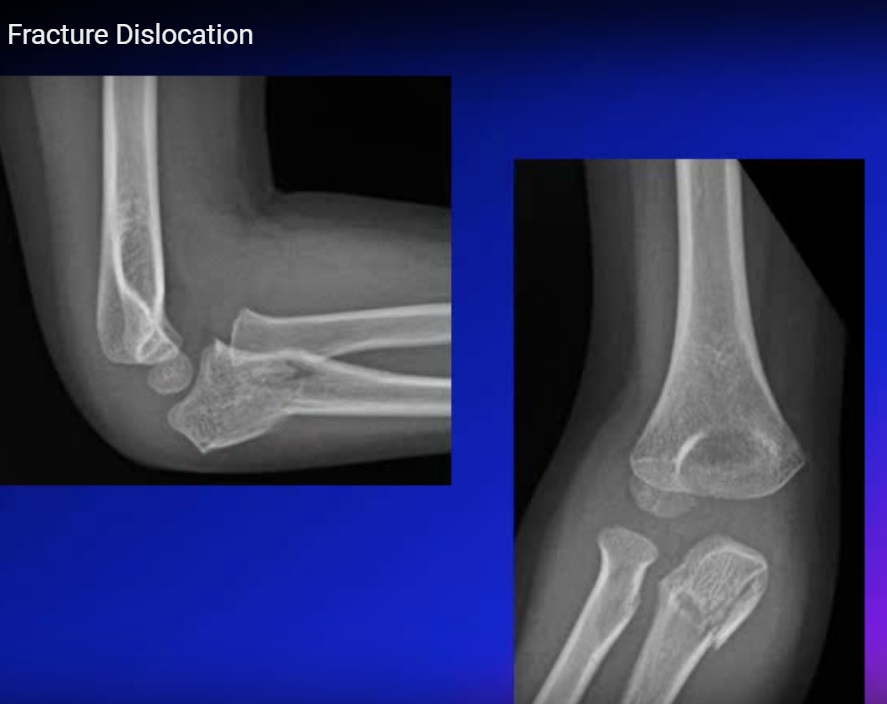
Monteggia fracture–dislocation is defined as:
-
A fracture of the proximal ulna
-
Associated with dislocation of the radial head from:
-
The proximal radioulnar joint
-
The radiocapitellar joint
-
Key principle:
Any fracture of the proximal ulna must prompt careful assessment of radial head alignment.
Clinical Presentation
-
Pain and swelling around the elbow and proximal forearm
-
Deformity of the elbow or forearm
-
Restriction of elbow movement
-
Possible posterior interosseous nerve (PIN) palsy, presenting as:
-
Inability to extend the thumb
-
Weak finger extension
-
Clinical Examination
Posterior Interosseous Nerve Assessment
-
Ask the patient to:
-
Extend the fingers
-
Dorsiflex the thumb
-
-
Inability suggests PIN palsy
-
PIN palsy is usually neuropraxia and often resolves after reduction
Radiographic Evaluation
Radiocapitellar Line (Most Important Rule)
-
A line drawn along the long axis of the radius
-
Must always bisect the capitellum
-
Applies to:
-
All radiographic views (AP, lateral, oblique)
-
All age groups
-
? If the radiocapitellar line does not intersect the capitellum ? radial head dislocation
Radiographic Findings in Monteggia Injury
-
Fracture of the proximal ulna
-
May involve the olecranon
-
-
Abnormal relationship between the radial head and capitellum
-
The radial head may be displaced:
-
Anteriorly
-
Posteriorly
-
Superiorly
-
Inferiorly
-
Direction may vary, but loss of radiocapitellar alignment confirms the diagnosis.
Role of Comparison Views
-
Radiographs of the contralateral normal elbow can be extremely helpful
-
Normal elbow:
-
Radiocapitellar line bisects the capitellum in all views
-
-
Comparison improves diagnostic confidence, especially in young children
Post-Reduction Assessment
-
Ulnar fracture alignment restored
-
Radial head must be:
-
Congruent with the capitellum
-
Stable through range of motion
-
-
Radiocapitellar line should again bisect the capitellum
-
In children, ulnar fractures remodel well once alignment is achieved
Failed Closed Reduction
-
If radial head does not reduce after closed manipulation:
-
Surgical intervention is required
-
-
Common technique:
-
Intramedullary fixation of the ulna
-
Restores ulnar length and alignment
-
Allows spontaneous reduction of the radial head
-
Missed Monteggia Fracture–Dislocation
-
Often misdiagnosed as an isolated ulnar fracture
-
Late presentation may show:
-
Elbow deformity
-
Pain during activity
-
Limited motion
-
-
Management usually requires:
-
Ulnar osteotomy
-
Open reduction of the radial head
-
Possible ligament reconstruction
-
-
Outcomes are less predictable than acute cases
Treatment Principles
Acute Monteggia Fracture–Dislocation
-
Urgent reduction is mandatory
-
Restore:
-
Ulnar alignment
-
Radiocapitellar congruity
-
-
Operative treatment indicated if:
-
Closed reduction fails
-
Radial head remains unstable
-
Chronic or Missed Monteggia
-
Complex reconstructive surgery
-
Higher complication rates
-
Inferior functional outcomes
Key Take-Home Messages
-
Always check the radiocapitellar line in pediatric elbow X-rays
-
Proximal ulnar fracture + radial head malalignment = Monteggia fracture–dislocation
-
Never label these injuries as isolated ulnar fractures
-
Early diagnosis and reduction prevent long-term disability
-
Missed Monteggia injuries convert a simple problem into a major reconstructive challenge
Very short and very good thanks