• Skip to main content
  • Skip to secondary menu
  • Skip to primary sidebar
OrthopaedicPrinciples.com

OrthopaedicPrinciples.com

Integrating Principles and Evidence

Integrating Principles and Evidence

  • Home
  • Editorial Board
  • Our Books
    • Evidence Based Orthopaedic Principles
  • Courses
  • Exams
  • Reviews
  • Live Program
  • Contact

Monteggia Fracture Dislocation

Fracture of the proximal third of the ulna with dislocation of the radial head.

Fracture is more common in children, rare in adults.

Treatment depends on the age of the patient.

There are four types of this fracture /dislocation.

The normal position of the radial head and the shaft should line up with the capitellum in any position, dislocation of the radial head may be missed.

1- Type I:
– A fracture of the middle or proximal third of the ulna with anterior dislocation of the radial head and characteristic apex anterior angulation of the ulna.
– Most common of all types, about 60%.
– In children, immobilize in flexion and supination.
– Flex the elbow more than 90 degrees to relax the biceps.

2- Type II:
– 15% .
– Fracture of the middle or proximal third of the ulna with posterior dislocation of the radial head and characteristic apex posterior angulation of the ulna.
– Immobilize in extension.

3- Type III:
– 20%.
– Fracture to the ulna just distal to the coronoid process with lateral dislocation of the radial head.

4- Type IV:
– 5%.
– Fracture of the proximal or middle third of the ulna with anterior dislocation of the radial head, and a fracture of the proximal third of the radius below the bicipital tuberosity.
– Surgery even in children.
– Neurovascular examination is important.
– Nerve injury, especially involving the posterior interosseous nerve, is not uncommon (observe).
– Watch the patient for compartment syndrome.

Treatment:

1- Treatment in adults: ORIF of the ulna: when the ulna is properly aligned and fixed, the radial head will reduce by itself.
– Radial head instability may usually be caused by nonanatomic reduction of the ulna or by interposition of the ulnar ligament.
– Fracture of the ulna may need bone graft for healing.

2- Treatment in children:
– The radial head ossifies around 4 years of age.
– Type I-III fractures: do closed reduction of the ulna to restore the length of the ulna and reduce the radial head, immobilize in flexion and supination.
– Type IV fracture: Surgery, or in cases where unable to reduce the radial head or length of the ulna, use an IM rod or a plate.
– Do osteotomy of the ulna.
– Open reduction of the radial head followed by plating of the ulna.

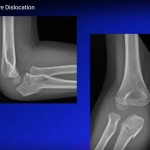
Monteggia fracture dislocation

Courtesy: Prof Nabil Ebraheim, University of Toledo, Ohio, USA
Post Views: 9,931

Related Posts

  • Monteggia Fracture Dislocation

    Courtesy: Dr Amr Abdelgawad, University of Texas, El Paso, USA Definition Monteggia fracture–dislocation is defined…

  • Monteggia Fracture Dislocation

    Courtesy: Dr Amr Abdelgawad, University of Texas, El Paso, USA Definition Monteggia fracture–dislocation is defined…

  • PIP Dorsal Fracture Dislocation

    Courtesy: Prof Nabile Ebraheim, University of Toledo, Ohio, United States

Reader Interactions

Leave a Reply

Your email address will not be published. Required fields are marked *

Primary Sidebar

Follow Us

instagram slideshare

Categories

  • -Applied Anatomy
  • -Approaches
  • -Basic Sciences
  • -Cartilage & Meniscus
  • -Classifications
  • -Examination
  • -Foot and Ankle
  • -Foot and Ankle Trauma
  • -FRCS(Tr and Orth) tutorials
  • -Gait
  • -Hand and Wrist
  • -Hand and Wrist Trauma
  • -Hand Infections
  • -Hip and Knee
  • -Hip Preservation
  • -Infections
  • -Joint Reconstruction
  • -Knee Arthroplasty
  • -Knee Preservation
  • -Metabolic Disorders
  • -Oncology
  • -OrthoBiologics
  • -OrthoPlastic
  • -Paediatric Orthopaedics
  • -Paediatric Trauma
  • -Patellofemoral Joint
  • -Pelvis
  • -Peripheral Nerves
  • -Principles
  • -Principles of Surgery
  • -Radiology
  • -Rheumatology
  • -Shoulder and Elbow
  • -Shoulder and Elbow Arthroplasty
  • -Spine Deformity
  • -Spine Oncology
  • -Spine Trauma
  • -Spine, Pelvis & Neurology
  • -Sports Ankle and Foot
  • -Sports Elbow
  • -Sports Knee
  • -Sports Medicine
  • -Sports Medicine Hip
  • -Sports Shoulder
  • -Sports Wrist
  • -Statistics
  • -Technical Tip
  • -Technology in Orth
  • -Trauma
  • -Trauma (Upper Limb)
  • -Trauma Life Support
  • -Trauma Reconstruction
  • Book Shelf
  • Book Shelf Medical
  • Careers
  • Case Studies and Free Papers
  • DNB Ortho
  • Evidence Based Orthopaedic Principles
  • Evidence Based Orthopaedics
  • Exam Corner
  • Fellowships
  • Guest Editor
  • Guest Reviews
  • Image Quiz
  • Instructional Course Lectures
  • Journal Club
  • MCQs
  • Meetings and Courses
  • Multimedia
  • News and Blog
  • Plaster Techniques
  • Podcasts
  • Public Health
  • Rehabilitation
  • Research
  • Shorts and Reels
Copyright@orthopaedicprinciples.com. All right rerserved.