
Courtesy: Dr Ashok Rajgopal, Dr Ashok Shyam, Ortho TV
Total Knee Arthroplasty Alignment Philosophies: The Critical Evidence-Based Perspective
The Driver Behind Alternate Alignments: Patient Dissatisfaction
-
The Core Argument: Contemporary proponents of alternate alignments argue that traditional techniques leave up to 15% to 20% of total knee arthroplasty (TKA) patients dissatisfied with their joint function.
-
The Clinical Counter-Perspective (Bob Booth Axiom):
-
Patient dissatisfaction is rarely driven solely by subtle geometric alignment nuances.
-
Dissatisfaction stems fundamentally from technical surgical errors (poor gap balancing, component malrotation) or inappropriate patient selection (unrealistic expectations, psychiatric overlay, neuropathic pain).
-
-
The Spectrum of Alignment Philosophies: The modern orthopedic landscape is fragmented into an overwhelming array of alignment strategies:
-
Anatomic alignment
-
Mechanical alignment (MA)
-
Adjusted mechanical alignment
-
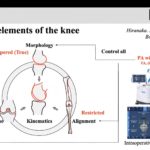
Kinematic alignment (KA)
-
Restricted kinematic alignment (rKA)
-
Inverse kinematic alignment (iKA)
-
Functional alignment (FA)
-
Constitutional alignment
-
Coronal Plane Alignment of the Knee (CPAK matrix with 9 distinct phenotype quadrants)
-
Biomechanical Rationale of Joint Alignment
-
Primary Objectives of Component Alignment:
-
Minimize edge loading, mechanical wear, and shear stress across the ultra-high-molecular-weight polyethylene (UHMWPE) bearing surface.
-
Reduce destructive eccentric stresses at the bone-cement and bone-implant interfaces to avoid aseptic loosening.
-
Balance tension forces distributed throughout the collateral ligament and retinacular soft-tissue envelopes.
-
-
The Non-Physiological Reality of TKA:
-
Every total knee arthroplasty induces profound, non-physiological kinematics regardless of the alignment concept applied.
-
The anterior cruciate ligament (ACL) is sacrificed (and frequently the PCL as well), the joint line is altered, both fibrocartilaginous menisci are excised, and native condylar geometry is replaced by rigid metallic condyles.
-
Consequently, true physiological knee kinematics cannot be restored simply by altering bone resection angles.
-
-
Consequences of Poor Alignment: Increased shear, higher failure rates, early component loosening, and poor functional outcome scores.
Mechanical vs. Kinematic Philosophies: Historical Context and Concepts
-
Mechanical Alignment (John Insall School):
-
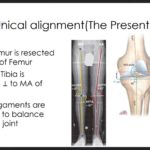
Cuts the distal femur and proximal tibia strictly perpendicular (90°) to their respective mechanical axes in the coronal plane.
-
Aims for a neutral postoperative mechanical Hip-Knee-Ankle (HKA) axis ().
-
Systematic, reproducible, and implant-protective, relying on targeted soft-tissue releases to balance rectangular flexion and extension gaps.
-
-
Kinematic Alignment (Ed Hollister Concept, Popularized by Stephen Howell):
-
Seeks to resurface the articular surfaces back to the patient’s individual pre-arthritic constitutional anatomy without routine ligamentous releases.
-
Matches bone cuts directly to implant thickness, accepting residual varus or valgus joint line obliquity.
-
The Fundamental Clinical Dilemma: In patients with severe constitutional varus or severe deformities, executing pure kinematic alignment without soft-tissue releases forces extreme component positioning that can overload the medial plateau or produce unacceptable ligamentous imbalance.
-
Literature Review & Comparative Clinical Evidence
-
Finite Element Analysis (FEA) and Stress Modeling:
-
Neutral mechanical alignment significantly reduces asymmetric contact pressures and trabecular bone stresses beneath the tibial baseplate.
-
Historically, post-surgical varus alignment exceeding 3° has been correlated with increased medial compartment stress and premature implant failure.
-
-
Fluoroscopic and Articular Kinematics (Dennis & Karist Data):
-
While mechanically aligned knees may exhibit lateral condylar lift-off during deep flexion activities, modern highly conforming articulations accommodate these loads safely without premature catastrophic wear.
-
-
Clinical Trials & Mid-Term Functional Scores:
-
Comparative randomized trials (including long-term data from Chitranjan Ranawat and Kelly Vince cohorts) demonstrate that functional scores, pain relief, and subjective satisfaction between mechanical and kinematic alignment are comparable, with kinematic alignment failing to prove superiority.
-
Gait analysis evaluations at 5 years show no statistically significant functional kinematic differences between mechanically aligned and kinematically aligned knees.
-
-
Short-Term vs. Long-Term Retrieval Analysis:
-
Short-term studies (such as Niki et al.) occasionally show marginal early functional score advantages in small subsets, but these equalize over time.
-
Long-term retrieval analyses reveal that placing unconstrained implants in high-degree constitutional varus increases asymmetric medial polyethylene burnishing, delamination, and deformation.
-
-
Systematic Reviews & Registry Realities (Matar et al., 2020–2023):
-
Global arthroplasty registry data confirm that between 90% and 99% of long-term surviving knees were implanted using mechanical alignment principles, retaining revision rates as low as 3% to 5% beyond 10 to 20 years.
-
Broad meta-analyses of randomized controlled trials (RCTs) confirm no clinically meaningful difference in patient-reported outcome measures (PROMs) between well-executed mechanical alignment and alternate alignment strategies.
-
High-Yield Clinical Takeaways
-
Alternating alignment angles by 2° to 3° does not reliably drive superior clinical outcomes or overcome underlying patient dissatisfaction.
-
Patient dissatisfaction is predominantly governed by patient selection, surgical execution errors, and unrealistic expectations rather than minor angular variances.
-
True kinematic alignment cannot recreate normal joint kinematics because the resection of the cruciates, menisci, and native articular contours permanently alters joint mechanics.
-
Mechanical alignment remains the global benchmark with the longest registry track record of predictable, multi-decade implant survivorship.
-
Long-term clinical success depends fundamentally on sound, reproducible surgical technique, accurate gap balancing, correct component rotation, and appropriate patient indication.


Leave a Reply