
Courtesy: Prof Nabil Ebraheim, University of Toledo, Ohio, USA
Importance of Identifying Red Flags
-
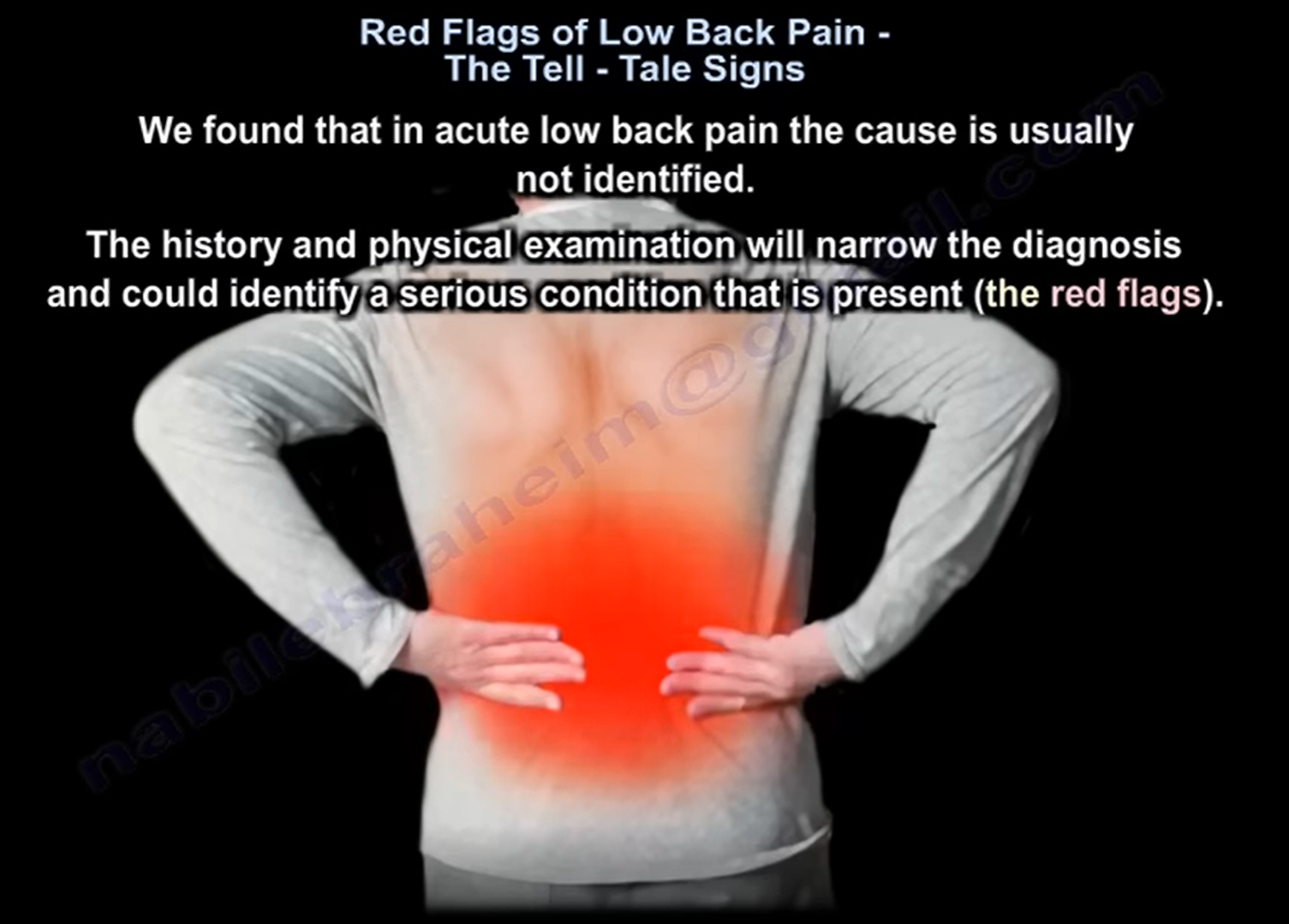
A detailed history and careful physical examination are essential.
-
Red flags are warning signs that may indicate a serious underlying condition.
-
In the absence of red flags, acute low back pain is usually treated conservatively.
Management of Uncomplicated Acute Low Back Pain
-
Early return to activity as tolerated.
-
Limited rest.
-
Nonsteroidal anti-inflammatory medications (NSAIDs).
-
Physiotherapy.
-
Muscle relaxants.
-
Symptomatic treatment.
Imaging
-
Diagnostic imaging is not necessary unless:
-
Symptoms persist.
-
Treatment fails.
-
Red flags are present.
-
-
If imaging is required:
-
Start with X-rays.
-
Do not begin with MRI unless indicated.
-
-
Unnecessary imaging does not improve outcomes.
Major Red Flags
1. Cauda Equina Syndrome (Orthopaedic Emergency)
Key Symptoms
-
Bladder dysfunction
-
Bowel dysfunction
-
Urinary incontinence or retention
-
Fecal incontinence
-
Saddle anesthesia
-
Bilateral lower extremity weakness or numbness
-
Decreased anal sphincter tone
Action
-
Immediate emergency MRI.
-
Immediate interpretation.
-
Early surgical treatment.
Do not miss cauda equina syndrome.
2. Malignancy
Risk Factors
-
Age over 50 years
-
History of cancer
-
Unexplained weight loss
-
Pain at rest
-
Night pain
-
Persistent pain for weeks or months without improvement
Key Points
-
The spine is a common site of metastatic tumor.
-
Metastasis often involves:
-
Vertebral body
-
Pedicle
-
-
30–40% bone loss is required before a lesion becomes visible on X-ray.
-
Cortical bone loss may produce the “winking owl” sign.
-
Renal tumors involving the spine may require:
-
Arteriography
-
Embolization
-
Biopsy or surgery
-
3. Spinal Infection
Clinical Clues
-
Fever
-
Chills
-
History of:
-
Pneumonia
-
Cellulitis
-
Urinary tract infection
-
Kidney infection
-
-
Pain at rest
-
Night pain
-
Diabetes
-
HIV
-
Immunocompromised state
Laboratory Findings
-
Elevated ESR
-
Elevated CRP
-
Fever present in only about 50% of cases
-
White blood cell count elevated in less than 50% of cases
-
Blood cultures positive in approximately 24% of patients
Infection Location
-
Often involves the intervertebral disc space.
Management
-
MRI for diagnosis.
-
Blood cultures.
-
Biopsy.
-
Antibiotics guided by culture and sensitivity.
-
Epidural abscess requires surgery, especially if:
-
Neurological deterioration
-
Diabetic patient with MRSA
-
4. Vertebral Fracture
Risk Factors
-
Osteoporosis
-
Elderly patients
-
Steroid use
-
Minimal trauma
Facts
-
Approximately 700,000 spine fractures occur annually.
-
Decreased bone strength predisposes to fracture.
Management
-
Treat fracture.
-
Perform DEXA scan.
-
Check vitamin D level.
-
Initiate medical treatment for osteoporosis.
Benefits of Treatment
-
Decreases incidence of spine fractures:
-
60% after 1 year
-
40% after 2 years
-
5. Cervical Spine Myelopathy
-
May present with low back pain but symptoms arise from cervical cord compression.
-
Progressive condition requiring early diagnosis and treatment.
Symptoms
-
Unsteady gait
-
Hand clumsiness
-
Decreased manual dexterity
-
Difficulty buttoning and unbuttoning
-
Dropping objects
-
Hyperreflexia
-
Positive Hoffman sign
Diagnosis
-
MRI is the study of choice.
Other Red Flags Outside the Spine
Consider non-spinal causes such as:
-
Renal colic
-
Biliary colic
-
Abdominal aortic aneurysm
-
Urinary tract infection
-
Pancreatitis
-
Pelvic inflammatory disease
When No Red Flags Are Present
A simple low back pain patient will have:
-
No constitutional symptoms
-
No major trauma history
-
No neurological deficit
-
No bladder or bowel dysfunction
-
No gait disturbance
Herniated Disc
-
Not considered a red flag.
-
Not a serious condition in most cases.
-
May cause:
-
Sciatica
-
Pain radiating to lower leg and foot
-
-
Usually treated conservatively for at least six weeks.
-
MRI may be indicated if symptoms do not improve.
Summary
-
Red flags indicate possible serious pathology.
-
Presence of red flags warrants further investigation.
-
Imaging and laboratory studies are indicated when red flags are present.
-
In uncomplicated acute low back pain, conservative treatment is appropriate.
-
Careful history and physical examination remain the most important tools.
Related Posts
 Complicated Low Back Pain.
Courtesy: Prof Nabil Ebraheim, University of Toledo, Ohio, USA
 Spine Concepts: Low Back Pain
Courtesy: Prof Nabil Ebraheim, University of Toledo, Ohio, USA
- Spine Concepts: Low Back Pain
Courtesy: Prof Nabil Ebraheim, University of Toledo, Ohio, USA
Leave a Reply