
Courtesy: Prof Nabil Ebraheim, University of Toledo, Ohio, USA
Hip Pain vs Sciatica (Spine Pathology)
Introduction
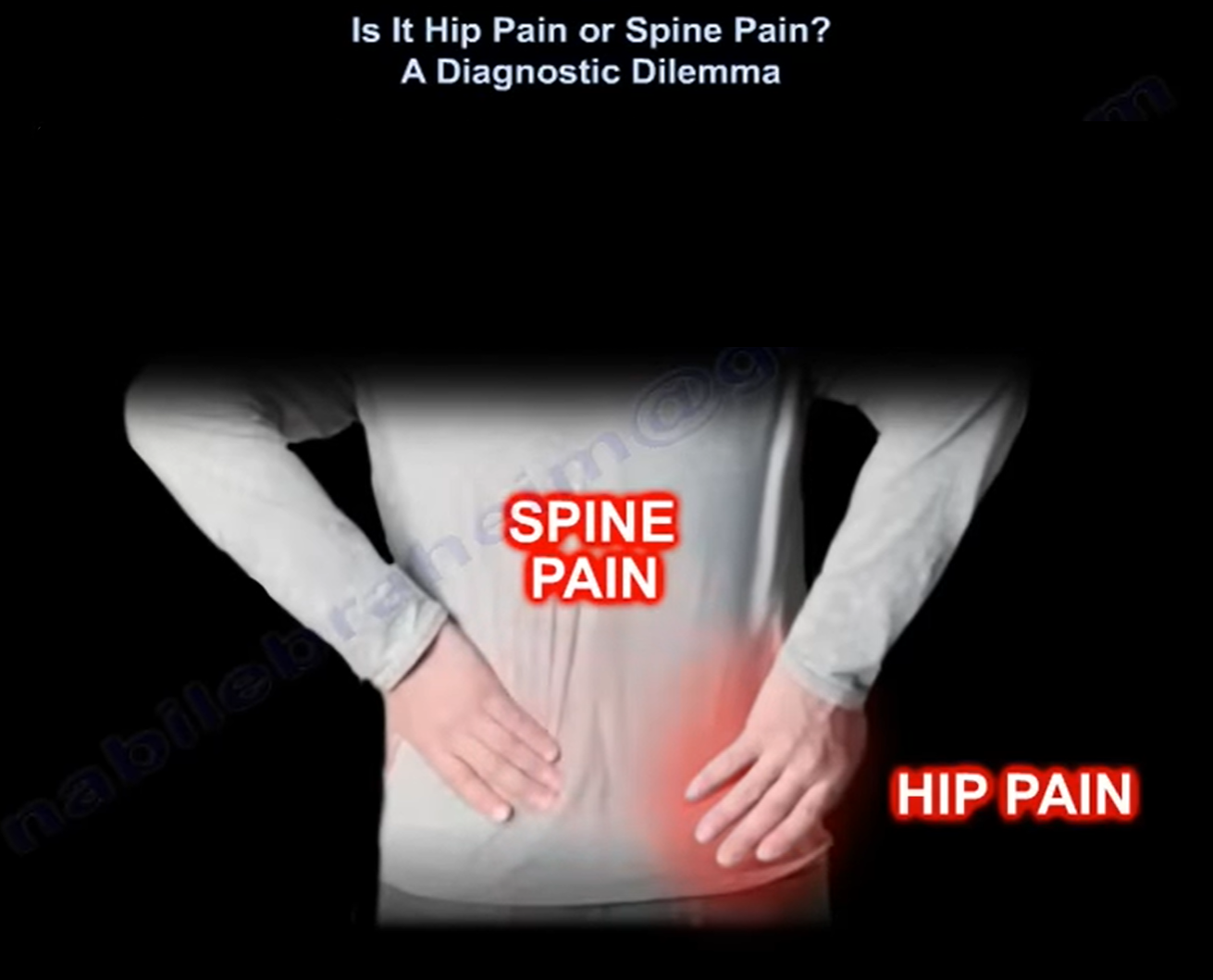
Hip disorders and lumbar spine disorders frequently coexist and often produce overlapping symptoms.
This overlap can lead to:
- Misdiagnosis
- Delayed treatment
- Inappropriate surgery
A careful clinical assessment is essential to determine whether symptoms arise primarily from the hip, the spine, or both.
Diagnostic Challenge
Important principles include:
- Hip and spine pathology commonly coexist
- Symptoms frequently overlap
- Imaging abnormalities may not correlate with symptoms
- Treating one condition alone may not relieve pain if the other pathology is missed
Always evaluate both:
- Hip pathology in spine patients
- Spine pathology in hip patients
Differences in History
Hip Pathology
Typical Pain Location
The classic location is:
- Groin pain
Groin pain strongly suggests hip pathology and is approximately seven times more likely to arise from the hip than the spine.
Radiation of Pain
Hip pain may radiate to:
- Thigh
- Knee
- Occasionally below the knee
Associated Features
Common associated symptoms include:
- Limping gait
- Difficulty tying shoes
- Difficulty sitting cross-legged
- Pain with hip motion
Spine Pathology (Sciatica / Lumbar Stenosis)
Typical Pain Location
Pain commonly involves:
- Low back
- Buttock
Radiation Pattern
Pain follows a nerve root distribution.
Typical features include:
- Radicular pain
- Paresthesia
- Numbness
- Weakness
Functional Clues
| Clinical Feature | Suggests |
|---|---|
| Leaning forward while walking | Lumbar spinal stenosis |
| Limping gait | Hip arthritis |
| Pain relieved by sitting | Lumbar stenosis |
| Difficulty tying shoes | Hip pathology |
| Shopping cart sign | Lumbar spinal stenosis |
Physical Examination
Hip Pathology
Common Findings
- Reduced range of motion
- Pain reproduced with hip movement
- Restricted internal rotation
- Antalgic gait
Loss of internal rotation is often one of the earliest signs of hip disease.
Spine Pathology
Neurological Findings
May include:
- Sensory loss
- Motor weakness
- Reflex changes
- Positive radiculopathy signs
Special Features
Features favoring spinal pathology include:
- Radicular symptoms
- Neurogenic claudication
- Pain relieved by spinal flexion
Important Clinical Principles
Patients may have:
- Hip pathology alone
- Spine pathology alone
- Both conditions simultaneously
Failure to recognize combined pathology may lead to persistent symptoms after treatment.
Clinical correlation is always essential.
Role of Imaging
Important Concept
Imaging findings do not always correlate with symptoms.
Degenerative changes are common in asymptomatic individuals.
Imaging Must Be Correlated Clinically
Always correlate:
- History
- Physical examination
- Imaging findings
Never rely on MRI or X-ray findings alone.
Diagnostic Injection
When the diagnosis is uncertain, an intra-articular hip injection can help localize the source of pain.
Interpretation
Significant Pain Relief
Suggests:
- Hip joint is the primary pain source
No Pain Relief
Suggests:
- Spine pathology is more likely
Diagnostic injection is often considered the “tie-breaker” test.
Red Flags Suggesting Spine Pathology
Features favoring spinal origin include:
- Radiculopathy
- Paresthesia
- Neurogenic claudication
- Weakness
- Pain relieved by lumbar flexion
Red Flags Suggesting Hip Pathology
Features favoring hip origin include:
- Groin pain
- Limp
- Restricted hip range of motion
- Pain reproduced with hip movement
Neurogenic Claudication
Typical Features
Seen in lumbar spinal stenosis.
Symptoms include:
- Leg heaviness
- Pain during walking
- Relief with sitting or bending forward
Shopping Cart Sign
Patients feel relief while leaning forward on a shopping cart.
This strongly suggests lumbar spinal stenosis.
Key Clinical Pearls
- Groin pain usually suggests hip pathology.
- Buttock and back pain more commonly suggest spinal pathology.
- Loss of hip internal rotation strongly favors hip disease.
- Neurological deficits suggest spinal pathology.
- Hip and spine disorders frequently coexist.
- Imaging abnormalities may be incidental.
- Diagnostic hip injection is useful when diagnosis remains unclear.

Leave a Reply