• Skip to main content
  • Skip to secondary menu
  • Skip to primary sidebar
OrthopaedicPrinciples.com

OrthopaedicPrinciples.com

Integrating Principles and Evidence

Integrating Principles and Evidence

  • Home
  • Editorial Board
  • Our Books
    • Evidence Based Orthopaedic Principles
  • Courses
  • Exams
  • Reviews
  • Live Program
  • Contact

Hitchhiker’s sign


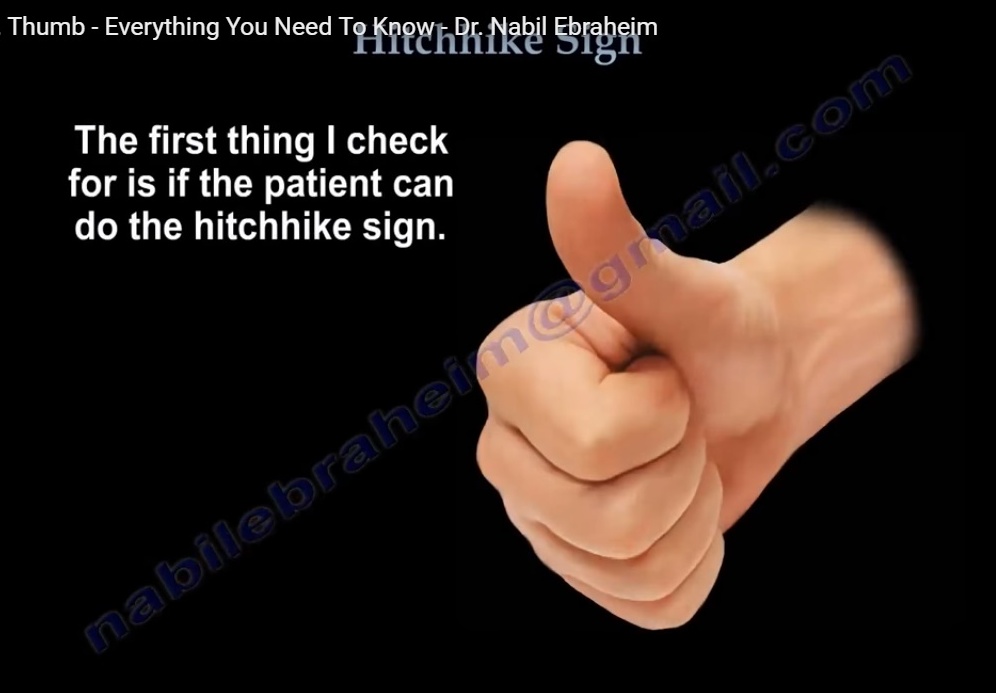
  • Extension of the thumb is sometimes called the hitchhike sign.
  • The hitchhike sign is used in two conditions to identify a problem: radial nerve or posterior interosseous nerve palsy and diastrophic dwarfism.
    Radial nerve or posterior interosseous nerve palsy:
  • The fracture may cause injury to the radial nerve which results in paralysis of the wrist and finger extensors.
  • Examine the patient before and after surgery that is done to fix the fracture!
  • Patient with posterior interosseous nerve injury can perform wrist extension, but no finger extension. The radial nerve gives innervation to the wrist, finger and thumb extensors.
  • The posterior interosseous nerve will give finger and thumb extension only. Injury at a higher level is probably associated with the radial nerve.
  • Injury at a lower level, usually occurring around the elbow, probably is associated with the posterior interosseous nerve.
  • The first thing I check for is if the patient can do the hitchhike sign.
  • Ask the patient to “hitchhike”, and if they can do this then the radial nerve and posterior interosseous nerve functions are intact. If the patient cannot perform the hitchhike sign, then the posterior interosseous nerve may be affected and the radial nerve may be unaffected.
  • Ask the patient to extend their wrist! If the patient can extend the wrist, then the radial nerve is unaffected up to the level of the posterior interosseous nerve, meaning the PIN is the one that is involved.
  • Remember! Sometimes it is hard to distinguish whether the patient has a true wrist drop or not based on the splinting and immobilization and also the examination.
  • The patient may extend the fingers by the intrinsic muscles which predominantly involves the ulnar nerve with some median nerve contribution.
  • If you want to examine the fingers well, extend the wrist then ask the patient to extend the fingers. This is more complicated then asking the patient to perform the hitchhike sign.


  • Diastrophic dwarfism or diastrophic dysplasia (DTD) are closely associated with hitchhiker thumb. Associated features include Cauliflower ear, clubfoot. The defect is in the sulphate transporter gene
  • Hitchhike sign
    Courtesy: Prof Nabil Ebraheim, University of Toledo, Ohio, USA
Post Views: 36,456

Related Posts

  • Wartenberg sign

    Courtesy : Prof Nabile Ebraheim, University of Toledo, Ohio, USA

  • Gower's Sign

    Courtesy: Prof Nabile Ebraheim, University of Toledo, Ohio, USA

  • Froment's sign

    Courtesy: Prof Nabile Ebraheim, University of Toledo, Ohio, USA

Reader Interactions

Comments

  1. drswamy says

    at

    Nice

Leave a Reply

Your email address will not be published. Required fields are marked *

Primary Sidebar

Follow Us

instagram slideshare

Categories

  • -Applied Anatomy
  • -Approaches
  • -Basic Sciences
  • -Cartilage & Meniscus
  • -Classifications
  • -Examination
  • -Foot and Ankle
  • -Foot and Ankle Trauma
  • -FRCS(Tr and Orth) tutorials
  • -Gait
  • -Hand and Wrist
  • -Hand and Wrist Trauma
  • -Hand Infections
  • -Hip and Knee
  • -Hip Preservation
  • -Infections
  • -Joint Reconstruction
  • -Knee Arthroplasty
  • -Knee Preservation
  • -Metabolic Disorders
  • -Oncology
  • -OrthoBiologics
  • -OrthoPlastic
  • -Paediatric Orthopaedics
  • -Paediatric Trauma
  • -Patellofemoral Joint
  • -Pelvis
  • -Peripheral Nerves
  • -Principles
  • -Principles of Surgery
  • -Radiology
  • -Rheumatology
  • -Shoulder and Elbow
  • -Shoulder and Elbow Arthroplasty
  • -Spine Deformity
  • -Spine Oncology
  • -Spine Trauma
  • -Spine, Pelvis & Neurology
  • -Sports Ankle and Foot
  • -Sports Elbow
  • -Sports Knee
  • -Sports Medicine
  • -Sports Medicine Hip
  • -Sports Shoulder
  • -Sports Wrist
  • -Statistics
  • -Technical Tip
  • -Technology in Orth
  • -Trauma
  • -Trauma (Upper Limb)
  • -Trauma Life Support
  • -Trauma Reconstruction
  • Book Shelf
  • Book Shelf Medical
  • Careers
  • Case Studies and Free Papers
  • DNB Ortho
  • Evidence Based Orthopaedic Principles
  • Evidence Based Orthopaedics
  • Exam Corner
  • Fellowships
  • Guest Editor
  • Guest Reviews
  • Image Quiz
  • Instructional Course Lectures
  • Journal Club
  • MCQs
  • Meetings and Courses
  • Multimedia
  • News and Blog
  • Plaster Techniques
  • Podcasts
  • Public Health
  • Rehabilitation
  • Research
  • Shorts and Reels
Copyright@orthopaedicprinciples.com. All right rerserved.