
Courtesy:Prof Nabile Ebraheim, Chairman, Dept of Orthopaedics and Trauma, University of Toledo, United States.
Gluteus Maximus Gait (Gluteus Maximus Lurch)
Normal Gait (For Comparison)
- During normal walking:
- Trunk remains upright and stable
- Hip extensors (especially gluteus maximus) control:
- Forward movement of trunk at heel strike
Definition
- Gluteus maximus gait occurs due to:
- Weakness of the gluteus maximus muscle
Key Feature
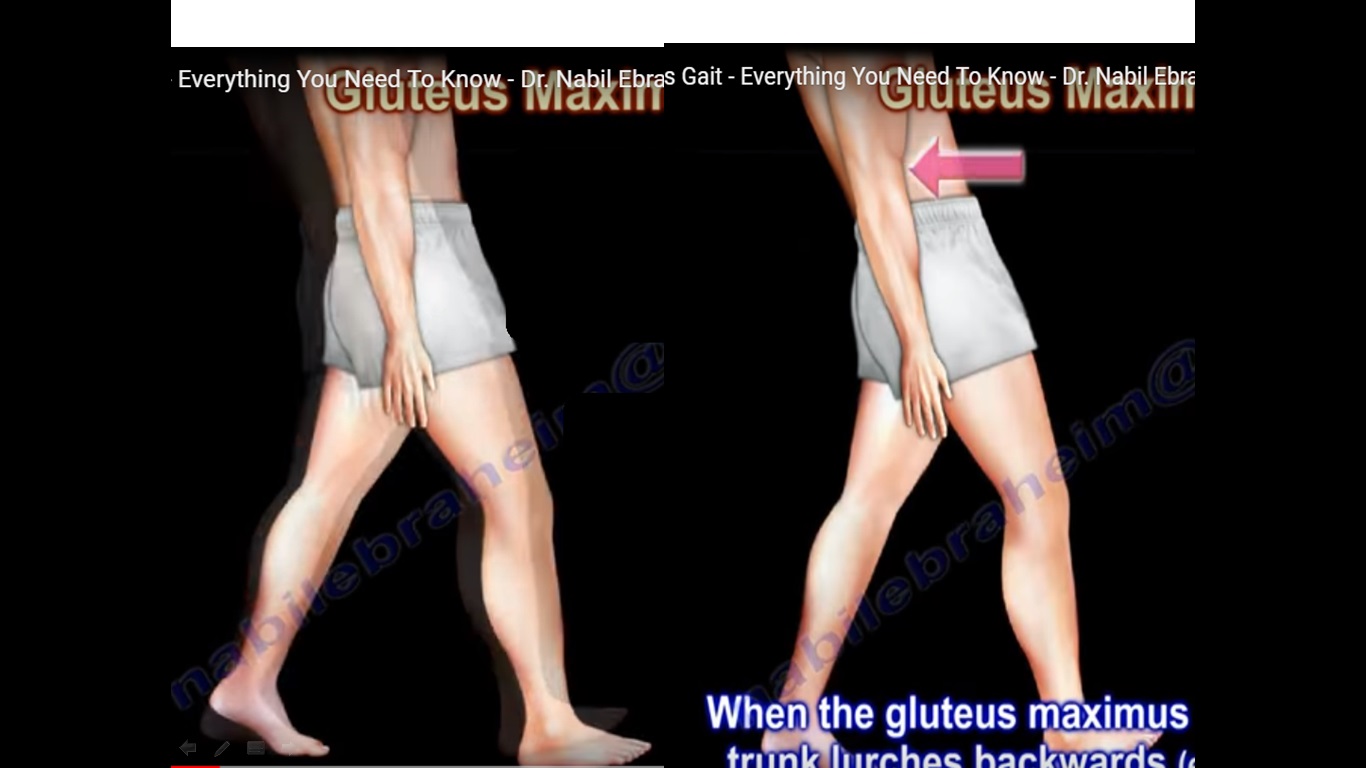
- Backward trunk lurch at heel strike on the affected side
Mechanism
Normal Function
- Gluteus maximus:
- Extends hip
- Stabilizes trunk
In Weakness
- Sudden backward trunk movement at heel strike
Biomechanical Effect
- Center of gravity shifts:
- Posterior to hip joint
Result
- Prevents forward fall of trunk
- Compensates for loss of hip extension power
When Does It Occur?
- During heel strike of affected limb
- In the stance phase
Clinical Appearance
- Patient appears to:
- “Throw” trunk backward while stepping
Anatomy of Gluteus Maximus
General Features
- Largest gluteal muscle
- Most superficial
- Part of:
- Gluteus maximus
- Gluteus medius
- Gluteus minimus
Origin
- Posterior ilium
- Sacrum
- Sacrotuberous ligament
- Thoracolumbar fascia
Insertion
- Gluteal tuberosity of femur
- Iliotibial tract
Blood Supply
- Superior gluteal artery
- Inferior gluteal artery
Nerve Supply
- Inferior gluteal nerve
Root Values
- L5, S1, S2
Functions of Gluteus Maximus
- Hip extension
- External rotation of hip
- Stabilizes trunk during walking
- Maintains knee extension via IT band
- Important for:
- Running
- Climbing stairs
- Rising from sitting
Clinical Causes of Weakness
- Inferior gluteal nerve injury
- Muscular dystrophy
- Poliomyelitis
- Trauma to gluteal region
Summary Table
| Feature | Description |
|---|---|
| Cause | Weak gluteus maximus |
| Key sign | Backward trunk lurch |
| Timing | Heel strike |
| Purpose | Compensation for weak hip extension |

Leave a Reply