
Courtesy: Prof Nabil Ebraheim, University of Toledo, Ohio, USA
Felon
1. Definition
A felon is an abscess of the fingertip pulp, usually involving the volar distal aspect of the finger.
It commonly presents with:
- Severe pain
- Swelling
- Tenderness of the fingertip
2. Cause
Usually follows penetrating trauma, such as:
- Needle prick
- Splinter
- Other penetrating injury
The most common organism mentioned is Staphylococcus aureus.
3. Why a Felon Is Important
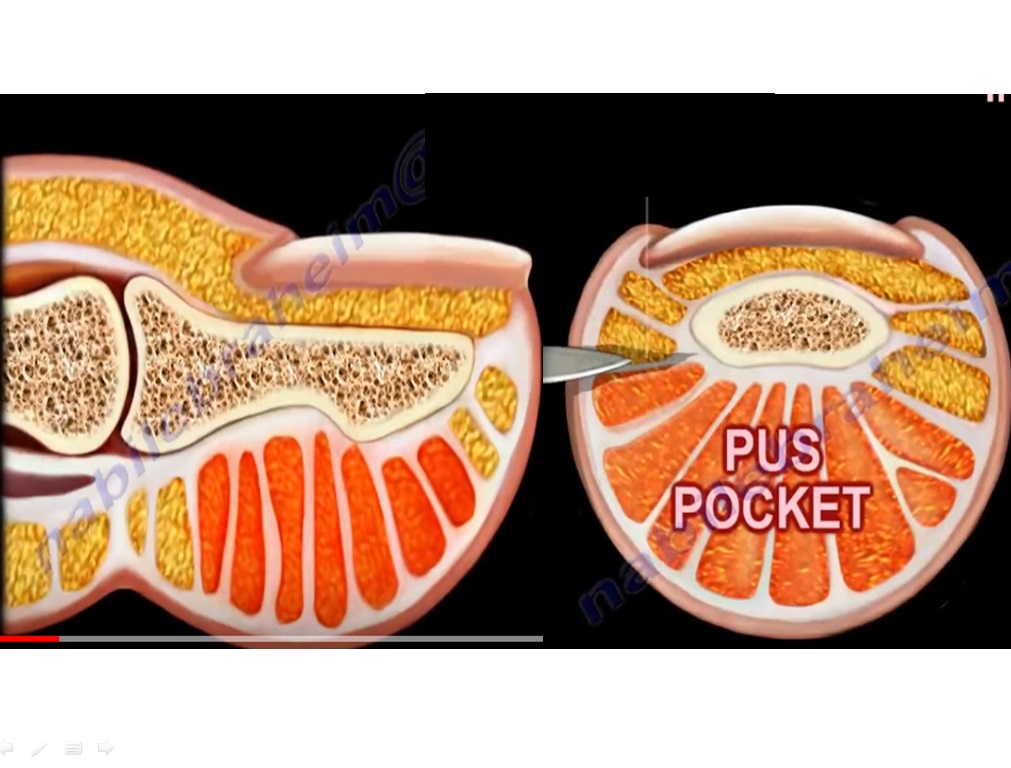
The fingertip pulp contains multiple small compartments of subcutaneous fat separated by fibrous septa.
When infection develops:
- Pus accumulates within these compartments.
- Pressure increases within the closed spaces.
- Vascular compromise can occur.
- Tissue necrosis may develop.
Therefore, a felon should not be regarded as a simple superficial abscess.
4. Important Complications
Untreated infection may extend to:
- Distal phalanx, causing osteomyelitis
- Flexor tendon sheath, causing flexor tenosynovitis
5. Treatment
Incision and Drainage
The fundamental treatment is:
Incision and drainage with decompression of the individual compartments.
The fibrous septa should be adequately released to decompress the infection.
Important Precaution
Do not violate:
- Flexor tendon sheath
- Distal interphalangeal joint
6. Choice of Incision
No Foreign Body
The lecture describes:
- Mid-axial incision
- J-shaped incision
The wound may be left open after drainage.
Foreign Body Present
For a retained foreign body such as a splinter:
- Volar longitudinal incision
This allows identification and removal of the foreign body.
7. Incisions to Avoid
Fish-mouth incision
Avoid because it may result in:
- Unstable fingertip pulp
Double lateral incision
Avoid because it may cause:
- Injury to the neurovascular bundle
Exam Pearls
- Felon = abscess of fingertip pulp
- Usually follows penetrating trauma
- Staphylococcus aureus is the common organism mentioned
- Multiple closed pulp compartments can develop high pressure and vascular compromise
- Treatment is incision, drainage and decompression
- Do not enter the flexor tendon sheath or DIP joint
- Foreign body present: volar longitudinal incision
- Avoid fish-mouth incision
- Avoid double lateral incision because of neurovascular injury risk


Leave a Reply