
Courtesy: Prof Nabil Ebraheim, University of Toledo, Ohio, USA
L4 Nerve Root Examination
Overview
Examination of any nerve root has three components:
Sensory examination – Motor examination – Reflex examination
For L4, emphasizes:
- Sensation: medial side of the foot
- Motor: mainly tibialis anterior for ankle dorsiflexion; quadriceps can also reflect L4 function
- Reflex: patellar tendon reflex
- Sensory Examination
lower-limb sensory sequence as:
- L4 – medial side of the foot
- L5 – dorsum/top of the foot
- S1 – lateral aspect of the foot
L4 Sensory Area
Medial side of the foot
Quick Recall
L4 medial – L5 dorsum – S1 lateral
- Reflex Examination
Patellar Reflex / Knee Jerk
The patellar tendon reflex is supplied by:
L2, L3, L4
but states it is predominantly an:
L4 reflex
Therefore, an L4 lesion may produce:
- Reduced knee jerk
- Absent knee jerk in more significant involvement
Viva Pearl
L4 – patellar reflex
- Motor Examination
Tibialis Anterior
uses tibialis anterior as the practical muscle for testing L4.
Functions mentioned:
- Ankle dorsiflexion
- Foot inversion
Therefore:
Ask the patient to dorsiflex the ankle against resistance.
Weakness suggests L4 involvement in the speaker’s framework.
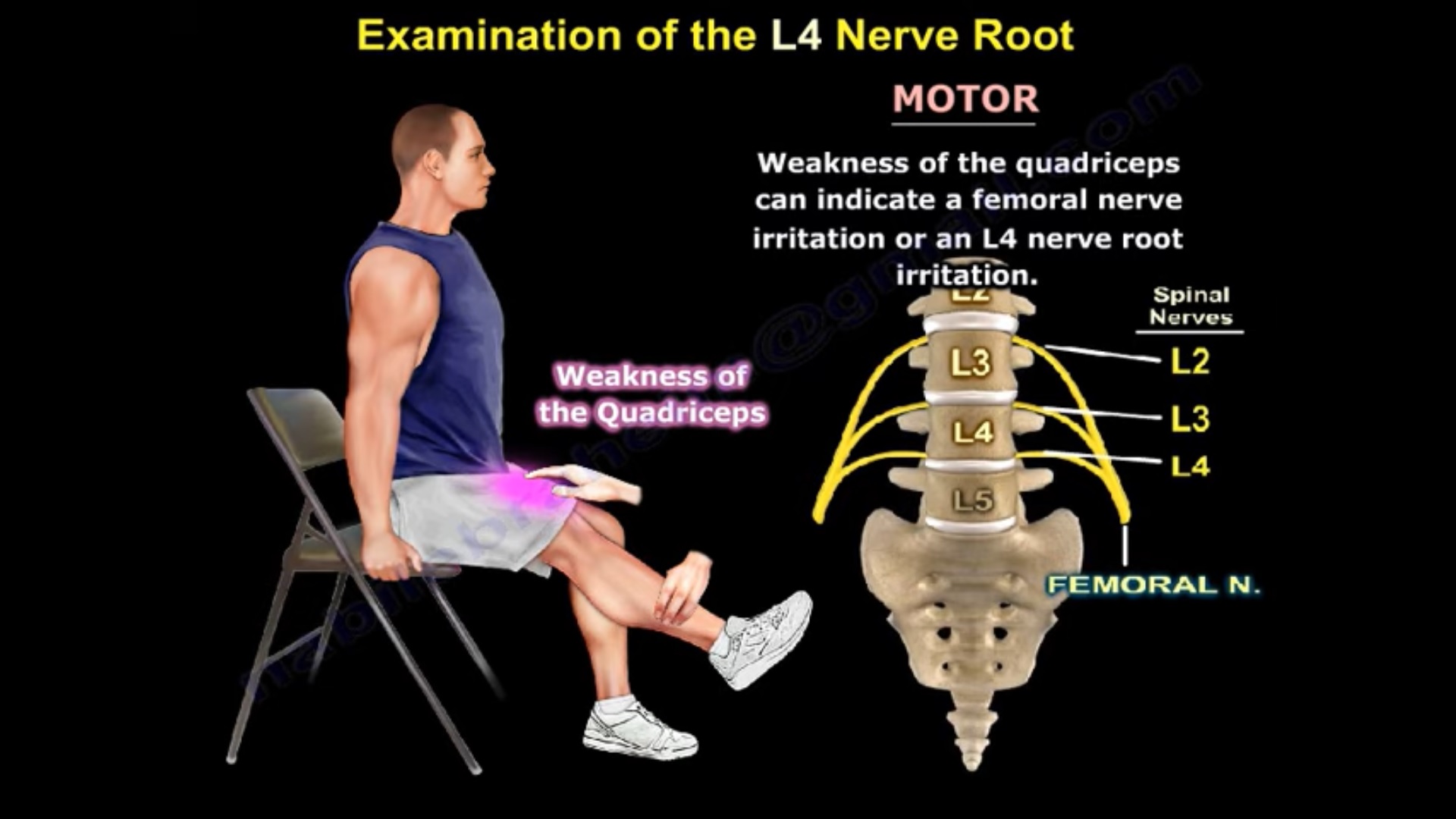
Quadriceps
The quadriceps receives innervation from:
L2, L3, L4 via the femoral nerve
emphasizes that L4 is an important/predominant contribution.
Therefore quadriceps weakness may suggest:
- L4 nerve-root involvement
- Femoral nerve involvement
Functional Clue
The patient may have:
Difficulty squatting due to quadriceps weakness
- L4 Motor Summary
| Muscle | Function | Root emphasis in transcript |
| Tibialis anterior | Ankle dorsiflexion, inversion | L4 |
| Quadriceps | Knee extension | L2–L4, especially L4 |
Practical Examination
L4 motor – test ankle dorsiflexion with tibialis anterior
- Foot Drop
If the patient has foot drop, notes that:
Tibialis anterior may not be functioning properly.
Because uses tibialis anterior as an L4 motor muscle, foot drop should prompt evaluation of this muscle and the relevant neurological level.
- L3–L4 Disc Herniation
distinguishes posterolateral and foraminal/far-lateral disc herniation.
Posterolateral L3–L4 Disc Herniation
This affects the:
Traversing L4 nerve root
So:
L3–L4 posterolateral disc – L4 root
notes that this level of posterolateral disc herniation is relatively uncommon.
Foraminal L3–L4 Disc Herniation
This affects the:
Exiting L3 nerve root
Therefore:
L3–L4 foraminal disc – L3 root
- Provocative Test
In upper lumbar nerve-root involvement around L3–L4, says the patient may have:
Positive femoral nerve stretch test
while the:
Straight leg raise may not be positive
Exam Pearl
L3/L4 region – femoral stretch more useful than SLR
- L4–L5 Disc Herniation
Posterolateral L4–L5 Disc
A posterolateral disc herniation at L4–L5 affects:
L5 nerve root
This may produce:
- Weakness of toe extension / great-toe extension
- Sensory change over dorsum of foot
Far-Lateral L4–L5 Disc
A far-lateral/foraminal L4–L5 disc affects the:
Exiting L4 nerve root
Therefore:
L4–L5 posterolateral – L5
L4–L5 far lateral – L4
- Disc–Root Relationship
| Disc level / location | Root affected |
| L3–L4 posterolateral | L4 traversing root |
| L3–L4 foraminal | L3 exiting root |
| L4–L5 posterolateral | L5 traversing root |
| L4–L5 far lateral | L4 exiting root |
This is one of the most important concepts in .
- Complete L4 Root Syndrome
According to the speaker, L4 nerve-root irritation may produce:
Sensory
- Decreased sensation over the medial side of the foot
Motor
- Weak ankle dorsiflexion
- Quadriceps weakness may occur
Reflex
- Reduced patellar reflex
Functional
- Difficulty squatting because of quadriceps weakness
High-Yield L4 Examination Table
| Component | L4 finding |
| Sensory | Medial side of foot |
| Motor | Tibialis anterior — ankle dorsiflexion |
| Additional motor | Quadriceps — knee extension |
| Reflex | Patellar tendon reflex |
| Functional problem | Difficulty squatting |
| Provocative test | Femoral nerve stretch may be positive |
| Posterolateral disc causing L4 | L3–L4 |
| Far-lateral disc causing L4 | L4–L5 |
Key Take-Home Points
- Any nerve-root examination includes sensory, motor and reflex testing.
- L4 sensation = medial foot in this transcript.
- L4 reflex = patellar tendon reflex.
- practically tests L4 using tibialis anterior and ankle dorsiflexion.
- Quadriceps is supplied by L2–L4, with L4 strongly represented in .
- Posterolateral L3–L4 disc – traversing L4 root.
- Far-lateral L4–L5 disc – exiting L4 root.
- Femoral stretch may be positive in L3/L4 root irritation.
- Quadriceps weakness may make squatting difficult.
Exam Pearls
L4 = medial foot + dorsiflexion + knee jerk
L3–L4 posterolateral disc – L4
L4–L5 far lateral disc – L4
Femoral stretch – think upper lumbar roots
Difficulty squatting – check quadriceps / L4

Leave a Reply