
Courtesy: Prof Nabil Ebraheim, University of Toledo, Ohio, USA
Overview
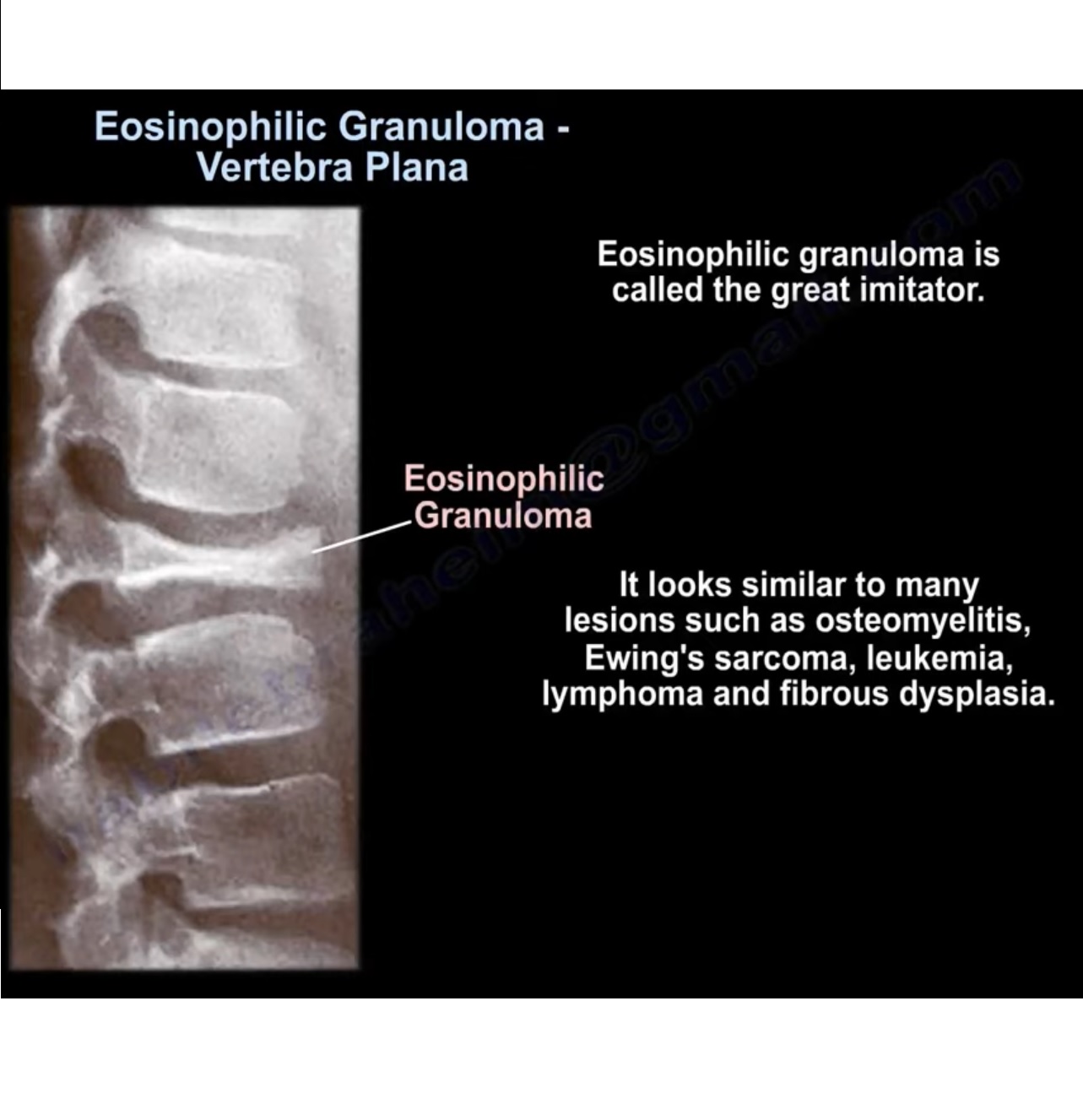
Vertebra plana refers to complete or near-complete collapse of a vertebral body, resulting in a flattened appearance.
- Classically associated with eosinophilic granuloma
- Represents a manifestation of Langerhans Cell Histiocytosis (LCH)
- Important because it can mimic multiple serious conditions
Definition
- Vertebra plana:
- Flattening of vertebral body
- Loss of both anterior and posterior height
Also Known As
- Pancake vertebra
- Flattened vertebra
Eosinophilic Granuloma (Underlying Cause)
Definition
- Tumor-like lesion due to proliferation of Langerhans cells (histiocytes)
- Part of the spectrum of Langerhans Cell Histiocytosis
Key Characteristic
- Benign but may appear aggressive on imaging
Distribution of Eosinophilic Granuloma
Common Sites
- Skull
- Spine
- Long bones
Other Possible Involvement
- Skin
- Visceral organs
Clinical Insight
- Known as the “great imitator” due to varied presentation
Differential Diagnosis
Eosinophilic granuloma may mimic:
- Osteomyelitis
- Ewing sarcoma
- Leukemia
- Lymphoma
- Fibrous dysplasia
Typical Features of Vertebra Plana
Spinal Involvement
- Most commonly affects:
- Thoracic spine
Pattern
- Usually involves a single vertebra
Important Radiological Features
- Vertebral body collapse
- Preserved intervertebral disc height
- Posterior elements intact
Age-Based Causes of Vertebral Collapse
In Children (2–10 years)
- Most common cause:
- Eosinophilic granuloma
In Elderly
- Most common cause:
- Osteoporosis
Clinical Presentation
Symptoms
- Back pain
- Neck pain
- Spinal deformity (kyphosis)
Neurological Features
- May occur if:
- Spinal cord compression develops
Multiple Vertebral Involvement
If more than one vertebra is involved, consider:
- Lymphoma
- Gaucher disease
- Mucopolysaccharidosis
- Metastatic disease
Radiological Features
Key Findings
- Focal bone destruction
- Vertebral body collapse
- Preserved disc spaces
- Minimal posterior element involvement
Important Point
- Appears aggressive
- But usually benign and self-limiting
Histology
Langerhans Cells
- Large histiocytes with:
- Abundant cytoplasm
- Coffee-bean shaped nuclei
- Nuclear grooves
Eosinophils
- Bilobed nuclei
- Eosinophilic cytoplasm
- Present in large numbers
Birbeck Granules
- Seen on electron microscopy
- Tennis racket-shaped structures
- Diagnostic of Langerhans cells
Differentiation from Other Conditions
Ewing Sarcoma
- Small round blue cells
Osteomyelitis
- Mixed inflammatory infiltrate
- Signs of infection
Natural History
- Typically:
- Benign
- Self-limiting
- Spontaneously resolving
Recovery
- Vertebral body may regain:
- Up to ~50% of original height over time
Management
1. Conservative Treatment (Most Cases)
Approach
- Observation
- Regular follow-up
Supportive Measures
- Spinal bracing:
- Prevent deformity
- Aid healing
2. Surgical Treatment
Indications (~10%)
- Severe spinal deformity
- Neurological deficit
3. Radiotherapy
Indications
- Neurological compression
- When surgery is not feasible
Dose
- Low-dose radiation (~500–900 cGy)
Key Takeaways
- Vertebra plana is most commonly caused by eosinophilic granuloma in children
- It is a benign, self-limiting condition despite aggressive imaging appearance
- Single vertebra involvement + preserved disc space is characteristic
- Always consider differentials in multiple vertebral collapse
- Most cases are treated conservatively with good outcomes


Leave a Reply