
Courtesy: Martin Herman, MD
Pediatric femoral shaft fractures
- Common pediatric fracture.
- Excellent healing potential.
- Union is usually achieved without difficulty.
- Main concerns are limb length and alignment rather than fracture healing.
Common complications
- Shortening (most common).
- Malunion.
- Delayed union (rare).
AAOS Based Treatment Guidelines
0 to 6 months
- Pavlik harness.
6 months to 5 years
- Immediate hip spica cast.
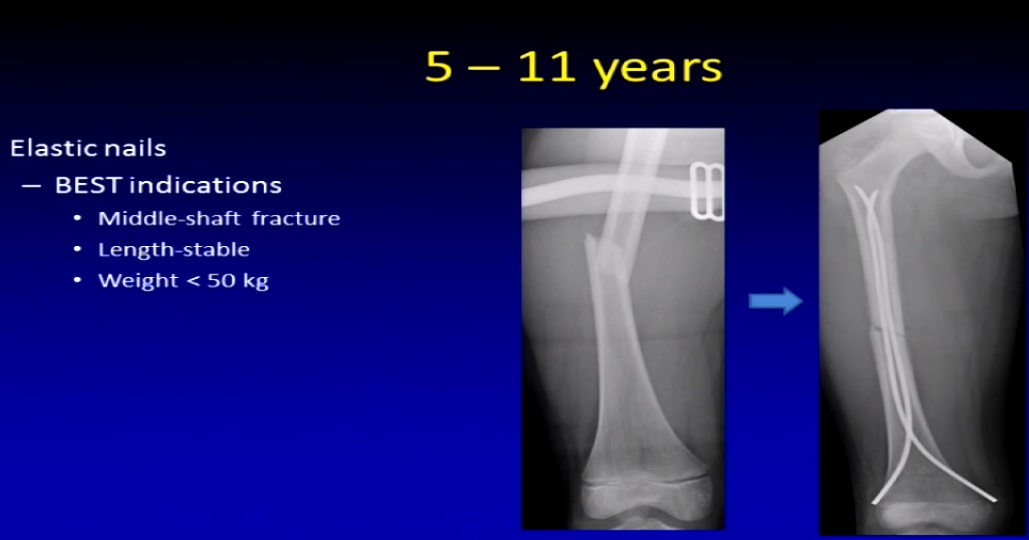
5 to 11 years
- Elastic intramedullary nails.
More than 11 years
- Elastic nails or rigid locked intramedullary nails depending on patient factors.
Important point
- Age is only a guideline.
- Treatment should be individualized.
Factors Affecting Treatment Choice
Factors to consider
- Age.
- Weight of the child.
- Femoral canal size.
- Fracture pattern.
- Length stability.
- Associated injuries.
- Polytrauma.
Most important concept
- Failure to recognize length unstable fractures is the commonest cause of treatment failure.
Pavlik Harness
Indications
- Infants younger than 6 months.
Advantages
- Functional immobilization.
- Easy nursing care.
- Better skin monitoring.
Disadvantages
- Less pain control initially.
- Difficult in suspected child abuse cases.
Hip Spica Cast
Indications
- Children aged 6 months to 5 years.
Principles
- Accept 1.5 to 2 cm of shortening due to expected overgrowth.
- Accept up to 20° of angulation in appropriate patients.
- Overgrowth commonly occurs between 2 and 10 years of age.
Common problem
- Hygiene difficulties.
Elastic Intramedullary Nails
Ideal indications
- Midshaft fractures.
- Length stable fractures.
- Weight less than 50 kg.
Advantages
- Minimally invasive.
- Reliable outcomes when properly indicated.
Contraindications
- Comminuted fractures.
- Long oblique fractures.
- Heavy children.
Complications
- Shortening.
- Nail prominence.
- Malunion.
Key concept
- Flexible nails should not be used for length unstable fractures.
Rigid Intramedullary Nails
Indications
- Older children and adolescents.
- Larger femoral canal.
- Length unstable fractures.
Preferred entry point
- Lateral trochanteric entry.
Avoid
- Piriformis entry due to risk of avascular necrosis of the femoral head.
Submuscular Plating
Indications
- Comminuted fractures.
- Length unstable fractures.
Advantages
- Functions as an internal external fixator.
- Preserves fracture biology.
External Fixation
Indications
- Polytrauma.
- Open fractures.
- Temporary stabilization.
- Severe soft tissue injury.
Length Stability
Length stable fractures
- Transverse fractures.
- Short oblique fractures.
- Suitable for elastic intramedullary nails.
Length unstable fractures
- Comminuted fractures.
- Long oblique fractures.
- Segmental fractures.
- Better treated with plating, rigid intramedullary nails, or external fixation.
Common Clinical Pitfalls
Treatment errors
- Using elastic nails for length unstable fractures.
- Ignoring patient weight.
- Using undersized nails.
- Poor nail configuration.
- Leaving distraction at the fracture site.
Compliance issues
- Hyperactive children.
- Children with autism.
- May require supplementary hip spica immobilization.
Special Situations
Tweener age group (10 to 16 years)
- Treatment based on weight and canal size rather than age.
- Rigid intramedullary nail is often preferred.
Pathological fractures
- Always consider a simple bone cyst or other underlying pathology.
Exam Pearls
Most common complication
- Shortening.
Overgrowth phenomenon
- Approximately 1.5 to 2 cm.
- Common between 2 and 10 years of age.
Best indication for elastic nails
- Midshaft, length stable fracture in a child weighing less than 50 kg.
Contraindications to elastic nails
- Comminuted fractures.
- Long oblique fractures.
- Segmental fractures.
- Heavy children.
Piriformis entry nail complication
- Avascular necrosis of the femoral head.
Submuscular plating
- Functions as an internal external fixator.
Key Take Home Message
Management principles
- Pediatric femoral shaft fractures usually heal well.
- Success depends on choosing treatment according to fracture stability rather than age alone.
- Always assess length stability, patient size, and fracture pattern before selecting fixation.

Leave a Reply