• Skip to main content
  • Skip to secondary menu
  • Skip to primary sidebar
OrthopaedicPrinciples.com

OrthopaedicPrinciples.com

Integrating Principles and Evidence

Integrating Principles and Evidence

  • Home
  • Editorial Board
  • Our Books
    • Evidence Based Orthopaedic Principles
  • Courses
  • Exams
  • Reviews
  • Live Program
  • Contact

Congenital Talipes Equinovarus/Clubfoot


32 club footJ
Courtesy : Dr Amr Abdelgawad, Associate Professor, University of Texas, USA
www.facebook.com/pediatricorthopedic
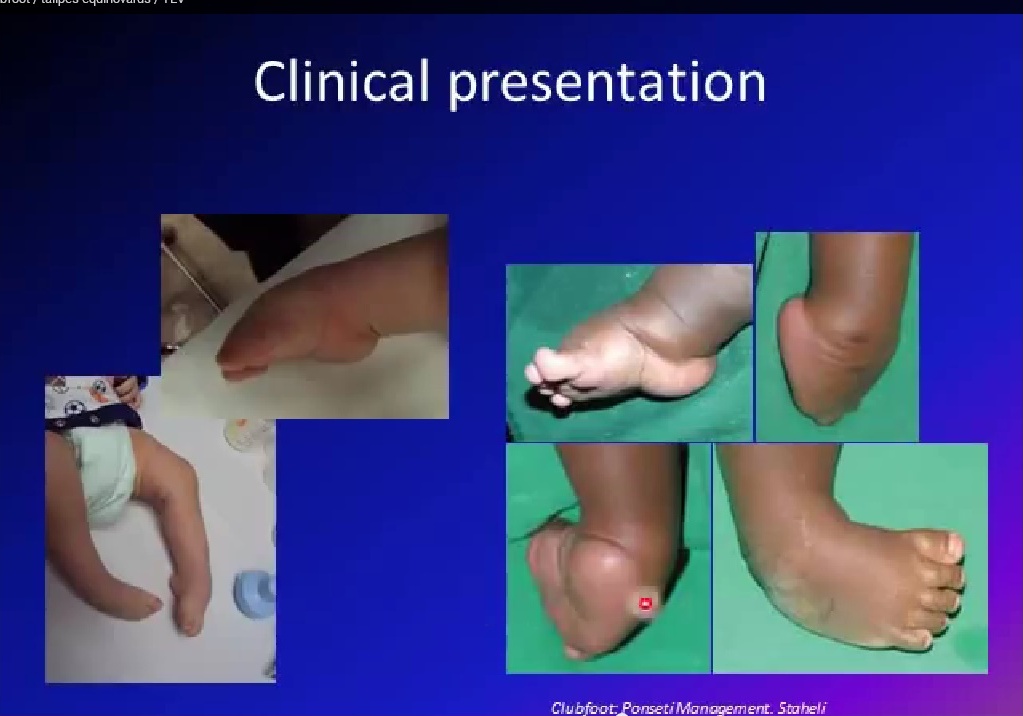
This video explains that club foot is a congenital deformity that may run in families. Many aetiologies have been proposed. It is a rigid deformity of the foot. Etiology is unknown. Mainly 4 types of club foot are known:1.idiopathic, which is the most common, 2.postural, which is easily corrected, 3.syndromic, and 4.associated with neuromuscular conditions like cerebral palsy. The deformities in clubfoot are cavus, adduction, varus and equinus. Clinically, there will be deep skin creases, small foot. No radiographs are needed to make a diagnosis of clubfoot. Ponseti s method of correction is preferred. Some may need achilles tenotomy and other open surgical corrections.

Post Views: 10,128

Related Posts

  • Congenital Talipes Equinovarus

    Courtesy: Sameer Qureshi, Consultant Orthopaedic Surgeon, The Young Orthopod Channel

  • Congenital Talipes Equinovarus

    Courtesy: Sameer Qureshi, Consultant Orthopaedic Surgeon, The Young Orthopod Channel

  • Congenital Femoral Deficiency

    COurtesy: William Mackenzie, Jefferson Medical College, USA OVERVIEW Congenital femoral deficiency is a spectrum of…

Reader Interactions

Comments

  1. Ihab Shreif says

    at

    Thanks for this valuble vedio … it simplyfies the subject and clarifies confusing points in club foot

  2. dr shewale rajendra prof n hod ortho says

    at

    Good clinical pic of Ctev

Leave a Reply

Your email address will not be published. Required fields are marked *

Primary Sidebar

Follow Us

instagram slideshare

Categories

  • -Applied Anatomy
  • -Approaches
  • -Basic Sciences
  • -Cartilage & Meniscus
  • -Classifications
  • -Examination
  • -Foot and Ankle
  • -Foot and Ankle Trauma
  • -FRCS(Tr and Orth) tutorials
  • -Gait
  • -Hand and Wrist
  • -Hand and Wrist Trauma
  • -Hand Infections
  • -Hip and Knee
  • -Hip Preservation
  • -Infections
  • -Joint Reconstruction
  • -Knee Arthroplasty
  • -Knee Preservation
  • -Metabolic Disorders
  • -Oncology
  • -OrthoBiologics
  • -OrthoPlastic
  • -Paediatric Orthopaedics
  • -Paediatric Trauma
  • -Patellofemoral Joint
  • -Pelvis
  • -Peripheral Nerves
  • -Principles
  • -Principles of Surgery
  • -Radiology
  • -Rheumatology
  • -Shoulder and Elbow
  • -Shoulder and Elbow Arthroplasty
  • -Spine Deformity
  • -Spine Oncology
  • -Spine Trauma
  • -Spine, Pelvis & Neurology
  • -Sports Ankle and Foot
  • -Sports Elbow
  • -Sports Knee
  • -Sports Medicine
  • -Sports Medicine Hip
  • -Sports Shoulder
  • -Sports Wrist
  • -Statistics
  • -Technical Tip
  • -Technology in Orth
  • -Trauma
  • -Trauma (Upper Limb)
  • -Trauma Life Support
  • -Trauma Reconstruction
  • Book Shelf
  • Book Shelf Medical
  • Careers
  • Case Studies and Free Papers
  • DNB Ortho
  • Evidence Based Orthopaedic Principles
  • Evidence Based Orthopaedics
  • Exam Corner
  • Fellowships
  • Guest Editor
  • Guest Reviews
  • Image Quiz
  • Instructional Course Lectures
  • Journal Club
  • MCQs
  • Meetings and Courses
  • Multimedia
  • News and Blog
  • Plaster Techniques
  • Podcasts
  • Public Health
  • Rehabilitation
  • Research
  • Shorts and Reels
Copyright@orthopaedicprinciples.com. All right rerserved.