
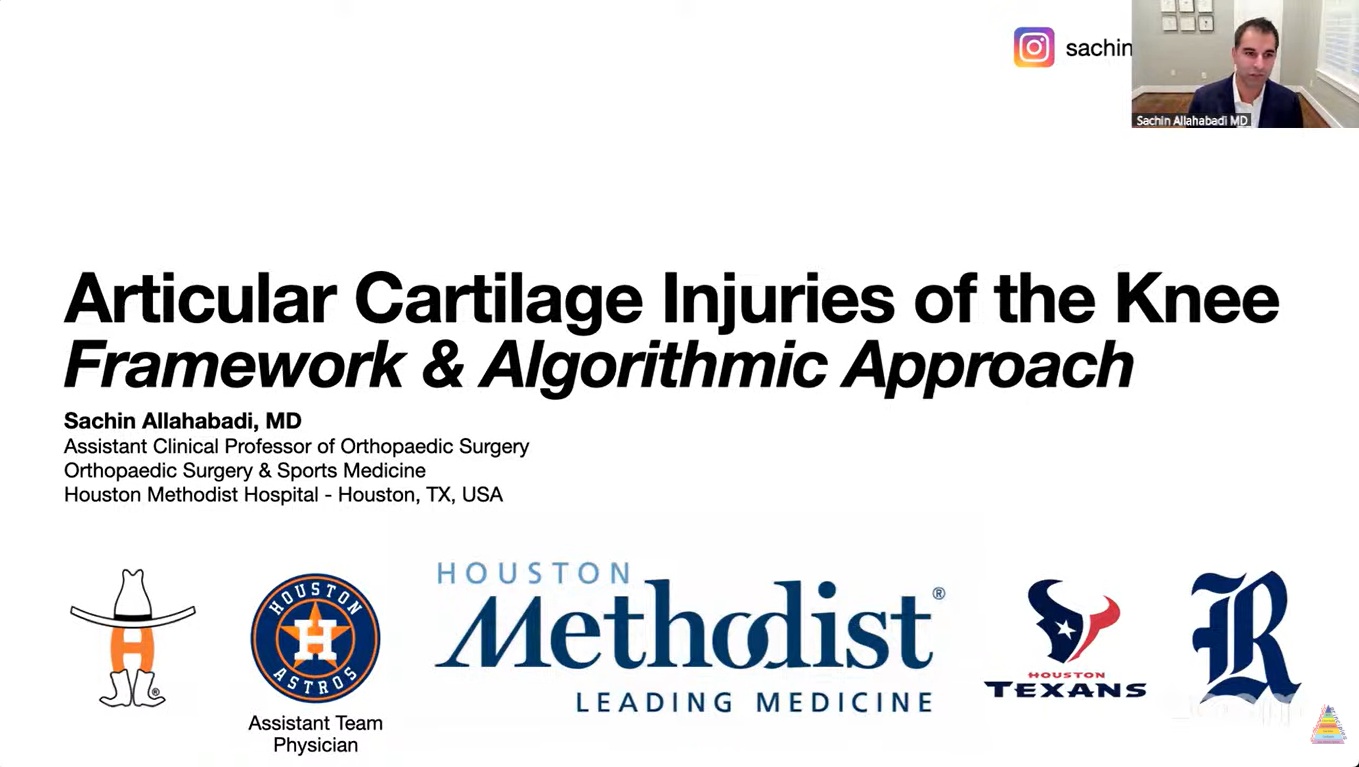
Courtesy: Sachin Allahabadi MD, Houston, TX
Why Do Cartilage Defects Matter?
1. Poor Healing Potential
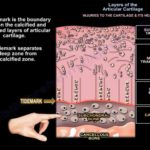
Articular cartilage has:
-
Limited blood supply
-
Low chondrocyte density
-
Dense extracellular matrix
-
Limited cell migration capacity
Additionally:
-
The knee undergoes repetitive multidirectional load
-
Healing is mechanically and biologically challenging
2. High Prevalence
-
Articular cartilage defects are found in ~60% of knee arthroscopies
-
More common in athletes
-
~48% of professional basketball players show cartilage defects on MRI
Notably:
-
MRI findings do not always correlate with symptoms
-
Imaging abnormalities alone should not drive treatment decisions
Natural History
-
Some defects enlarge over time
-
Many remain asymptomatic
-
79% of untreated defects return to sports
-
Cartilage defects found during ACL reconstruction often do not affect long-term outcomes
Key Principle:
Treat the symptomatic defect — not the MRI.
Skillful Neglect
A key concept emphasized:
-
Not all cartilage defects require intervention
-
Appropriate patient counseling is critical
-
Understand patient goals
-
Manage symptoms rather than imaging findings
Core Principles in Cartilage Management
-
Least invasive effective treatment first
-
Consider recovery timelines
-
Identify the cause of the defect
-
Address:
-
Alignment
-
Meniscus status
-
Ligament stability
-
-
Preserve the osteochondral unit
Clinical Workup
Imaging
-
Weight-bearing radiographs (mandatory)
-
Flexion weight-bearing views
-
Long-leg alignment films
-
MRI (standard)
-
CT scan when indicated
Patient Factors to Consider
-
Age and skeletal maturity
-
Activity level and goals
-
Symptom severity
-
Mechanical symptoms
-
Lesion size (absolute and relative)
-
Subchondral bone involvement
-
Lesion location
-
Containment
Non-Surgical Management
Appropriate when:
-
Symptoms are mild
-
MRI findings are incidental
-
Acute flare-ups
Options include:
-
Observation (“regression to the mean”)
-
Physical therapy
-
Unloader bracing
-
Weight reduction
-
Injections
Surgical Options – Simplified Algorithm
1. Chondroplasty & Debridement
Dr. Alhabadi’s first-line surgical treatment.
Benefits:
-
Quick procedure
-
Low cost
-
Fast recovery
-
Does not burn bridges
-
~50% may improve with debridement alone
Return to play in NFL athletes: ~67%.
2. Marrow Stimulation (Microfracture / Drilling)
-
Produces fibrocartilage
-
Outcomes deteriorate over time
-
Poor performance in patella
-
May complicate future ACI
Drilling preferred over traditional awl technique.
Microfracture-plus options:
-
Micronized extracellular matrix (e.g., BioCartilage)
-
AMIC (Autologous Matrix-Induced Chondrogenesis)
3. Single-Stage Off-the-Shelf Options
a) Cryopreserved Cartilage
b) Minced Autologous Cartilage
c) Juvenile Cartilage (e.g., DeNovo)
d) Aragonite-Based Scaffolds (e.g., CartiHeal)
Aragonite scaffold shows promising results in:
-
Larger defects
-
Subchondral bone restoration
-
RCT showed improved fill vs microfracture
Long-term durability remains under evaluation.
4. Osteochondral Autograft Transfer (OATS)
Best for:
-
Small (<1–2 cm²) symptomatic lesions
-
High-demand athletes
Advantages:
-
Hyaline cartilage
-
Best return-to-sport rates
-
Cost-effective
Limitations:
-
Donor-site morbidity
-
Difficult for large defects
5. Autologous Chondrocyte Implantation (ACI / MACI)
-
Two-stage procedure
-
Cell-based therapy
-
Particularly useful in patellofemoral joint
-
Does not address subchondral bone
Limitations:
-
Cost
-
Logistics
-
Requires cartilage harvest
-
Less effective after failed microfracture
6. Osteochondral Allograft (OCA)
Dr. Alhabadi’s primary choice for:
-
Large defects
-
Deep lesions
-
Bone involvement
-
Bipolar lesions
-
Revision cartilage surgery
Advantages:
-
Restores osteochondral unit
-
No donor-site morbidity
-
Good long-term survivorship (~82% at 10 years after prior surgery)
-
87.5% return to sport in professional athletes (isolated OCA)
Technical Pearls for OCA
-
Submerge graft during reaming to reduce thermal necrosis
-
Minimize subchondral bone depth (4–6 mm)
-
Pulse lavage graft
-
Use pressurized CO? to reduce immunogenic elements
-
Soak graft in bone marrow aspirate concentrate
-
Minimize impaction forces
Address the “Other” Factors
1. Ligament Stability
-
Chronic instability increases cartilage damage
-
Reconstruction improves outcomes
2. Meniscus Preservation
-
Essential for load distribution
-
Meniscus transplant yields outcomes comparable to isolated OCA
3. Alignment & Osteotomy
-
Osteotomy improves graft survival
-
Consider >5° correction in tibiofemoral compartment
-
Tibial tubercle osteotomy for patellofemoral lesions
-
Osteotomy alone may improve symptoms in selected cases
Key Takeaways
-
Decision-making is harder than the procedure itself
-
Not every defect requires surgery
-
Chondroplasty remains a powerful tool
-
Microfracture role is decreasing
-
ACI is valuable but limited by bone involvement
-
OCA is highly effective for large/deep lesions
-
Alignment, meniscus, and stability must be addressed
-
Patient expectations must be carefully managed
Final Message
Cartilage surgery requires:
-
Thoughtful patient selection
-
Honest counseling
-
Biological and mechanical optimization
-
Willingness to learn from failures
Ultimately:
“Do the least you need to do for a successful outcome.”
Leave a Reply