
Courtesy: Prof Nabil Ebraheim, University of Toledo, Ohio, USA
Quadriceps Tendon Rupture
Introduction
Quadriceps tendon rupture is a serious injury involving disruption of the knee extensor mechanism.
The injury most commonly occurs in:
- Middle-aged and older adults
and may occasionally present as:
- Bilateral quadriceps tendon rupture
which is rare but clinically important.
Early diagnosis and surgical repair are essential to restore knee extension and prevent long-term disability.
Relevant Anatomy
Quadriceps Muscle Group
The quadriceps muscle group consists of:
- Rectus femoris
- Vastus lateralis
- Vastus medialis
- Vastus intermedius
These muscles function primarily to:
- Extend the knee joint
Extensor Mechanism
The quadriceps tendon inserts into:
- The superior pole of the patella
Distally, the extensor mechanism continues as the:
- Patellar tendon
which inserts onto the:
- Tibial tuberosity
Common Site of Rupture
Quadriceps tendon rupture most commonly occurs:
- Approximately 1–2 cm proximal to the superior pole of the patella
This area is relatively:
- Hypovascular
making it more susceptible to degeneration and rupture.
Epidemiology
Quadriceps Tendon Rupture
Quadriceps tendon rupture is more common in:
- Patients older than 40 years
- Males
Patellar Tendon Rupture
In contrast, patellar tendon rupture is more common in:
- Younger individuals
- Athletes
Important Clinical Distinction
Quadriceps tendon rupture predominates in:
- Older adults
whereas patellar tendon rupture is more common in:
- Younger active patients
Comparison: Quadriceps vs Patellar Tendon Rupture
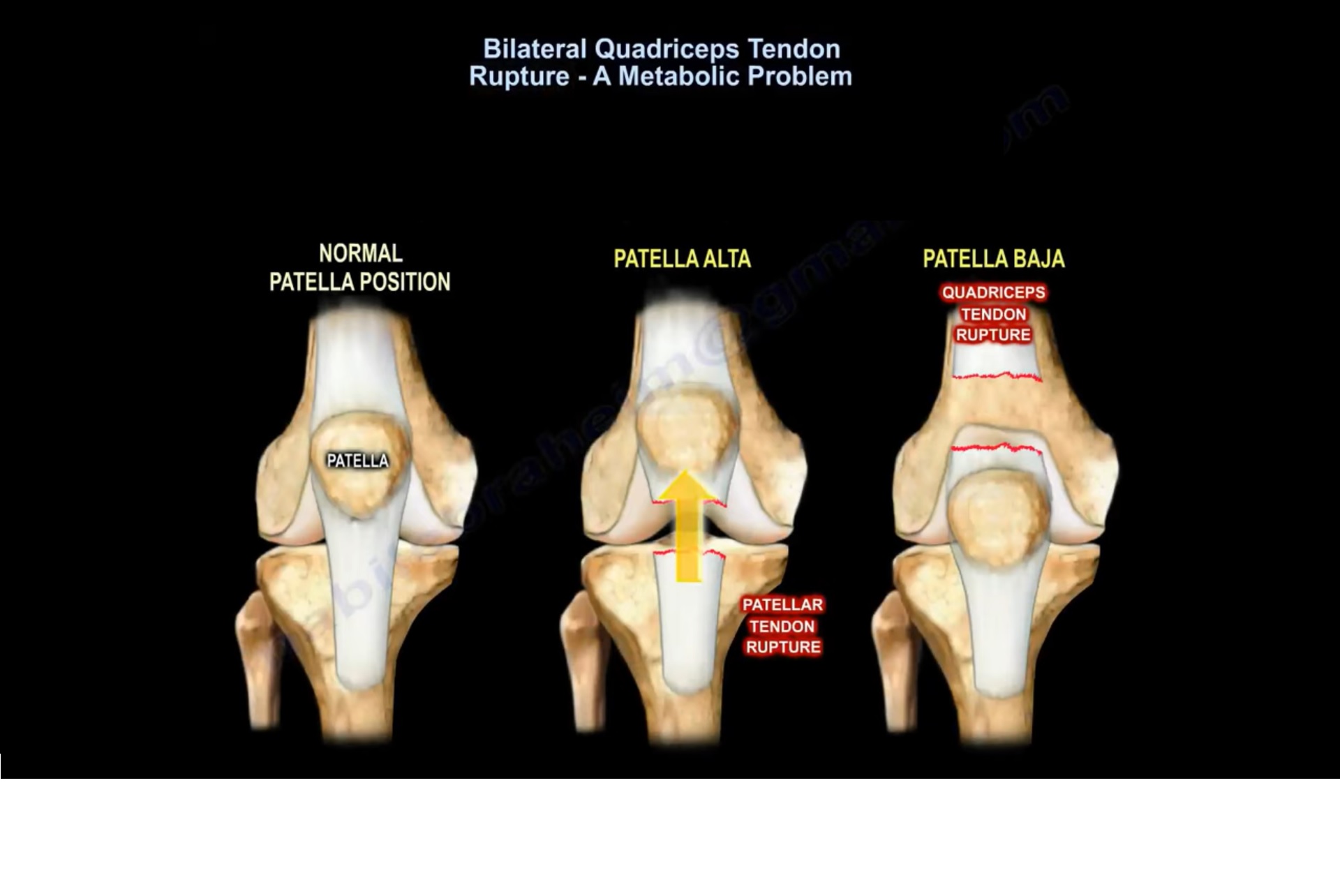
Quadriceps Tendon Rupture
Findings include:
- Patella baja (inferiorly displaced patella)
because the intact patellar tendon pulls the patella distally.
Patellar Tendon Rupture
Findings include:
- Patella alta (superiorly displaced patella)
because the intact quadriceps mechanism pulls the patella proximally.
Bilateral Quadriceps Tendon Rupture
Clinical Importance
Bilateral rupture is:
- Rare
- Frequently missed
- Often diagnosed late
because patients may still retain some limited mobility.
Associated Systemic Disorders
Bilateral ruptures are commonly associated with:
- Chronic kidney disease
- Dialysis
- Diabetes mellitus
- Rheumatoid arthritis
- Gout
- Hyperparathyroidism
- Long-term steroid use
- Fluoroquinolone use
These conditions weaken tendon structure and predispose to rupture.
Pathophysiology
Quadriceps tendon rupture disrupts continuity between:
- The quadriceps muscle
- The patella
This produces:
- Failure of the knee extensor mechanism
leading to inability to actively extend the knee.
Clinical Presentation
Pain and Swelling
Patients commonly present with:
- Acute anterior knee pain
- Swelling around the knee
Loss of Active Extension
The key diagnostic feature is:
- Inability to actively extend the knee
Patients may still be able to:
- Flex the knee
Palpable Defect
A palpable:
- Suprapatellar gap or defect
may be present at the rupture site.
Functional Difficulty
Patients often experience:
- Difficulty walking
- Inability to bear weight normally
Imaging
Plain Radiographs
X-rays may demonstrate:
- Patella baja
- Soft tissue swelling
- Loss of normal quadriceps tendon shadow
Chronic cases may also show:
- Calcification within the tendon
MRI
MRI is considered the:
- Gold standard imaging modality
It helps identify:
- Tendon discontinuity
- Degree of tendon retraction
- Partial tears
- Associated soft tissue injury
Diagnosis
Diagnosis is primarily:
- Clinical
MRI is especially useful when:
- The diagnosis is uncertain
- Partial tears are suspected
- Bilateral injuries are present
Management
Surgical Treatment
Early surgical repair is considered the:
- Standard of care
Prompt repair improves functional outcomes.
Surgical Techniques
Common repair methods include:
- Transosseous sutures through the patella
- Suture anchor fixation
Both techniques aim to restore:
- Continuity of the extensor mechanism
Postoperative Care
Postoperative management usually includes:
- Knee immobilization in extension for 4–6 weeks
- Gradual rehabilitation
- Progressive range-of-motion exercises
Prognosis
With early diagnosis and appropriate repair:
- Functional outcomes are generally good
- Restoration of knee extension is expected in most patients
Delayed diagnosis may result in:
- Persistent weakness
- Functional disability
- Difficult reconstruction
Differential Diagnosis
Conditions that may mimic quadriceps tendon rupture include:
- Patellar Tendon Rupture
- Patellar fracture
- Knee contusion
- Partial extensor mechanism injury
Important Clinical Pearls
- Inability to actively extend the knee is the key clinical finding.
- Quadriceps tendon rupture is more common in older adults.
- Patellar tendon rupture is more common in younger athletes.
- Bilateral ruptures are often associated with systemic disease.
- Patella baja suggests quadriceps tendon rupture.
- MRI is helpful in partial tears and difficult cases.
- Early surgical repair provides the best outcomes.
Final Take-Home Message
Quadriceps tendon rupture is a potentially disabling injury involving disruption of the knee extensor mechanism.
The condition commonly presents with:
- Pain
- Swelling
- Loss of active knee extension
Bilateral ruptures should raise suspicion for underlying systemic or metabolic disease.
Early recognition and prompt surgical repair are essential for restoring knee function and preventing long-term disability.
Related Posts
 Bilateral Quadriceps Tendon Rupture
Courtesy: Prof Nabil Ebraheim, University of Toledo, Ohio, USA
 Quadriceps Tendon Rupture
Courtesy: Prof Nabil Ebraheim, University of Toledo, Ohio, USA Quadriceps Tendon Rupture 1. Basic…
 Achilles Tendon Rupture
Courtesy: Prof Nabil Ebraheim, Univsrsity of Toledo, Ohio, USA
Leave a Reply