
Courtesy: Prof Nabil Ebraheim, University of Toledo, Ohio, USA
Baker’s Cyst (Popliteal Cyst)
Definition
-
Baker’s cyst, also called a popliteal cyst, is a benign swelling located behind the knee.
-
It may vary in size, from small to large.
-
It is a fluid-filled cyst, not a solid tumor.
-
The cyst should transilluminate.
Anatomy and Pathophysiology
-
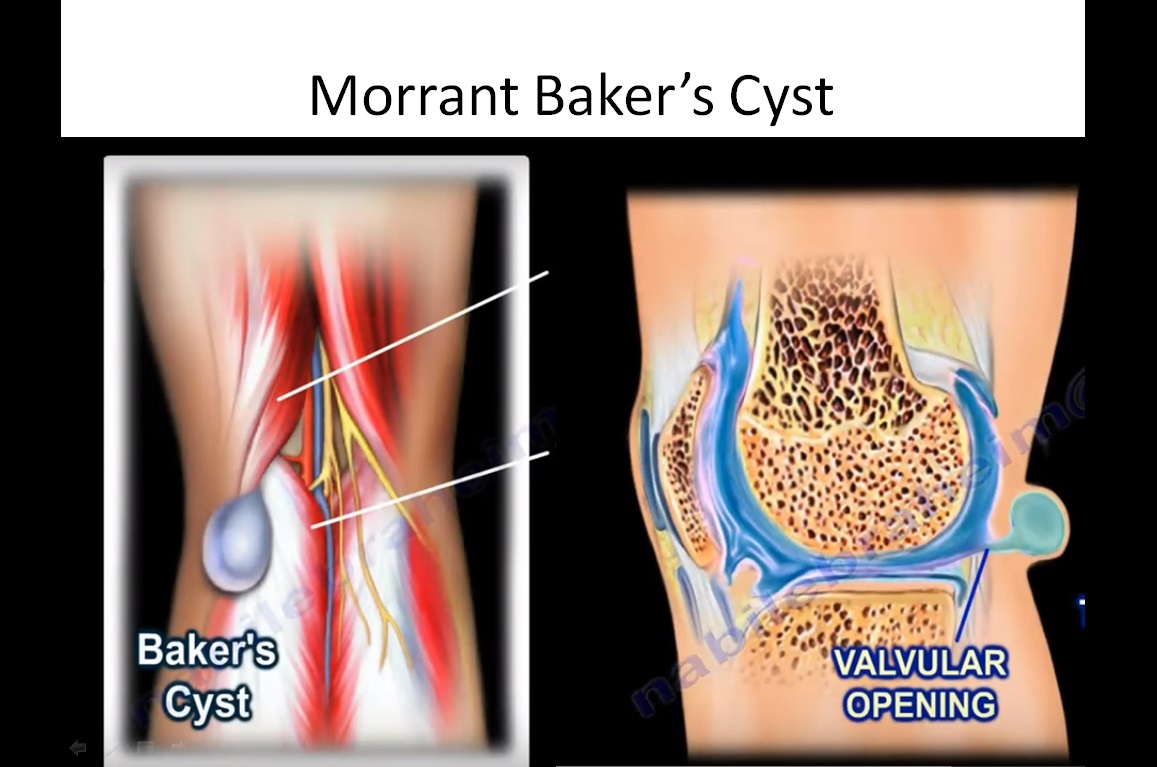
The cyst lies posterior to the medial femoral condyle.
-
It is connected to the knee joint through a valvular opening.
-
The cyst is located between:
-
Semimembranosus muscle
-
Medial head of the gastrocnemius muscle
-
-
It is usually located at or below the joint line.
Mechanism of Formation
-
Knee effusion (excess intra-articular fluid) allows fluid to pass:
-
From the knee joint
-
Through the valve
-
Into the cyst
-
-
The fluid movement is unidirectional, usually toward the back of the knee.
-
Tears of the posterior horn of the meniscus extending to the capsule may create a defect or one-way valve between:
-
The knee joint
-
The bursa between gastrocnemius and semimembranosus
-
Causes
The two most common causes are:
-
Knee arthritis
-
Meniscal tear (especially medial meniscus)
Clinical Presentation
-
Swelling behind the knee
-
Pain
-
Fullness
-
Tenderness
-
Baker’s cyst is more visible with the knee fully extended.
-
Swelling behind the knee may alert the clinician to underlying intra-articular pathology.
Diagnosis
Clinical Findings
-
Posterior knee swelling
-
Associated knee effusion
Imaging
-
MRI
-
Confirms diagnosis
-
Identifies associated intra-articular pathology
-
-
Ultrasound
-
Helpful diagnostic tool
-
Cyst located medial to the blood vessels
-
Especially useful if cyst is in an atypical location
-
Differential Diagnosis
-
If located in an atypical position, consider tumor.
-
Ruptured cyst may cause:
-
Calf pain
-
Swelling
-
Rule out:
-
Deep vein thrombosis
-
Thrombophlebitis
-
-
Treatment in Adults
Conservative Treatment
-
Ice
-
Compression wrap
-
Anti-inflammatory medication
-
Strengthening exercises
Aspiration
-
Can be performed:
-
Blindly
-
Under ultrasound guidance
-
-
Fluid may be obtained during aspiration.
Surgical Treatment
-
Excision of the cyst
-
Recurrence is common if intra-articular pathology persists.
-
Best treatment:
-
Arthroscopy
-
Debridement of intra-articular pathology
-
-
Primary focus of treatment should be:
-
Meniscal tear
-
Arthritis
-
Complications
-
Cyst rupture
-
Causes calf pain and swelling
-
Must rule out deep vein thrombosis or thrombophlebitis
-
-
Recurrence is common after removal if underlying pathology continues.
Popliteal Cyst in Children
Characteristics
-
Common soft tissue mass behind the knee
-
Occurs more frequently in boys
-
Usually asymptomatic
-
Transilluminates
-
Not a tumor
Pathology
-
May not be intra-articular
-
May not be connected to the knee joint
-
Usually not associated with a meniscal tear
Management
-
Surgery is rarely indicated.
-
Usually managed with observation.
-
Spontaneous resolution may occur within 10–20 months.
-
In difficult cases:
-
Aspiration may be performed.
-
May respond to aspiration and steroid injection because it is not connected to the knee joint.
-
Leave a Reply