
Courtesy: Michael Sussmanand www.global-help.org
Physical Examination in Ambulatory Cerebral Palsy Patients with Gait Abnormalities
Overview
- Before gait analysis, clinicians must perform:
- Detailed history
- Focused lower limb examination
- Specific clinical tests
Purpose
- Identify:
- Structural deformities
- Muscle tone abnormalities
- Functional limitations
Initial Observation
First Step
- Observe the patient walking
Assess
- Strength
- Stamina
- Balance
- Major deformities
Key Observations
- Symmetry of gait
- Arm positioning (used for balance)
- Presence of deformities
Clinical Insight
- Arms held out — may indicate:
- Balance impairment
- Compensation for deformity
Classification of Severity in Cerebral Palsy
Gross Motor Function Classification System (GMFCS)
Purpose
- Classifies severity of motor impairment
Levels
| Level | Description |
|---|---|
| I | Walks without limitation |
| II | Walks with some limitation |
| III | Walks with assistive devices |
| IV | Limited mobility (may use powered mobility) |
| V | Dependent for mobility |
Important Note
- GMFCS is not an outcome measure
Outcome Assessment
Gross Motor Function Measure (GMFM)
- Used to:
- Quantify improvement
- Track progress over time
Detailed Physical Examination
Structured Assessment Includes
- Joint range of motion
- Muscle strength
- Spasticity
- Special clinical tests
Documentation
- Use structured examination charts
- Enables:
- Follow-up comparison
- Outcome evaluation
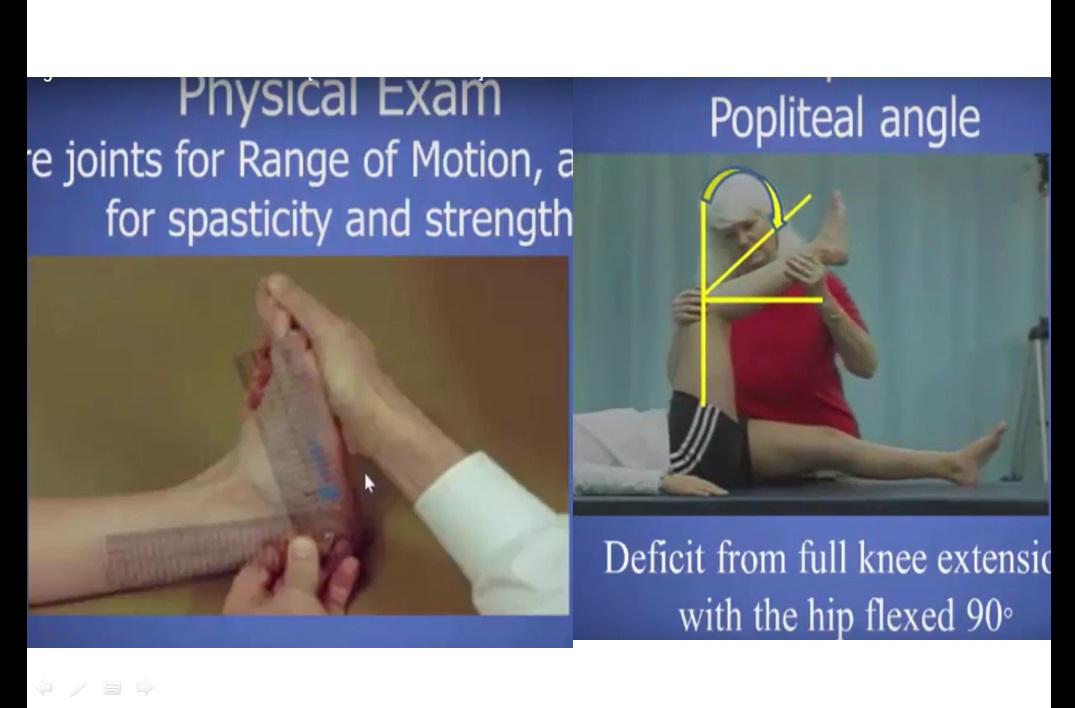
Range of Motion Assessment
- Use goniometer for accuracy
- Avoid visual estimation
Muscle Tone Abnormalities
1. Spasticity
Definition
- Velocity-dependent increase in tone
Features
- Increased resistance with rapid stretch
- “Catch” during movement
2. Contracture
- Permanent restriction of movement
- Not velocity-dependent
Causes
- Muscle shortening
- Joint capsule tightening
3. Rigidity
- Constant resistance throughout movement
- Not dependent on speed
Quantification of Spasticity
Modified Ashworth Scale
| Score | Description |
|---|---|
| 0 | Normal |
| 1 | Slight increase |
| 2 | Moderate increase |
| 3 | Considerable increase |
| 4 | Severe rigidity |
Special Clinical Tests
1. Popliteal Angle Test
Purpose
- Assess hamstring tightness
Method
- Hip flexed to 90°
- Knee extended
- Measure angle
Interpretation
- Larger angle — hamstring tightness
2. Tardieu Test
Purpose
- Differentiate:
- Spasticity
- Contracture
Principle
- Compare:
- Fast stretch
- Slow stretch
Interpretation
- Large difference — spasticity
3. Duncan–Ely Test
Purpose
- Detect rectus femoris spasticity
Method
- Patient prone
- Rapid knee flexion
Positive Test
- Pelvic elevation
Clinical Significance
- Suggests stiff-knee gait
4. Silfverskiöld Test
Purpose
- Differentiate:
- Gastrocnemius vs soleus tightness
Method
- Measure ankle dorsiflexion:
- Knee flexed
- Knee extended
Interpretation
| Finding | Cause |
|---|---|
| Improved dorsiflexion with knee flexion | Gastrocnemius tightness |
| No change | Soleus/Achilles contracture |
Video Recording in Gait Assessment
Recommended Views
- Sagittal (side)
- Coronal (front/back)
Advantages
- Slow-motion analysis
- Frame-by-frame review
- Long-term comparison
Limitation
- Cannot assess rotational deformities well
Walking Speed Assessment
10-Meter Walk Test
Method
- Measure time over 10 meters
- Patient walks beyond start and end lines
Importance
- Reflects functional ability
- Important for:
- Daily activity
- Peer comparison
Key Points
- Start with:
- History + physical examination
- GMFCS:
- Classifies severity
- Differentiate:
- Spasticity vs contracture vs rigidity
- Essential tests:
- Popliteal angle
- Tardieu
- Duncan-Ely
- Silfverskiöld
- Use:
- Video analysis
- Walking speed
Leave a Reply