• Skip to main content
  • Skip to secondary menu
  • Skip to primary sidebar
OrthopaedicPrinciples.com

OrthopaedicPrinciples.com

Integrating Principles and Evidence

Integrating Principles and Evidence

  • Home
  • Editorial Board
  • Our Books
    • Evidence Based Orthopaedic Principles
  • Courses
  • Exams
  • Reviews
  • Live Program
  • Contact

Ankle Fractures In Children

Courtesy: Prof Nabil Ebraheim, University of Toledo, Ohio, USA

Growth Arrest Risk

  • Incidence after distal tibial physeal injury:
    • Up to 50%

Higher Risk In

  • Displaced fractures
  • Intra-articular injuries
  • Medial malleolar injuries

Salter-Harris classification (Ankle)


Type I & II

Treatment

  • Closed reduction + casting

Key Point

  • Surgery does not reduce the risk of growth arrest

Type III & IV

Key Feature

  • Intra-articular fractures – require anatomical reduction

Treatment

  • ORIF / CRIF

Fixation Principles

  • Epiphyseal screws:
    • Parallel to the physis
  • Metaphyseal screw:
    • Used if a large metaphyseal fragment is present (Type IV)

Important Precautions

  • Avoid crossing:
    • Joint surface
    • Growth plate

Highest Risk of Growth Arrest

  • Medial malleolus – Type IV injury

Outcome

  • Varus deformity of the ankle

Special Radiological Sign

Anterior Widening of Distal Tibial Physis

  • Cause:
    • Periosteal interposition

Clinical Significance

  • Prevents proper reduction
  • May require surgical intervention

Important Fracture Types


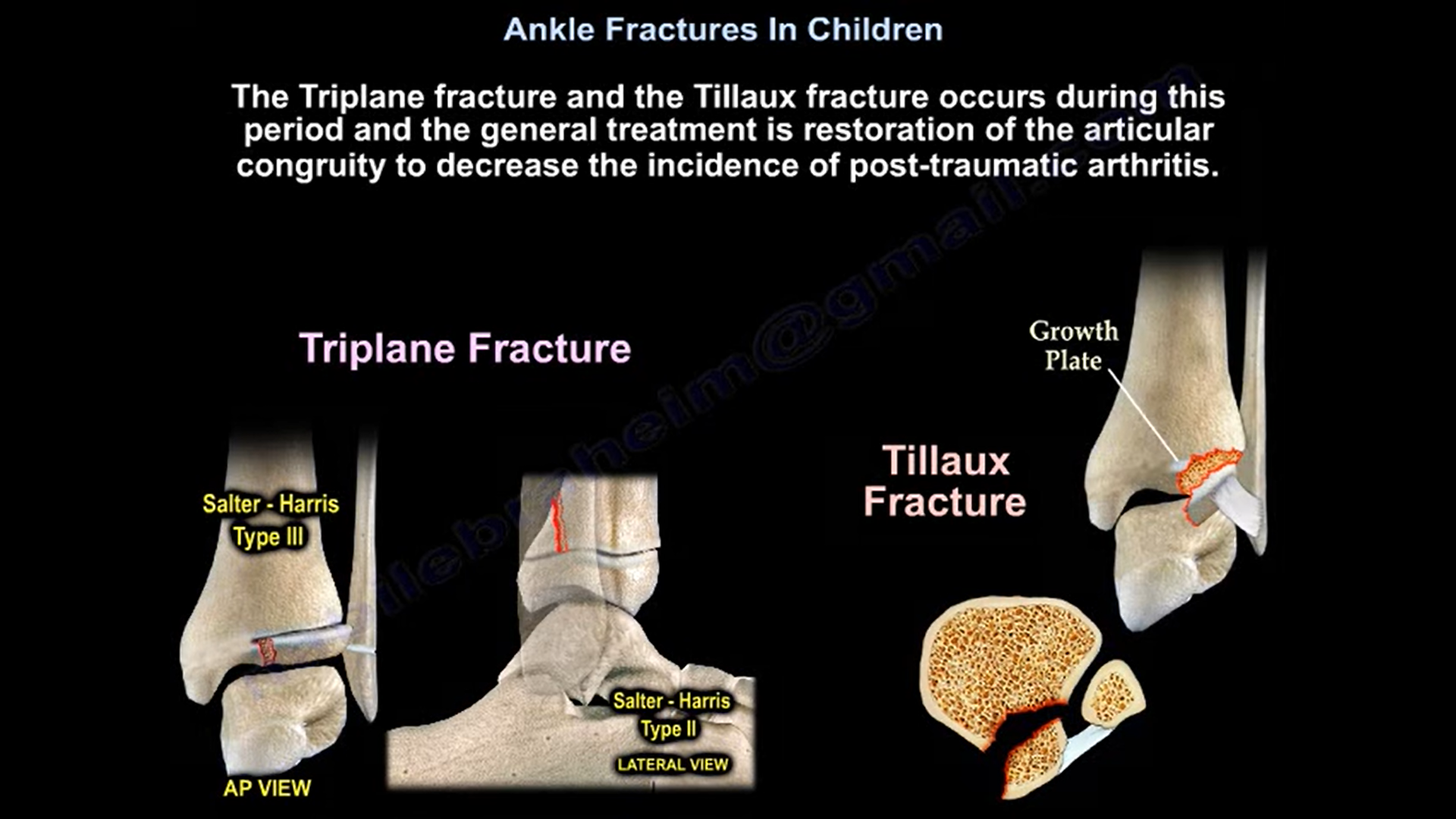
Tillaux fracture

Cause

  • Avulsion by:
    • Anterior inferior tibiofibular ligament (AITFL)

Mechanism

  • External rotation injury

Pathophysiology

  • Lateral physis remains open
  • Other portions of the physis are already closed

Treatment

  • < 2 mm displacement ? Casting
  •  2 mm displacement ? Reduction + fixation

Triplane fracture

Definition

  • Fracture occurring in three planes:
    • Coronal
    • Sagittal
    • Axial

Radiographic Appearance

  • AP view  resembles Type III
  • Lateral view  resembles Type II (posterior metaphyseal fragment)

Mechanism

  • Supination–external rotation / inversion

Physeal Closure Pattern (Key Concept)

  • Distal tibial physis closes sequentially:
  1. Central
  2. Posterior
  3. Medial
  4. Lateral (last)

Clinical Relevance

Explains:

  • Tillaux fracture
  • Triplane fracture

Core Treatment Principle

  • Restore articular congruity

Prevents

  • Post-traumatic arthritis
  • Growth disturbance

Exam Pearls

  • Type I & II  Conservative management
  • Type III & IV  Operative management (due to joint involvement)
  • Tillaux fracture:
    • AITFL avulsion
  • Triplane fracture:
    • Three-plane injury
  • Highest growth arrest risk:
    • Medial malleolar Type IV injury
  • Anterior physeal widening:
    • Indicates periosteal interposition

Final Takeaway

  • Management of pediatric ankle fractures depends on:
    • Physeal involvement
    • Articular congruity
    • Stability
  • Missing reduction in intra-articular fractures leads to:
    • Deformity
    • Long-term joint degeneration

Post Views: 1,550

Related Posts

  • Ankle fractures in Children

    Courtesy: Kaye Wilkins, Lynn Staheli , www.global-help.org  Pediatric Ankle Fractures (Distal Tibia & Fibula) Key…

  • Difficult Ankle Fractures

    Courtesy: Saqib Rehman MD, Director of Orthopaedic Trauma, Temple University, Philadelphia, Pennsylvania, USA

  • Osteoclasts for the FRCSOrth

    Courtesy: Quen Tang, FRCSOrth, UK

Reader Interactions

Leave a Reply

Your email address will not be published. Required fields are marked *

Primary Sidebar

Follow Us

instagram slideshare

Categories

  • -Applied Anatomy
  • -Approaches
  • -Basic Sciences
  • -Cartilage & Meniscus
  • -Classifications
  • -Examination
  • -Foot and Ankle
  • -Foot and Ankle Trauma
  • -FRCS(Tr and Orth) tutorials
  • -Gait
  • -Hand and Wrist
  • -Hand and Wrist Trauma
  • -Hand Infections
  • -Hip and Knee
  • -Hip Preservation
  • -Infections
  • -Joint Reconstruction
  • -Knee Arthroplasty
  • -Knee Preservation
  • -Metabolic Disorders
  • -Oncology
  • -OrthoBiologics
  • -OrthoPlastic
  • -Paediatric Orthopaedics
  • -Paediatric Trauma
  • -Patellofemoral Joint
  • -Pelvis
  • -Peripheral Nerves
  • -Principles
  • -Principles of Surgery
  • -Radiology
  • -Rheumatology
  • -Shoulder and Elbow
  • -Shoulder and Elbow Arthroplasty
  • -Spine Deformity
  • -Spine Oncology
  • -Spine Trauma
  • -Spine, Pelvis & Neurology
  • -Sports Ankle and Foot
  • -Sports Elbow
  • -Sports Knee
  • -Sports Medicine
  • -Sports Medicine Hip
  • -Sports Shoulder
  • -Sports Wrist
  • -Statistics
  • -Technical Tip
  • -Technology in Orth
  • -Trauma
  • -Trauma (Upper Limb)
  • -Trauma Life Support
  • -Trauma Reconstruction
  • Book Shelf
  • Book Shelf Medical
  • Careers
  • Case Studies and Free Papers
  • DNB Ortho
  • Evidence Based Orthopaedic Principles
  • Evidence Based Orthopaedics
  • Exam Corner
  • Fellowships
  • Guest Editor
  • Guest Reviews
  • Image Quiz
  • Instructional Course Lectures
  • Journal Club
  • MCQs
  • Meetings and Courses
  • Multimedia
  • News and Blog
  • Plaster Techniques
  • Podcasts
  • Public Health
  • Rehabilitation
  • Research
  • Shorts and Reels
Copyright@orthopaedicprinciples.com. All right rerserved.