• Skip to main content
  • Skip to secondary menu
  • Skip to primary sidebar
OrthopaedicPrinciples.com

OrthopaedicPrinciples.com

Integrating Principles and Evidence

Integrating Principles and Evidence

  • Home
  • Editorial Board
  • Our Books
    • Evidence Based Orthopaedic Principles
  • Courses
  • Exams
  • Reviews
  • Live Program
  • Contact

Anatomy of the Deltoid Muscle

Courtesy: Prof Nabil Ebraheim, University of Toledo, Ohio, USA

Deltoid muscle

Anatomy
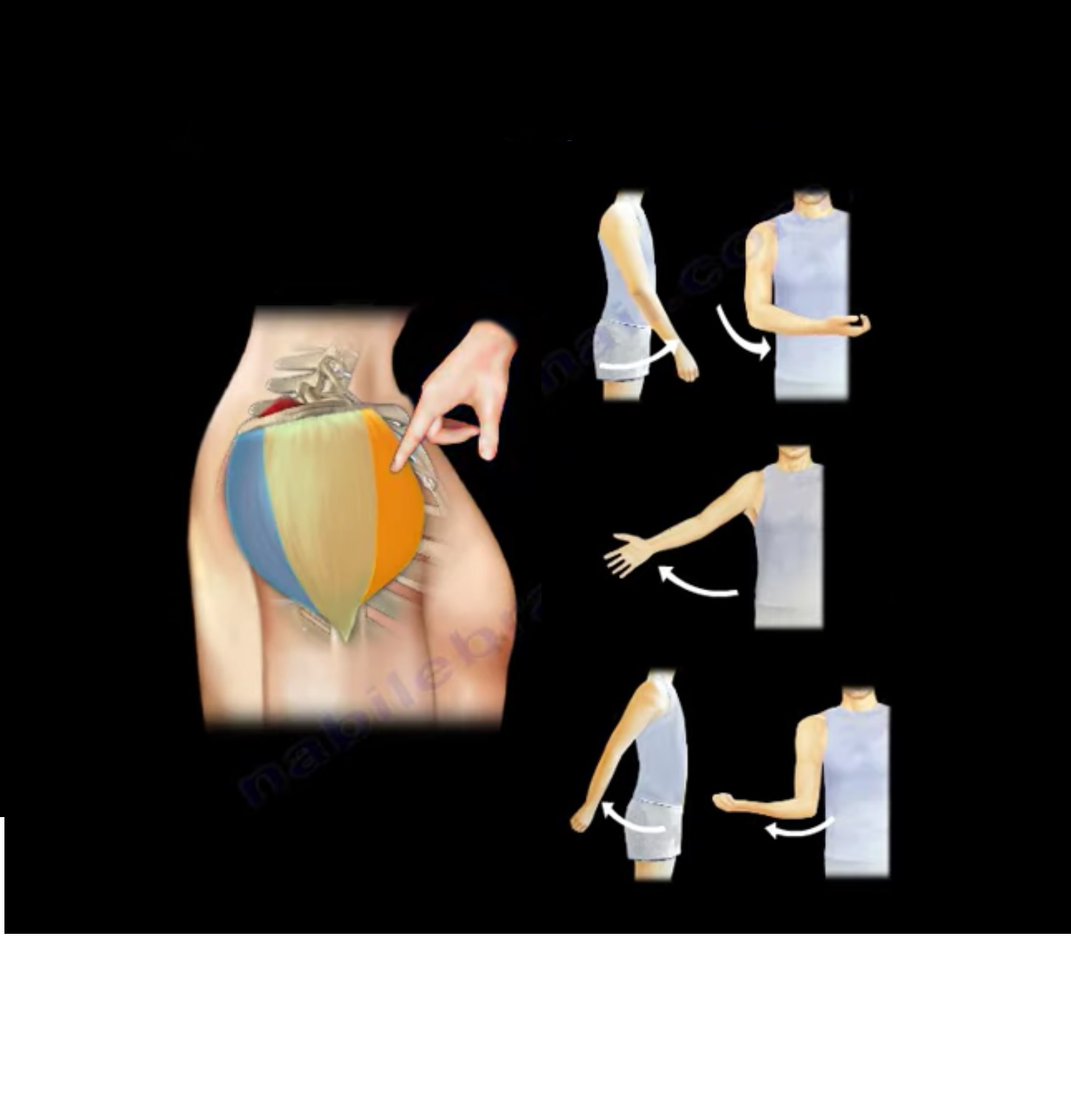
3 parts(on the basis of its three origins)
1. Anterior part(lateral 1/3 rd of clavicle)
2. Lateral/acromial part(acromion of scapula)
3. Posterior part/spinal part(spine of scapula)

Function of various parts

• Anterior-flexes and medially rotates the arm
• Lateral-abduction of arm upto horizontal level
• Posterior-extends and laterally rotates the arm

Insertion• Deltoid tuberosity in humerus(fibres join together to form a short tendon)

Facts
• Anterior to posteriorly bulk of the deltoid muscle encircles the shoulder joint
• Shoulder and deltoid muscle gets its round appearance due to deltoid passing over upper part of humerus.

Nerve supply
• Axillary nerve(motor supply to deltoid, sensory supply to shoulder area)

Axillary nerve
• Origin: a terminal branch of posterior cord of brachial plexus

• Course: runs transversely from posterior to anterior about 7 cm distal to acromion

• Injury of axillary nerve:

Cause of injury: during fracture or dislocation of shoulder joint
clinical findings

  • Weakness of abduction
  • Atrophy of deltoid muscle
  • Flattening of shoulder
  • Loss of sensation over shoulder area

Arterial supply:
• Anteriorly: thoracoacromial artery(branch of axillary artery)
• Posteriorly: posterior circumflex humeral artery

Quadrangular space:
• Bound by humerus, long head of triceps, teres major, teres minor
• Contents: posterior circumflex humeral artery and axillary artery

Rupture of deltoid muscle
Causes of damage of deltoid:
• Sports or heavy manual labour
• Surgery that require release of deltoid muscle from its origin
• Surgery of os acromiale
• Total acromionectomy

  •  Arthroscopic procedures are better than open shoulder procedure
  • Rupture should be repaired or reconstructed

Applied anatomy

1. Danger of lateral approach
• Axillary nerve runs transversely from 7 cm distal to acromion
• Incision should not be more than 5 cm distal to the acromion to protect axillary nerve damage
• In fixation of proximal humerus where incision needed to be made distally, additional anterolateral incision over humeral shaft should be made to avoid axillary nerve injury

2.deltoid intramuscular injection
• Injection site:3-5 cm distal to acromion, in middle of lateral part of deltoid
• Should not exceed 5 cm distal to acromion (danger zone of axillary nerve injury)
• High injection avoided as it may enter capsule/shoulder joint
• Low injection avoided as it causes neurovascular injuries
Post Views: 3,403

Related Posts

  • Anatomy of Plantaris Muscle

    Courtesy: Prof Nabil Ebraheim, University of Toledo, Ohio, USA Anatomy Plantaris muscle arises from the…

  • Popliteus Muscle

    Courtesy : Prof Nabile Ebraheim, University of Toledo, Ohio, USA Popliteus Muscle A triangular muscle…

  • Deltoid: Anatomy and Injury

    Courtesy: Prof Nabil Ebraheim, University of Toledo, Ohio, USA Anatomy Of Deltoid Muscle The Deltoid…

Reader Interactions

Leave a Reply

Your email address will not be published. Required fields are marked *

Primary Sidebar

Follow Us

instagram slideshare

Categories

  • -Applied Anatomy
  • -Approaches
  • -Basic Sciences
  • -Cartilage & Meniscus
  • -Classifications
  • -Examination
  • -Foot and Ankle
  • -Foot and Ankle Trauma
  • -FRCS(Tr and Orth) tutorials
  • -Gait
  • -Hand and Wrist
  • -Hand and Wrist Trauma
  • -Hand Infections
  • -Hip and Knee
  • -Hip Preservation
  • -Infections
  • -Joint Reconstruction
  • -Knee Arthroplasty
  • -Knee Preservation
  • -Metabolic Disorders
  • -Oncology
  • -OrthoBiologics
  • -OrthoPlastic
  • -Paediatric Orthopaedics
  • -Paediatric Trauma
  • -Patellofemoral Joint
  • -Pelvis
  • -Peripheral Nerves
  • -Principles
  • -Principles of Surgery
  • -Radiology
  • -Rheumatology
  • -Shoulder and Elbow
  • -Shoulder and Elbow Arthroplasty
  • -Spine Deformity
  • -Spine Oncology
  • -Spine Trauma
  • -Spine, Pelvis & Neurology
  • -Sports Ankle and Foot
  • -Sports Elbow
  • -Sports Knee
  • -Sports Medicine
  • -Sports Medicine Hip
  • -Sports Shoulder
  • -Sports Wrist
  • -Statistics
  • -Technical Tip
  • -Technology in Orth
  • -Trauma
  • -Trauma (Upper Limb)
  • -Trauma Life Support
  • -Trauma Reconstruction
  • Book Shelf
  • Book Shelf Medical
  • Careers
  • Case Studies and Free Papers
  • DNB Ortho
  • Evidence Based Orthopaedic Principles
  • Evidence Based Orthopaedics
  • Exam Corner
  • Fellowships
  • Guest Editor
  • Guest Reviews
  • Image Quiz
  • Instructional Course Lectures
  • Journal Club
  • MCQs
  • Meetings and Courses
  • Multimedia
  • News and Blog
  • Plaster Techniques
  • Podcasts
  • Public Health
  • Rehabilitation
  • Research
  • Shorts and Reels
Copyright@orthopaedicprinciples.com. All right rerserved.