
Courtesy: Prof Nabil Ebraheim, University of Toledo, Ohio, USA
Anatomy
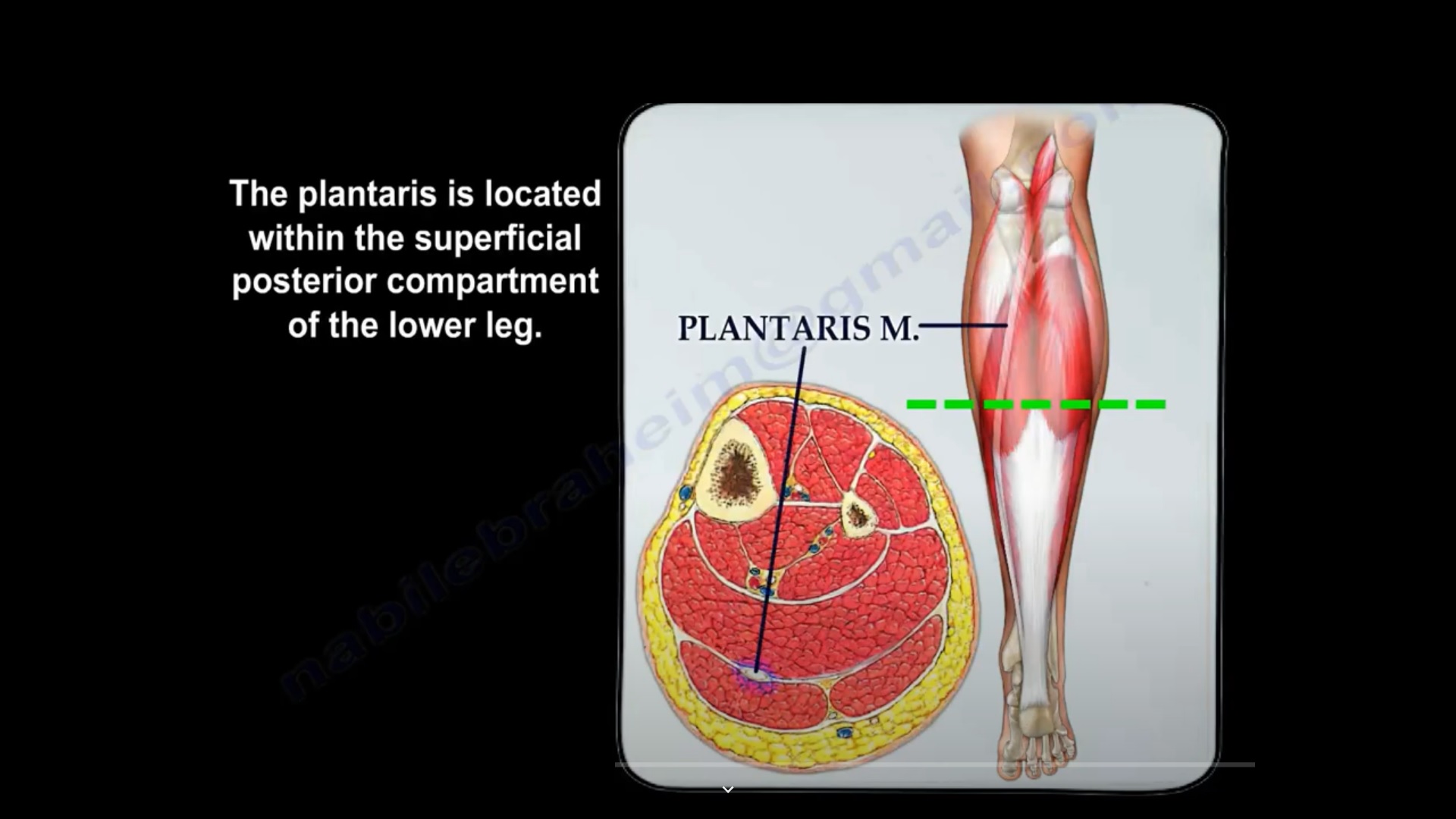
- Plantaris muscle arises from the lateral supracondylar ridge of the femur.
- Origin is located above the lateral head of the gastrocnemius muscle.
- The tendon passes between the gastrocnemius and soleus muscles.
- It inserts on the medial side of the calcaneus.
- It lies in the superficial posterior compartment of the leg.
Function
- Assists in plantarflexion of the ankle.
- Assists in flexion of the knee.
- Contains a high density of proprioceptive receptors providing position feedback to the CNS.
Innervation
- Innervated by the tibial nerve.
Clinical Importance
- Often used as a tendon graft in reconstructive procedures.
- Commonly used to augment Achilles tendon repair.
Association with Achilles Tendon Rupture
- Plantaris tendon may rupture together with the Achilles tendon.
- If plantaris remains intact with Achilles rupture, the Thompson test may appear falsely negative.
- Plantarflexion may still occur due to the intact plantaris tendon.
Plantaris Tendon Rupture (Tennis Leg)
- Patients feel sudden sharp pain in the posterior calf.
- Often described as feeling like being struck from behind.
- Associated with swelling and bruising of the calf.
- Commonly called ‘Tennis leg’.
Mechanism of Injury
- Injury usually occurs due to eccentric loading of the ankle with the knee extended.
Management
- Conservative treatment.
- Crutches for ambulation if needed.
- Pain control.


Leave a Reply