• Skip to main content
  • Skip to secondary menu
  • Skip to primary sidebar
OrthopaedicPrinciples.com

OrthopaedicPrinciples.com

Integrating Principles and Evidence

Integrating Principles and Evidence

  • Home
  • Editorial Board
  • Our Books
    • Evidence Based Orthopaedic Principles
  • Courses
  • Exams
  • Reviews
  • Live Program
  • Contact

Anatomy of Supraspinatus

Courtesy: Prof Nabile Ebraheim, University of Toledo, Ohio, USA

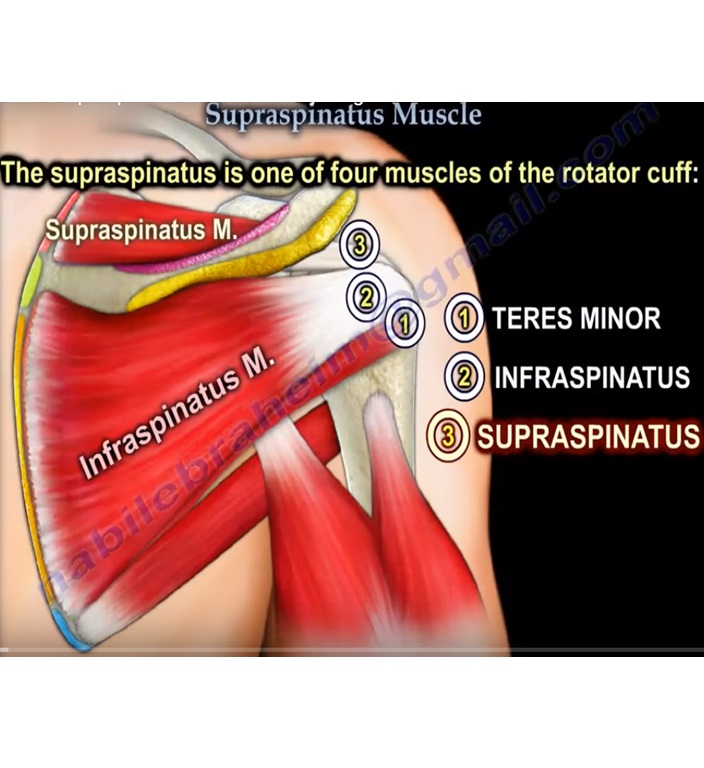
SUPRASPINATUS is a small muscle that originates from the superior aspect of the scapula and runs from supraspinatus fossa to the greater tuberosity of the humerus.
THE SUPRASPINATUS TENDON inserts into the superior facet of greater tubercle of humerus.
THE SUPRASPINATUS IS ONE OF THE four muscles of the rotator cuff:
1. TERES MINOR
2. INFRASPINATUS
3. SUPRASPINATUS
4. SUBSCAPULARIS
FUNCTION: Supraspinatus assists the deltoid muscle in abduction of the arm. Supraspinatus demonstrates peak activity in late cocking phase of throwing mechanics

INNERVATION:SUPRASCAPULAR NERVE (c5, C6)

  • The suprascapular nerve passes under the transverse scapular ligament at the suprascapular notch.
  • The transverse scapular artery runs above the transverse scapular ligament.
  • The suprascapular nerve gives branches to the supraspinatus muscle and branches to the infraspinatus muscle.
  • Nerve compression at the suprascapular notch affects both the supraspinatus and infraspinatus muscles causing decrease in abduction and loss of external rotation.
  • Nerve compression at the spinoglenoid notch affects only the infraspinatus muscle causing loss of external rotation.

Dimensions of the supraspinatus tendon:
•Tendon averages 25 mm wide
•Medial to lateral footprint of 12 mm at mid-tendon.

Examination tests:
•Neer impingement test
•Hawkin’s test
•Jobe test

Pathological entities involving the supraspinatus muscle
1. Subacromial impingement
•Most common cause of shoulder pain (first stage of rotator cuff disease)
•Pain with overhead activity and pain at night
•A continuation of the disease that includes tendonitis and tears,
2. Rotator cuff tears
3.Rotator cuff arthropathy
•Massive chronic cuff tear with arthritis
•Collapse of the humeral head
•Pseudoparalysis with escape of the humeral head anteriorly and superiorly.
4.Suprascapular neuropathy
•Ganglion or entrapment of the nerve at the suprascapular notch, it involves both the supraspinatus and infraspinatus muscles.
5.PASTA (Partial articular-sided Supraspinatus tendon Avulsion)
6.Failure of the supraspinatus following total shoulder arthroplasty or hemiarthroplasty
Results in superior escape of the humerus.
Treatment: Repair of the tendon or revision of the prosthesis into reverse total shoulder arthroplasty.
7.Calcific tendonitis
•Calcification of the tendon
•Usually, occurs in the tendons of the shoulder (rotator cuff tendons of the shoulder (rotator cuff tendons causing pain and inflammation).
Post Views: 9,435

Related Posts

  • Sciatica Anatomy

    Courtesy: Prof Nabil Ebraheim University of Toledo, Ohio, USA Anatomy of sciatica The sciatic nerve…

  • Acetabular fractures: Applied Anatomy

    Courtesy: Saqib Rehman MD Director of Orthopaedic Trauma Temple University Philadelphia Pennsylvania USA

  • Anatomy of the Triceps

    Courtesy: Prof Nabil Ebraheim, University of Toledo, Ohio, USA

Reader Interactions

Comments

  1. Dr. Rajkumar Indrasen Suryawanshi says

    at

    Nice information regarding orthopaedics..!

Leave a Reply

Your email address will not be published. Required fields are marked *

Primary Sidebar

Follow Us

instagram slideshare

Categories

  • -Applied Anatomy
  • -Approaches
  • -Basic Sciences
  • -Cartilage & Meniscus
  • -Classifications
  • -Examination
  • -Foot and Ankle
  • -Foot and Ankle Trauma
  • -FRCS(Tr and Orth) tutorials
  • -Gait
  • -Hand and Wrist
  • -Hand and Wrist Trauma
  • -Hand Infections
  • -Hip and Knee
  • -Hip Preservation
  • -Infections
  • -Joint Reconstruction
  • -Knee Arthroplasty
  • -Knee Preservation
  • -Metabolic Disorders
  • -Oncology
  • -OrthoBiologics
  • -OrthoPlastic
  • -Paediatric Orthopaedics
  • -Paediatric Trauma
  • -Patellofemoral Joint
  • -Pelvis
  • -Peripheral Nerves
  • -Principles
  • -Principles of Surgery
  • -Radiology
  • -Rheumatology
  • -Shoulder and Elbow
  • -Shoulder and Elbow Arthroplasty
  • -Spine Deformity
  • -Spine Oncology
  • -Spine Trauma
  • -Spine, Pelvis & Neurology
  • -Sports Ankle and Foot
  • -Sports Elbow
  • -Sports Knee
  • -Sports Medicine
  • -Sports Medicine Hip
  • -Sports Shoulder
  • -Sports Wrist
  • -Statistics
  • -Technical Tip
  • -Technology in Orth
  • -Trauma
  • -Trauma (Upper Limb)
  • -Trauma Life Support
  • -Trauma Reconstruction
  • Book Shelf
  • Book Shelf Medical
  • Careers
  • Case Studies and Free Papers
  • DNB Ortho
  • Evidence Based Orthopaedic Principles
  • Evidence Based Orthopaedics
  • Exam Corner
  • Fellowships
  • Guest Editor
  • Guest Reviews
  • Image Quiz
  • Instructional Course Lectures
  • Journal Club
  • MCQs
  • Meetings and Courses
  • Multimedia
  • News and Blog
  • Plaster Techniques
  • Podcasts
  • Public Health
  • Rehabilitation
  • Research
  • Shorts and Reels
Copyright@orthopaedicprinciples.com. All right rerserved.