• Skip to main content
  • Skip to secondary menu
  • Skip to primary sidebar
OrthopaedicPrinciples.com

OrthopaedicPrinciples.com

Integrating Principles and Evidence

Integrating Principles and Evidence

  • Home
  • Editorial Board
  • Our Books
    • Evidence Based Orthopaedic Principles
  • Courses
  • Exams
  • Reviews
  • Live Program
  • Contact

Achilles Tendon Pathology


Courtesy: Prof Nabil Ebraheim, University of Toledo, Ohio, USA

1. Location and Structure

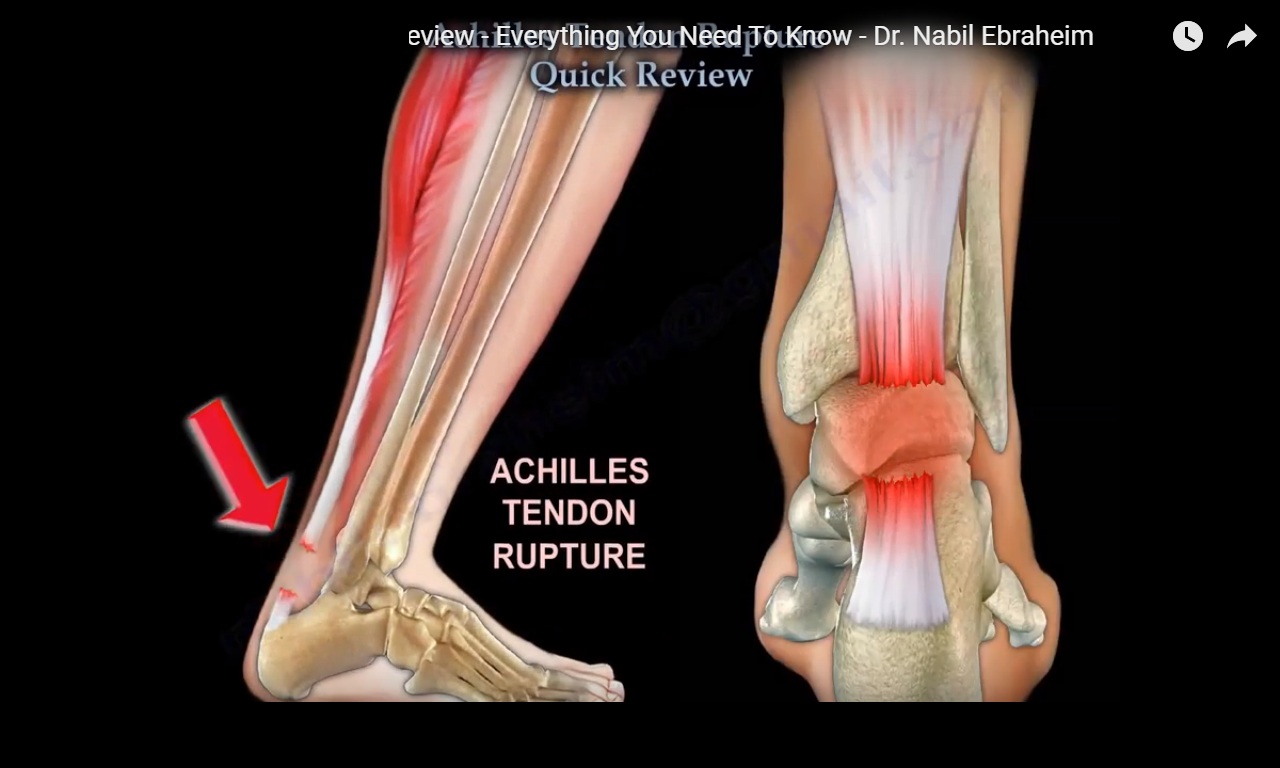
  • The Achilles tendon is located in the posterior ankle.

  • It is the strongest and thickest tendon in the body.

  • Formed from:

    • Soleus muscle

    • Gastrocnemius muscle

  • Inserts into the calcaneus (heel bone).


2. Associated Bursae

Subcutaneous Calcaneal Bursa

  • Located superficial to the Achilles tendon.

  • Lies between:

    • Skin

    • Distal aspect of the Achilles tendon.

Subtendinous Calcaneal Bursa

  • Located deep to the Achilles tendon.

  • Lies between:

    • Achilles tendon

    • Calcaneus.

Clinical Relevance

  • Inflammation of one or both bursae can cause:

    • Posterior heel pain

    • Posterior ankle pain.


3. Vascular Supply and Watershed Zone

  • The Achilles tendon has relatively poor vascularity.

  • The watershed zone:

    • Area with the worst blood supply.

    • Located approximately 2 to 6 cm proximal to the calcaneal insertion.

    • Narrow in width.

  • This area is prone to:

    • Tendinitis

    • Tendon rupture.


4. Achilles Tendon Rupture

  • Most ruptures occur above the calcaneal insertion.

  • Frequently occur within the watershed zone.

  • Rupture in this region may resemble pulling apart a rope.


5. Epidemiology

  • Often referred to as the “weekend warrior” injury.

  • Typically occurs due to:

    • Overperforming

    • Overdoing physical activity.

  • More common in:

    • Men aged 30 to 40 years.


6. Mechanism of Injury

  • Usually due to:

    • Eccentric loading

    • On a dorsiflexed ankle

    • With the knee extended.


7. Functional Complaint After Rupture

Patients may report:

  • One leg feels normal.

  • The affected leg feels weak or problematic.

  • Inability to stand on one leg on the affected side.


Summary

  • The Achilles tendon is the strongest tendon in the body.

  • It inserts into the calcaneus and is formed by the gastrocnemius and soleus.

  • The watershed zone (2–6 cm proximal to insertion) is prone to rupture due to poor blood supply.

  • Rupture commonly occurs in active adults, especially men aged 30–40.

  • Mechanism typically involves eccentric loading on a dorsiflexed ankle with knee extension.

  • Posterior heel pain may also arise from inflammation of the associated bursae.
Post Views: 461

Related Posts

  • Achilles Tendon Rupture

    Courtesy: Lyndon Mason, FRCSOrth, Liverpool, UK

  • Achilles Tendon Ruptures

    Courtesy: International Foot and Ankle Symposium, Chennai

  • Achilles Tendon Ruptures

    Courtesy: Manuel Santos Carvalho MD, Porto, Portugal   Anatomy The Achilles tendon is the largest…

Reader Interactions

Leave a Reply

Your email address will not be published. Required fields are marked *

Primary Sidebar

Follow Us

instagram slideshare

Categories

  • -Applied Anatomy
  • -Approaches
  • -Basic Sciences
  • -Cartilage & Meniscus
  • -Classifications
  • -Examination
  • -Foot and Ankle
  • -Foot and Ankle Trauma
  • -FRCS(Tr and Orth) tutorials
  • -Gait
  • -Hand and Wrist
  • -Hand and Wrist Trauma
  • -Hand Infections
  • -Hip and Knee
  • -Hip Preservation
  • -Infections
  • -Joint Reconstruction
  • -Knee Arthroplasty
  • -Knee Preservation
  • -Metabolic Disorders
  • -Oncology
  • -OrthoBiologics
  • -OrthoPlastic
  • -Paediatric Orthopaedics
  • -Paediatric Trauma
  • -Patellofemoral Joint
  • -Pelvis
  • -Peripheral Nerves
  • -Principles
  • -Principles of Surgery
  • -Radiology
  • -Rheumatology
  • -Shoulder and Elbow
  • -Shoulder and Elbow Arthroplasty
  • -Spine Deformity
  • -Spine Oncology
  • -Spine Trauma
  • -Spine, Pelvis & Neurology
  • -Sports Ankle and Foot
  • -Sports Elbow
  • -Sports Knee
  • -Sports Medicine
  • -Sports Medicine Hip
  • -Sports Shoulder
  • -Sports Wrist
  • -Statistics
  • -Technical Tip
  • -Technology in Orth
  • -Trauma
  • -Trauma (Upper Limb)
  • -Trauma Life Support
  • -Trauma Reconstruction
  • Book Shelf
  • Book Shelf Medical
  • Careers
  • Case Studies and Free Papers
  • DNB Ortho
  • Evidence Based Orthopaedic Principles
  • Evidence Based Orthopaedics
  • Exam Corner
  • Fellowships
  • Guest Editor
  • Guest Reviews
  • Image Quiz
  • Instructional Course Lectures
  • Journal Club
  • MCQs
  • Meetings and Courses
  • Multimedia
  • News and Blog
  • Plaster Techniques
  • Podcasts
  • Public Health
  • Rehabilitation
  • Research
  • Shorts and Reels
Copyright@orthopaedicprinciples.com. All right rerserved.