• Skip to main content
  • Skip to secondary menu
  • Skip to primary sidebar
OrthopaedicPrinciples.com

OrthopaedicPrinciples.com

Integrating Principles and Evidence

Integrating Principles and Evidence

  • Home
  • Editorial Board
  • Our Books
    • Evidence Based Orthopaedic Principles
  • Courses
  • Exams
  • Reviews
  • Live Program
  • Contact

Vitamin D Deficiency and its Implications

Courtesy: Prof Nabil Ebraheim, University of Toledo, Ohio, USA

VITAMIN D DEFICIENCY

Vitamin D is important for the proper maturation and development of bone and it also boosts our immunity.

  • We use the term “deficiency” if the vitamin D level is below 20 ng/ ml.
  • We use the term “insufficiency” if the vitamin D level is 20 – 30 ng / ml.
  • Vitamin D level greater than 30 ng/ ml is adequate.

Functions of Vitamin D:

  • The main function of vitamin D is absorption of calcium and phosphate from the intestines.
  • Through increased absorption of calcium and phosphate from the intestine it increases bone resorption of calcium and phosphate.
  • Impaired mineralization can lead to rickets in the young and osteomalacia in adults.

Sources of Vitamin D:

  • Vitamin D comes from diet, exposure to the sun and from supplements.
    In a healthy, young adult, the recommended daily allowance for vitamin D is 400 – 800 IU per day.
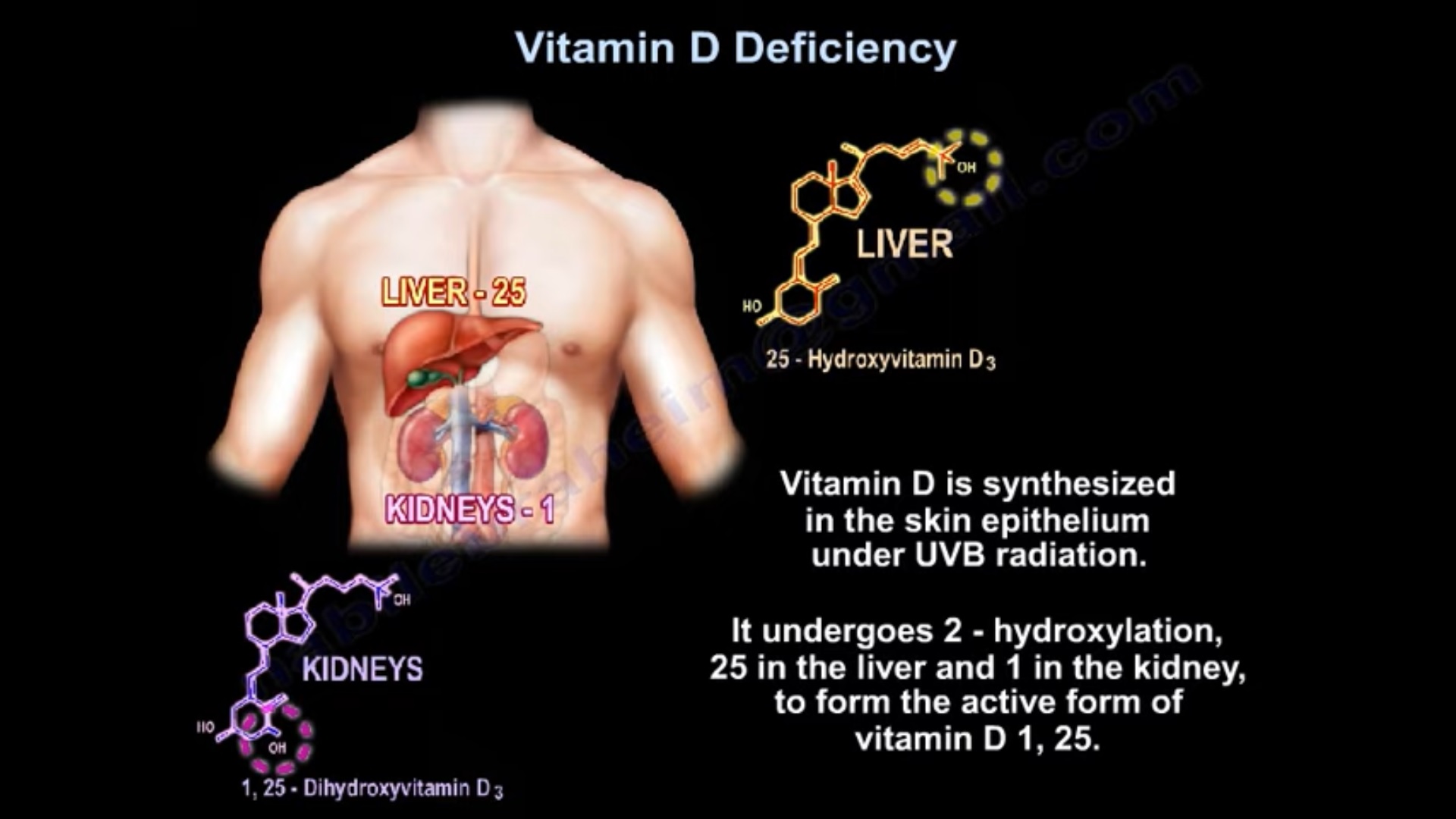
  • Vitamin D is synthesized in the skin epithelium under UVB radiation. It undergoes two hydroxylations, 25 in the liver and 1-alpha in the kidney, to form the active form of 1, 25 Dihydroxy vitamin D .
  • This crude vitamin D gets activated in the liver.
  • Staying home limits the amount of time spent in public, so the amount of vitamin D that is received through the sun is less.
  • You will need to get more vitamin D from other sources such as from diet and supplements.

Foods rich in vitamin D:

  • Found in oily fish such as salmon, sardines, herring, and mackerel.
  • Egg yolks
  • Mushrooms.
  • Dairy products
  • Meat

1, 25 (OH)2 – Vitamin D is the active form vitamin .

Features of Vitamin D deficiency:

The symptoms of vitamin D deficiency are subtle and non-specific, and the majority of people are not aware of it.

  • Depression
  • Fatigue / tiredness
  • Decreased physical activity
  • Muscle weakness
  • Hair loss
  • Bone pain
  • Sleeping disorders
  • Reduced bone mass
  • Slow healing or nonunion of fractures
  • Cardiovascular disorders

Investigation

  • The 25 Hydroxy vitamin D test is done in patients who are suspected to have low vitamin D levels.
  • This is because it has a long half life (2 – 3 weeks) and has a higher concentration, so it is a good test for vitamin D status

Management

  • Adults with a vitamin D deficiency should be given 50,000 IU of vitamin D3 once a week for eight weeks with the goal of achieving blood levels of vitamin D 25-hydroxy above 30.
  • This is followed by maintenance therapy between 1500 – 2000 lU daily which can be acquired from diet or supplement sources.
Post Views: 1,586

Related Posts

  • Hip dislocations and its Implications

    Courtesy: Prof Nabil Ebraheim

  • Types of Collagen and its implications

    Courtesy: Prof Nabil Ebraheim, University of Toledo, Ohio, USA This video describes about various types…

  • Obesity and its Implications in Orthopaedics

    “The Obesity Epidemic: Implications for Orthopedics and Current Trends in Management” Courtesy: University of Washington…

Reader Interactions

Leave a Reply

Your email address will not be published. Required fields are marked *

Primary Sidebar

Follow Us

instagram slideshare

Categories

  • -Applied Anatomy
  • -Approaches
  • -Basic Sciences
  • -Cartilage & Meniscus
  • -Classifications
  • -Examination
  • -Foot and Ankle
  • -Foot and Ankle Trauma
  • -FRCS(Tr and Orth) tutorials
  • -Gait
  • -Hand and Wrist
  • -Hand and Wrist Trauma
  • -Hand Infections
  • -Hip and Knee
  • -Hip Preservation
  • -Infections
  • -Joint Reconstruction
  • -Knee Arthroplasty
  • -Knee Preservation
  • -Metabolic Disorders
  • -Oncology
  • -OrthoBiologics
  • -OrthoPlastic
  • -Paediatric Orthopaedics
  • -Paediatric Trauma
  • -Patellofemoral Joint
  • -Pelvis
  • -Peripheral Nerves
  • -Principles
  • -Principles of Surgery
  • -Radiology
  • -Rheumatology
  • -Shoulder and Elbow
  • -Shoulder and Elbow Arthroplasty
  • -Spine Deformity
  • -Spine Oncology
  • -Spine Trauma
  • -Spine, Pelvis & Neurology
  • -Sports Ankle and Foot
  • -Sports Elbow
  • -Sports Knee
  • -Sports Medicine
  • -Sports Medicine Hip
  • -Sports Shoulder
  • -Sports Wrist
  • -Statistics
  • -Technical Tip
  • -Technology in Orth
  • -Trauma
  • -Trauma (Upper Limb)
  • -Trauma Life Support
  • -Trauma Reconstruction
  • Book Shelf
  • Book Shelf Medical
  • Careers
  • Case Studies and Free Papers
  • DNB Ortho
  • Evidence Based Orthopaedic Principles
  • Evidence Based Orthopaedics
  • Exam Corner
  • Fellowships
  • Guest Editor
  • Guest Reviews
  • Image Quiz
  • Instructional Course Lectures
  • Journal Club
  • MCQs
  • Meetings and Courses
  • Multimedia
  • News and Blog
  • Plaster Techniques
  • Podcasts
  • Public Health
  • Rehabilitation
  • Research
  • Shorts and Reels
Copyright@orthopaedicprinciples.com. All right rerserved.