
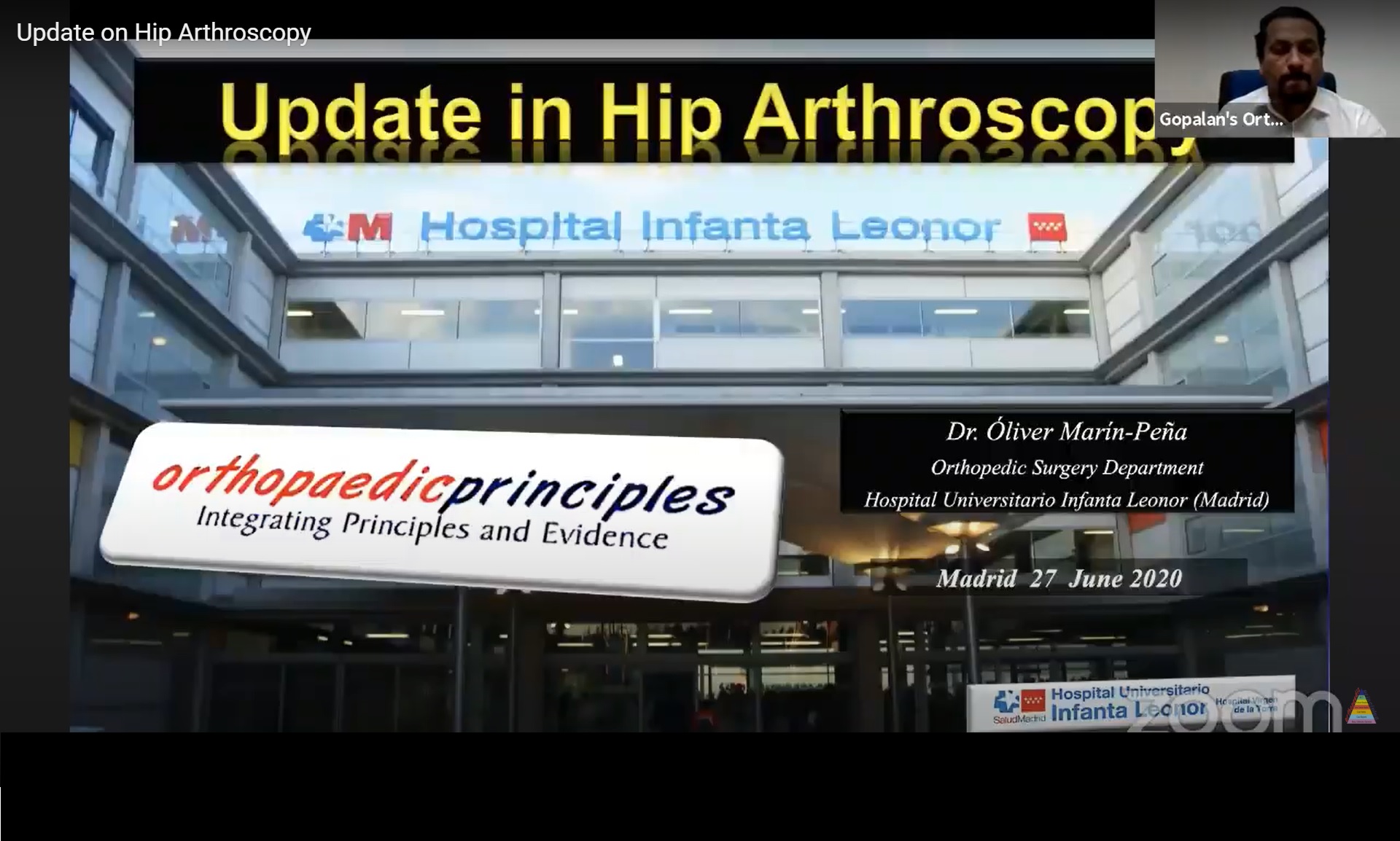
Courtesy: Oliver Marin-Pena, Madrid, Spain
Hip Arthroscopy and Hip Preservation Surgery: Current Concepts and Practical Pearls
Hip arthroscopy has become an increasingly important tool in the management of young adults with chronic hip and groin pain. Advances in imaging, surgical techniques, and understanding of hip biomechanics have expanded its indications. However, successful outcomes depend heavily on proper patient selection, accurate diagnosis, and meticulous surgical technique.
Introduction
Hip preservation surgery aims to relieve symptoms, improve function, and delay or prevent the development of osteoarthritis.
The ideal candidates are:
- Young adults, typically under 50 years of age
- Patients with chronic hip or groin pain
- Individuals with correctable structural abnormalities
The most important principle in hip preservation surgery is:
Correct indication determines success.
Clinical Evaluation
History
Patients often present with:
- Insidious onset hip or groin pain
- Symptoms lasting months or years
- Previous misdiagnoses such as:
- Lumbar spine pathology
- Hernias
- Sacroiliac joint disorders
A careful history is essential to identify the true pain source.
Physical Examination
General Assessment
Clinical examination should include:
- Gait analysis
- Single-leg stance testing
- Assessment of hip range of motion
- Evaluation of muscle strength
Important Clinical Findings
Reduced Global Range of Motion
Suggests:
- Hip osteoarthritis
- Advanced joint degeneration
Increased Range of Motion
May indicate:
- Generalized ligamentous laxity
- Hip hypermobility
Special Clinical Tests
Several examination maneuvers help localize pathology.
FADIR (Impingement Test)
Flexion, Adduction, Internal Rotation
Findings:
- High specificity
- Lower sensitivity
- Positive test suggests femoroacetabular impingement (FAI)
Decompression Test
Relief of symptoms with traction suggests:
- Intra-articular pathology
Dial Test
Used to assess:
- Capsular laxity
- Hip instability
Log Roll Test
Suggests:
- Intra-articular hip pathology
FABER Test
Useful for evaluating:
- Hip joint pathology
- Sacroiliac joint disorders
Stinchfield Test
Assesses:
- Intra-articular hip pain
Thomas Test
Evaluates:
- Hip flexion contractures
- Pelvic alignment
Important Clinical Pearl
Groin pain combined with a positive impingement test strongly suggests femoroacetabular impingement.
Treat the Patient, Not the Imaging
A critical concept in hip preservation surgery is the poor correlation between symptoms and imaging findings.
Research demonstrates that:
- Many patients with hip pain have normal radiographs.
- Many patients with radiographic osteoarthritis have little or no pain.
Therefore:
- Imaging should support clinical findings.
- Treatment decisions should never be based on imaging alone.
Differential Diagnosis of Hip Pain
Hip pain may originate from several structures.
Conditions That Must Be Excluded
Spine-Related Disorders
- Lumbar radiculopathy
- Lumbar spinal stenosis
Sacroiliac Joint Dysfunction
Can mimic intra-articular hip pain.
Knee Pathology
Pain may be referred to the hip or groin.
Greater Trochanteric Pain Syndrome
Includes:
- Trochanteric bursitis
- Gluteal tendinopathy
Deep Gluteal Syndrome
Compression of the sciatic nerve within the deep gluteal space.
Diagnostic Injections
An image-guided intra-articular injection can help determine whether symptoms originate from the hip joint.
Significant pain relief following injection supports:
- Intra-articular pathology
The Importance of the Labrum
Functions of the Labrum
The acetabular labrum plays several important roles:
- Maintains the fluid seal of the joint
- Improves stability
- Distributes load across the articular surface
Chondrolabral Junction
This is the transition zone between:
- Articular cartilage
- Acetabular labrum
It is often the first site of degeneration and injury.
Most labral tears occur alongside:
- Chondral damage
- Chondrolabral separation
Femoroacetabular Impingement (FAI)
Definition
FAI is a mechanical conflict between:
- The femoral head-neck junction
- The acetabular rim
Repeated impingement can lead to:
- Labral tears
- Cartilage damage
- Early osteoarthritis
Types of Femoroacetabular Impingement
Cam-Type Impingement
Pathology
A bony prominence develops at the femoral head-neck junction.
Consequences
- Abnormal contact during hip motion
- Deep cartilage injury
Imaging Findings
- Increased alpha angle
- Alpha angle >55° is generally considered abnormal
Pincer-Type Impingement
Pathology
Excessive acetabular coverage of the femoral head.
Radiographic Findings
- Crossover sign
- Acetabular retroversion
Important Consideration
Pelvic tilt must be controlled during radiographic assessment because false-positive findings are common.
Mixed-Type Impingement
The most common form of FAI.
Features include:
- Cam morphology
- Pincer morphology
Present simultaneously.
Imaging Evaluation
Plain Radiographs
Essential views include:
AP Pelvis
Assesses:
- Joint space
- Coverage
- Pelvic alignment
Dunn View
Useful for:
- Cam lesions
- Alpha angle measurement
Cross-Table Lateral View
Evaluates:
- Head-neck offset
False Profile View
Assesses:
- Anterior coverage
MRI and MR Arthrography
Helpful for evaluating:
- Labral tears
- Cartilage damage
- Associated soft tissue pathology
MR arthrography may improve visualization of labral pathology.
Indications for Hip Preservation Surgery
Surgery should only be considered when all of the following are present:
- Symptomatic patient
- Clinical findings correlate with imaging
- Failure of appropriate conservative treatment
Contraindications
Hip arthroscopy performs poorly in the presence of advanced degenerative disease.
Relative or Absolute Contraindications
Joint Space Less Than 2 mm
Associated with:
- Higher failure rates
- Increased conversion to total hip arthroplasty
Advanced Osteoarthritis
Poor outcomes after arthroscopy.
Surgical Options
Several joint-preserving procedures are available.
Hip Arthroscopy
Most commonly used for:
- FAI correction
- Labral repair
- Chondral treatment
Surgical Hip Dislocation
Provides:
- Complete visualization
- Access to complex deformities
Mini-Open Techniques
Useful in selected situations.
Key Surgical Principles
Labral Preservation
Current evidence favors:
- Labral repair
- Labral reconstruction when necessary
Labral excision should be avoided whenever possible.
Rim Trimming
Should be conservative.
Excessive resection may result in instability.
Cam Osteoplasty
The goal is to:
- Restore normal head-neck offset
- Eliminate impingement
Complications
Failure to Improve
Approximately:
- 15% experience no significant improvement
- 5% may have worse outcomes
Traction-Related Complications
Potential complications include:
- Nerve palsy
- Perineal compression injuries
- Temporary erectile dysfunction
Portal-Related Complications
Potential nerve injuries include:
- Femoral nerve
- Lateral femoral cutaneous nerve
- Sciatic nerve (especially with posterior portals)
Surgical Technique Complications
Examples include:
- Labral injury
- Instrument breakage
- Femoral neck fracture from excessive resection
Instability
May occur due to:
- Excessive rim trimming
- Capsular deficiency
- Labral resection
Rare but Serious Complications
Avascular Necrosis
Rare but potentially devastating.
Fluid Extravasation
May lead to:
- Abdominal distension
- Intra-abdominal complications
Surgical Pearls
Several technical principles help optimize outcomes.
Joint Distraction
- Apply adequate but not excessive traction
- Use intermittent traction when possible
Capsular Management
- Preserve the capsule whenever feasible
- Repair when indicated
Labral Management
- Repair rather than excise
- Maintain the suction seal
Safe Resection Limits
Femoral Neck
Avoid resection exceeding:
- 30% of femoral neck diameter
Acetabular Rim
Avoid rim trimming greater than:
- 4 mm
Dysplasia and Hip Arthroscopy
Careful assessment of acetabular coverage is essential.
Lateral Center-Edge Angle (LCEA)
Less Than 20°
Generally indicates:
- True dysplasia
Preferred treatment:
- Periacetabular osteotomy (PAO)
20–25°
Borderline dysplasia
Hip arthroscopy may be considered with caution:
- Avoid excessive rim trimming
- Preserve the capsule
- Maintain stability
Outcomes and Future Trends
Hip arthroscopy continues to grow worldwide.
However, conversion to total hip arthroplasty remains more likely in patients with:
- Age greater than 50 years
- Significant cartilage damage
- Established osteoarthritis
Proper patient selection remains the most important determinant of long-term success.
Learning Curve
Hip arthroscopy has a significant learning curve.
Basic Competency
Approximately:
- 30 cases
Advanced Procedures
Require:
- Additional experience
- Cadaveric training
- Structured mentorship
Key Take-Home Messages
- Hip arthroscopy is primarily a joint-preserving procedure for young symptomatic patients.
- Successful outcomes depend more on appropriate indications than on surgical technique alone.
- Clinical findings, physical examination, and imaging must correlate before surgery is considered.
- Labral preservation is critical for maintaining hip stability and function.
- Avoid hip arthroscopy in patients with advanced osteoarthritis or joint space less than 2 mm.
- Overcorrection can be as problematic as undercorrection.
- Dysplasia requires careful evaluation, and many patients are better treated with periacetabular osteotomy rather than arthroscopy.
- Patient selection remains the single most important factor in achieving durable results.
Related Posts
 Hip Arthroscopy to treat Instability!
Courtesy: Christopher Larson, Twin Cities Orthopaedics, Minnesota, USA
- Hip Arthroscopy to treat Instability!
Courtesy: Christopher Larson, Twin Cities Orthopaedics, Minnesota, USA
- Hip Arthroscopy to treat Instability!
Courtesy: Christopher Larson, Twin Cities Orthopaedics, Minnesota, USA
Leave a Reply