
Courtesy: Sanjay Desai, Ashok Shyam, IORG, OrthoTV
Oxford Unicompartmental Knee Arthroplasty vs HTO
1. HTO: Problems Highlighted
The speaker states that although he has been performing HTO since 1989–90, several concerns remain:
- Unpredictable results
- The same operation and technique can produce different outcomes.
- A proportion of patients remain dissatisfied without an obvious explanation.
- Prolonged recovery
- Tibial healing may take considerable time.
- Incomplete symptom relief
- Symptoms may persist despite correction.
- Limited longevity
- The results cited suggest that HTO provides satisfactory benefit in approximately three-fourths of patients for around 8–10 years.
- Changing techniques
- HTO has evolved through multiple techniques:
- Closed-wedge osteotomy
- Open-wedge osteotomy
- Various fixation methods
- Changes between plaster, staples and plates
- The speaker considers frequent changes in technique a concern regarding predictability and reproducibility.
- HTO has evolved through multiple techniques:
2. Oxford Unicompartmental Knee Arthroplasty
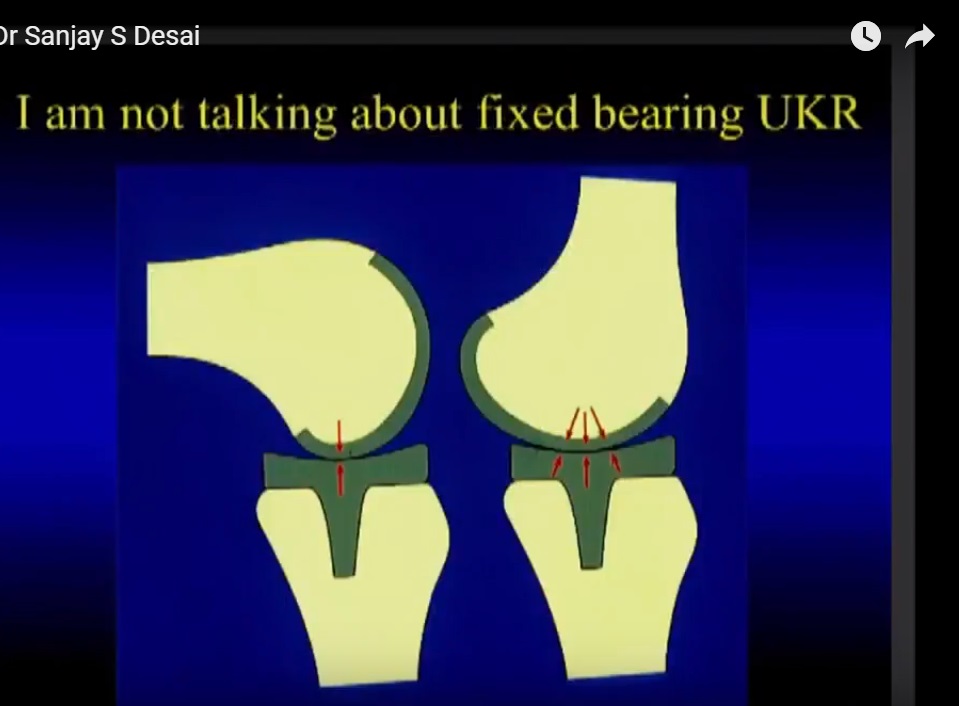
The discussion specifically concerns the mobile-bearing Oxford UKA, not fixed-bearing UKA.
Long-term design consistency
- Mobile-bearing Oxford design has been used for more than 30 years.
- The fundamental implant concept has remained essentially unchanged.
- Changes have mainly involved:
- Instrumentation
- Implant sizes
- Later modifications such as Microplasty instrumentation
The speaker considers this long-term consistency reassuring.
3. Oxford UKA Design Concept
The construct consists of:
- Spherical femoral component
- Flat tibial baseplate
- Fully mobile, unconstrained polyethylene bearing
- The polyethylene bearing is described as fully congruous.
Biomechanical concept
The mobile bearing allows:
- Sliding
- Rolling
- Large contact area
- Predominantly compressive forces
- Minimal shear forces
The surrounding soft tissues can also be maintained/restored toward normal tension.
4. Anatomical Basis
The speaker’s central argument is:
An operation that reproduces normal anatomy should have a greater likelihood of success.
The Oxford mobile-bearing concept is said to reproduce important functions of the normal meniscus:
- Large contact area
- Avoidance of point contact
- Mobility within the knee
Thus, the mobile bearing attempts to mimic the function of the native meniscus.
5. Wear Characteristics
The cited wear rate is:
- 0.03 mm/year
Therefore:
- Approximately 1 mm of polyethylene wear would take about 33 years.
This is presented as an important advantage of the Oxford mobile-bearing design.
6. Indications for Oxford UKA
The speaker lists the following important indications:
Essential pathology
- Full-thickness cartilage loss of the medial compartment
Ligament status
- Intact ACL
- Intact PCL
- Functionally normal MCL
Alignment
- Correctable varus deformity
Motion
- Near-full range of movement
These patient-selection criteria are emphasized as critical to achieving good results.
7. Oxford UKA Survival
The speaker presents several published series.
Designer series
- Approximately 98% survival at 10 years
Independent series
- Swad and Price, Sweden:
- 94% survival at 15 years
Other series cited
- Rodr…/Smith series:
- 94% survival at 10 years
- Keys et al.:
- 99% survival at 10 years
Overall message
The speaker concludes that published results consistently demonstrate high survival rates, generally in the mid-to-high 90% range at 10–15 years.
8. Polyethylene Bearing Dislocation
A potential complication of mobile-bearing UKA is bearing dislocation.
The speaker cites a current dislocation rate of approximately:
- 0.4%
provided the operation is performed properly.
9. Alignment and Component Position
The speaker describes his series of approximately 70 patients treated between 2007 and 2011.
Alignment of the femoral and tibial components was assessed in:
- AP plane
- Mediolateral plane
Important concept: Additive malalignment
If components are malaligned in more than one plane, the errors have an additive effect.
This means that several relatively small angular errors can combine and adversely affect the outcome.
Findings
- Approximately 6% had outliers involving two or more angles.
10. Femoral Component Positioning
One important source of malalignment was the femoral component.
Phase 3 instrumentation
- The femoral jig was not linked to the intramedullary canal.
- Therefore, positioning depended more on visual judgment.
Microplasty modification
- The femoral jig is now linked to the intramedullary canal.
- This improves the accuracy and reproducibility of femoral component placement.
The speaker therefore considers Microplasty an important instrumentation improvement.
11. Functional Outcomes
The speaker describes patients who were able to:
- Sit cross-legged
- Squat
These activities are particularly relevant to Indian patients and are presented as examples of functional capability following Oxford UKA.
12. Oxford UKA After Failed TKA
An important claim made in the presentation is that published studies show:
The results of TKA after failed UKA can be comparable to primary TKA.
The implication is that performing UKA does not necessarily compromise the outcome of a subsequent conversion to TKA.
13. Longevity
The speaker’s overall interpretation is that:
- An Oxford UKA can provide an implant life approaching 30 years.
This forms a major part of his argument for considering UKA in appropriately selected patients.
14. HTO vs Oxford UKA: Speaker’s Position
| HTO | Oxford UKA |
|---|---|
| Unpredictable results highlighted | High reported survivorship |
| Prolonged recovery | Relatively faster recovery implied |
| Tibial healing required | No osteotomy healing required |
| Symptom relief may be incomplete | High patient satisfaction reported |
| Benefit may diminish after 8–10 years in many patients | Longevity approaching 30 years claimed |
| Technique has evolved considerably | Fundamental implant design unchanged for >30 years |
| Multiple fixation strategies | Established mobile-bearing concept |
| Biological joint-preserving procedure | Unicompartmental replacement |
15. Patient Selection Is the Key
The speaker does not present HTO and UKA as competing operations for every patient.
His conclusion is:
“HTO and the Uni do not compete with each other; they complement each other.”
The key is selecting the appropriate patient for each procedure.
Younger/high-demand patient
- In a patient below 50 years, the speaker says he would consider HTO, particularly because these patients are generally high demand.
- He acknowledges that this represents a relatively small proportion of the overall medial compartment OA population.
Older patient
- A large proportion of patients with medial compartment OA are above 60 years.
- In this group, he favors Oxford UKA when the indications are satisfied.
Arthroscopy
- The speaker sees only a small role for arthroscopy in patients with OA and mechanical symptoms.
Key Take-Home Points
- HTO: major concerns are unpredictability, prolonged recovery, incomplete symptom relief and limited longevity.
- Oxford UKA: mobile-bearing design has remained fundamentally unchanged for >30 years.
- The mobile bearing attempts to replicate meniscal function.
- Large congruent contact area produces predominantly compressive forces.
- Reported polyethylene wear is approximately 0.03 mm/year.
- Proper patient selection requires:
- Medial full-thickness cartilage loss
- Intact ACL/PCL
- Functionally normal MCL
- Correctable varus
- Near-full ROM
- Published series cited show approximately 94–99% survival at 10–15 years.
- Mobile-bearing dislocation is reported at approximately 0.4% with proper technique.
- Component malposition in multiple planes can have an additive adverse effect.
- Microplasty instrumentation improves femoral component positioning by linking the jig to the intramedullary canal.
- Conversion of failed UKA to TKA is presented as capable of producing results comparable to primary TKA.
- The speaker’s central philosophy: HTO and UKA complement each other; patient selection determines which is appropriate.
Leave a Reply