• Skip to main content
  • Skip to secondary menu
  • Skip to primary sidebar
OrthopaedicPrinciples.com

OrthopaedicPrinciples.com

Integrating Principles and Evidence

Integrating Principles and Evidence

  • Home
  • Editorial Board
  • Our Books
    • Evidence Based Orthopaedic Principles
  • Courses
  • Exams
  • Reviews
  • Live Program
  • Contact

Types of Collagen and its implications


Courtesy: Prof Nabil Ebraheim, University of Toledo, Ohio, USA
This video describes about various types of collagen.

Collagen is made by fibroblasts & there are about 20 types of collagen which constitutes 20% of our body proteins

  • Type 1 collagen accounts for 90% of our body collagen & is associated with primary bone healing. It is found mainly in bones, ligaments, tendon, menisci & annulus fibrosus of intervertebral disc. Osteogenesis imperfecta which is characterized by fragile bone fractures , blue sclera & Ehlers danios syndrome ( loose joints & stretched skin ) are the diseases caused due to defect in type 1 collagen.
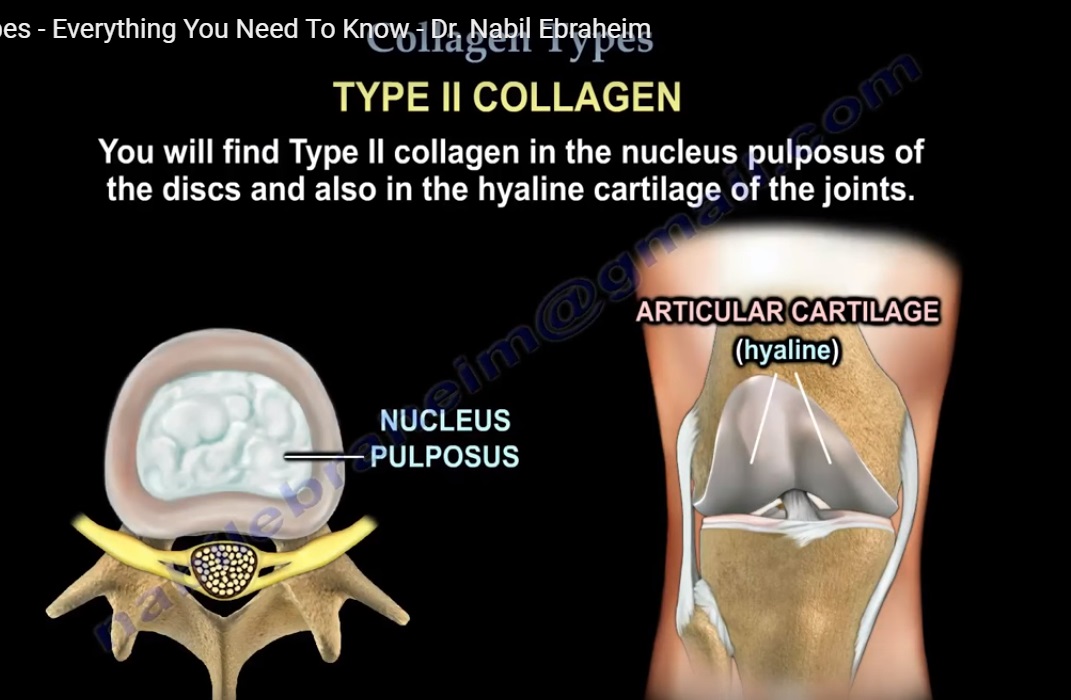
  • 95% of collagen in cartilage is Type 2 & is seen in secondary bone healing. It has long half life (25 yrs) . It is present in nucleus pulposus of disc & hyaline cartilage of joint. Genetic defect in type 2 collagen cause spondyloepiphyseal dysplasia.
  • Type 3 collagen is mainly seen in blood vessels & skin . It’s defect can cause Dupuytren’s contracture. During   healing of tendons, upto 7 days Type 3 collagen is produced & it is replaced by Type 1 until 18 months.
  • Defect in Type 10 collagen result in Schmid type Metaphyseal chondrodysplasia. Type 10 collagen is found in fracture callus, growth plate & heterotopic ossification & is associated with calcification of cartilage

Type11 collagen helps in holding collagen lattice together
types of collage

Post Views: 6,502

Related Posts

  • Types of Cartilage

    Courtesy: Harry Benjamin Laing, MRCS OrthoM8 FRCS(Tr and Orth) Tutorials

  • Shock- Types and Management

    Courtesy: Prof Nabil Ebraheim University of Toledo, Ohio, USA

  • Hip dislocations and its Implications

    Courtesy: Prof Nabil Ebraheim

Reader Interactions

Leave a Reply

Your email address will not be published. Required fields are marked *

Primary Sidebar

Follow Us

instagram slideshare

Categories

  • -Applied Anatomy
  • -Approaches
  • -Basic Sciences
  • -Cartilage & Meniscus
  • -Classifications
  • -Examination
  • -Foot and Ankle
  • -Foot and Ankle Trauma
  • -FRCS(Tr and Orth) tutorials
  • -Gait
  • -Hand and Wrist
  • -Hand and Wrist Trauma
  • -Hand Infections
  • -Hip and Knee
  • -Hip Preservation
  • -Infections
  • -Joint Reconstruction
  • -Knee Arthroplasty
  • -Knee Preservation
  • -Metabolic Disorders
  • -Oncology
  • -OrthoBiologics
  • -OrthoPlastic
  • -Paediatric Orthopaedics
  • -Paediatric Trauma
  • -Patellofemoral Joint
  • -Pelvis
  • -Peripheral Nerves
  • -Principles
  • -Principles of Surgery
  • -Radiology
  • -Rheumatology
  • -Shoulder and Elbow
  • -Shoulder and Elbow Arthroplasty
  • -Spine Deformity
  • -Spine Oncology
  • -Spine Trauma
  • -Spine, Pelvis & Neurology
  • -Sports Ankle and Foot
  • -Sports Elbow
  • -Sports Knee
  • -Sports Medicine
  • -Sports Medicine Hip
  • -Sports Shoulder
  • -Sports Wrist
  • -Statistics
  • -Technical Tip
  • -Technology in Orth
  • -Trauma
  • -Trauma (Upper Limb)
  • -Trauma Life Support
  • -Trauma Reconstruction
  • Book Shelf
  • Book Shelf Medical
  • Careers
  • Case Studies and Free Papers
  • DNB Ortho
  • Evidence Based Orthopaedic Principles
  • Evidence Based Orthopaedics
  • Exam Corner
  • Fellowships
  • Guest Editor
  • Guest Reviews
  • Image Quiz
  • Instructional Course Lectures
  • Journal Club
  • MCQs
  • Meetings and Courses
  • Multimedia
  • News and Blog
  • Plaster Techniques
  • Podcasts
  • Public Health
  • Rehabilitation
  • Research
  • Shorts and Reels
Copyright@orthopaedicprinciples.com. All right rerserved.