• Skip to main content
  • Skip to secondary menu
  • Skip to primary sidebar
OrthopaedicPrinciples.com

OrthopaedicPrinciples.com

Integrating Principles and Evidence

Integrating Principles and Evidence

  • Home
  • Editorial Board
  • Our Books
    • Evidence Based Orthopaedic Principles
  • Courses
  • Exams
  • Reviews
  • Live Program
  • Contact

Timed Up and Go TUG Test

Courtesy: Prof Nabil Ebraheim, University of Toledo, Ohio, USA


Timed Up and Go (TUG) Test

Overview & Objectives

  • Definition: A standardized functional test evaluating dynamic balance and mobility.

  • Primary Applications:

    • Assessment of functional mobility (rising, ambulating, turning, transfers).

    • Fall-risk screening, particularly in geriatric populations.

    • Direct observation of transitional movements: chair rise, forward gait, turning, return gait, and sitting down.

Equipment & Setup

  • Apparatus:

    • Standard armchair.

    • Stopwatch / timing device.

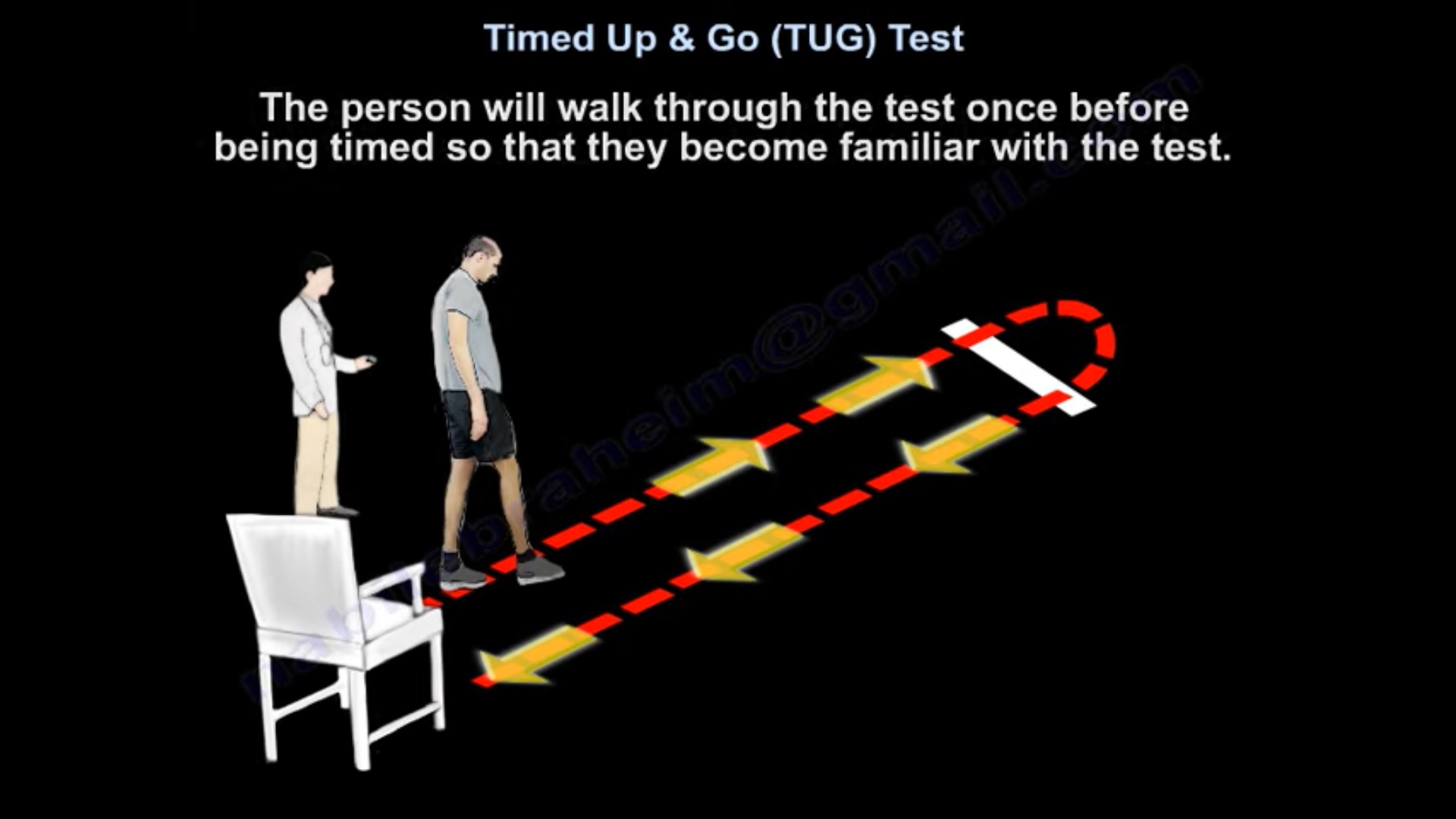
    • Clear marker/line placed 3 meters (~10 feet) directly in front of the chair.

  • Patient Requirements:

    • Wears regular, everyday footwear.

    • Permitted to use customary walking aids (e.g., cane, walker).

Examination Protocol & Technique

  • Familiarization: Patient is allowed one unrecorded practice trial to ensure comprehension.

  • Standardized Instruction: “When I say go, stand up from the chair, walk to the line at your normal pace, turn around, walk back to the chair at your normal pace, and sit down.”

  • Kinematic Sequence:

    1. Seated in armchair.

    2. Stand up.

    3. Walk forward 3 meters at habitual pace.

    4. Turn around at the line.

    5. Walk back to the chair.

    6. Sit down fully.

  • Timing Parameters:

    • Initiation: Triggered on the verbal command “Go”.

    • Termination: Stopped the moment the patient’s buttocks make contact with the chair seat.

    • Units: Recorded in elapsed seconds.

  • Patient Safety: An assistant or examiner must remain in close proximity throughout the test to prevent falls, especially in patients with evident gait instability.

Clinical Interpretation & Diagnostic Metrics

  • Cut-Off Threshold: $>12$ seconds indicates an increased risk of falls in older adults.

  • Reported Diagnostic Values:

    • Sensitivity: 80%

    • Specificity: 100%

  • Clinical Considerations:

    • Falls in the elderly are multifactorial, involving environmental hazards and activity-related triggers.

    • Increased completion time correlates with higher risks of musculoskeletal injury and secondary functional activity limitation.

Master Revision Summary

  • Clinical Purpose: Dynamic mobility assessment and fall-risk stratification.

  • Distance: 3 meters (~10 feet) from an armchair.

  • Pace: Normal / customary walking speed.

  • Assistive Devices: Routine walking aids allowed.

  • Practice: One practice run allowed prior to measurement.

  • Pathological Cut-Off: $>12$ seconds denotes high fall risk in elderly patients.

  • Reported Accuracy: 80% sensitivity, 100% specificity.
Post Views: 2,312

Related Posts

  • Trendelenburg test

    Courtesy: Sameer Qureshi MS, Consultant Orthopaedic Surgeon, India

  • Silverskold Test

    Courtesy: Professor Nabile Ebraheim, Chairman, Department of Orthopaedics and Trauma, University of Toledo, Ohio, United…

  • Finkelstein's test

    Courtesy: Prof Nabil Ebraheim, University of Toledo, Ohio, USA

Reader Interactions

Leave a Reply

Your email address will not be published. Required fields are marked *

Primary Sidebar

Follow Us

instagram slideshare

Categories

  • -Applied Anatomy
  • -Approaches
  • -Basic Sciences
  • -Cartilage & Meniscus
  • -Classifications
  • -Examination
  • -Foot and Ankle
  • -Foot and Ankle Trauma
  • -FRCS(Tr and Orth) tutorials
  • -Gait
  • -Hand and Wrist
  • -Hand and Wrist Trauma
  • -Hand Infections
  • -Hip and Knee
  • -Hip Preservation
  • -Infections
  • -Joint Reconstruction
  • -Knee Arthroplasty
  • -Knee Preservation
  • -Metabolic Disorders
  • -Oncology
  • -OrthoBiologics
  • -OrthoPlastic
  • -Paediatric Orthopaedics
  • -Paediatric Trauma
  • -Patellofemoral Joint
  • -Pelvis
  • -Peripheral Nerves
  • -Principles
  • -Principles of Surgery
  • -Radiology
  • -Rheumatology
  • -Shoulder and Elbow
  • -Shoulder and Elbow Arthroplasty
  • -Spine Deformity
  • -Spine Oncology
  • -Spine Trauma
  • -Spine, Pelvis & Neurology
  • -Sports Ankle and Foot
  • -Sports Elbow
  • -Sports Knee
  • -Sports Medicine
  • -Sports Medicine Hip
  • -Sports Shoulder
  • -Sports Wrist
  • -Statistics
  • -Technical Tip
  • -Technology in Orth
  • -Trauma
  • -Trauma (Upper Limb)
  • -Trauma Life Support
  • -Trauma Reconstruction
  • Book Shelf
  • Book Shelf Medical
  • Careers
  • Case Studies and Free Papers
  • DNB Ortho
  • Evidence Based Orthopaedic Principles
  • Evidence Based Orthopaedics
  • Exam Corner
  • Fellowships
  • Guest Editor
  • Guest Reviews
  • Image Quiz
  • Instructional Course Lectures
  • Journal Club
  • MCQs
  • Meetings and Courses
  • MS Ortho
  • Multimedia
  • News and Blog
  • Plaster Techniques
  • Podcasts
  • Public Health
  • Rehabilitation
  • Research
  • Shorts and Reels
Copyright@orthopaedicprinciples.com. All right rerserved.