• Skip to main content
  • Skip to secondary menu
  • Skip to primary sidebar
OrthopaedicPrinciples.com

OrthopaedicPrinciples.com

Integrating Principles and Evidence

Integrating Principles and Evidence

  • Home
  • Editorial Board
  • Our Books
    • Evidence Based Orthopaedic Principles
  • Courses
  • Exams
  • Reviews
  • Live Program
  • Contact

The Lachman’s Test and ACL injury

Courtesy: Prof NabileEbraheim, University of Toledo, Ohio, USA

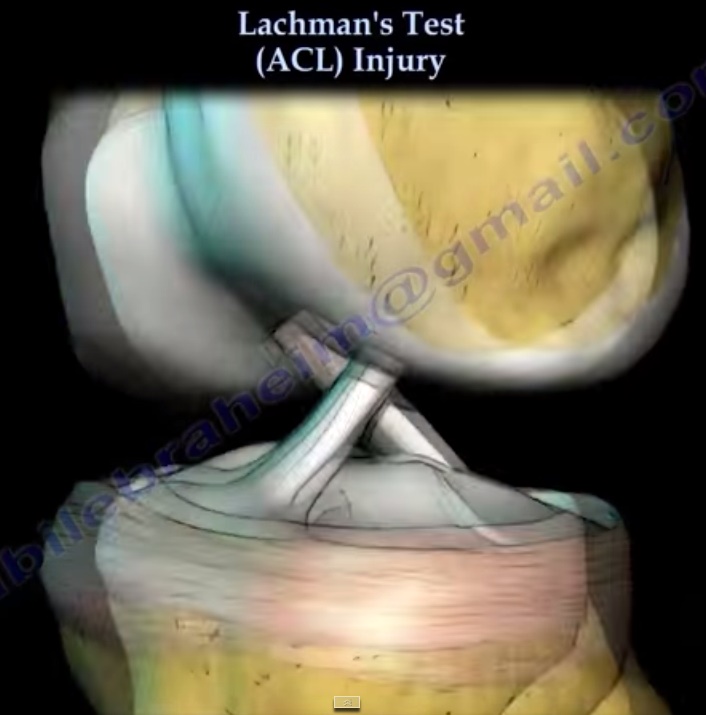
LACHMAN’S TEST
(ACL) INJURY

  • Lachman’s test is the most sensitive examination test for ACL injury
  • The anterior cruciate ligament is located in front of the knee.
  • The ACL keeps the tibia from sliding out in front of the femur and provides rotational stability to the knee.
  • Rupture of the anterior cruciate ligament is a condition commonly seen in sports due to a non-contact pivoting injury.

Patient evaluation

• Patient will feel a “POP” within the knee
• Pain
• Immediate swelling
• There is usually hemorrhaging within the knee joint
• Knee giving way

  • If aspiration of the knee shows hemarthrosis, then there is a 75% chance of an ACL tear and meniscal injury

How do you perform the Lachman’s test?

  • The patient should be lying supine and completely relaxed.
  • Make sure that the patient’s hip muscles, quadriceps, and hamstring muscles are all relaxed
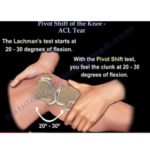
  • Bend the knee to about 20-30 degrees
  • Stabilize the femur with one hand and with the other hand, pull the tibia anteriorly and posteriorly against the femur.
  • With an intact ACL, as the tibia is pulled forward, the examiner should feel an end point.
  • The examiner should feel a firm end point.
  • With a rupture, the ACL will be lax and the examination will feel softer with no end point.
  • The tibia can be pulled forward more than normal (anterior translation).
  • Lachman’s test is the best examination to diagnose a tear of the ACL.
  • Be aware that a PCL tear may give posterior subluxation of the tibia and a false positive Lachman’s test.

Radiological examination

  • MRI of the knee joint shows bone lesions or bruising associated with tears of the ACL.
  • These injuries typically located at the middle of the femoral condyle and posterior part of the tibia laterally.
Lachman's test

Post Views: 5,288

Related Posts

  • Pivot Shift test in #ACL injury

    Courtesy: Prof Nabile Ebraheim, University of Toledo, Ohio, USA

  • Lachman's Test and Anterior Cruciate Ligament Injury

    Courtesy: Prof Nabil Ebraheim, University of Toledo, Ohio, USA Lachman's test is the most sensitive…

  • ACL Injury and Surgical Intervention

    Courtesy: Sports Kongres, Copenhagen Dr Farres Haddad, UK

Reader Interactions

Comments

  1. Khoi Tranchi says

    at

    Very very good clip

  2. Vivasvan says

    at

    Thank you .very clear

Leave a Reply

Your email address will not be published. Required fields are marked *

Primary Sidebar

Follow Us

instagram slideshare

Categories

  • -Applied Anatomy
  • -Approaches
  • -Basic Sciences
  • -Cartilage & Meniscus
  • -Classifications
  • -Examination
  • -Foot and Ankle
  • -Foot and Ankle Trauma
  • -FRCS(Tr and Orth) tutorials
  • -Gait
  • -Hand and Wrist
  • -Hand and Wrist Trauma
  • -Hand Infections
  • -Hip and Knee
  • -Hip Preservation
  • -Infections
  • -Joint Reconstruction
  • -Knee Arthroplasty
  • -Knee Preservation
  • -Metabolic Disorders
  • -Oncology
  • -OrthoBiologics
  • -OrthoPlastic
  • -Paediatric Orthopaedics
  • -Paediatric Trauma
  • -Patellofemoral Joint
  • -Pelvis
  • -Peripheral Nerves
  • -Principles
  • -Principles of Surgery
  • -Radiology
  • -Rheumatology
  • -Shoulder and Elbow
  • -Shoulder and Elbow Arthroplasty
  • -Spine Deformity
  • -Spine Oncology
  • -Spine Trauma
  • -Spine, Pelvis & Neurology
  • -Sports Ankle and Foot
  • -Sports Elbow
  • -Sports Knee
  • -Sports Medicine
  • -Sports Medicine Hip
  • -Sports Shoulder
  • -Sports Wrist
  • -Statistics
  • -Technical Tip
  • -Technology in Orth
  • -Trauma
  • -Trauma (Upper Limb)
  • -Trauma Life Support
  • -Trauma Reconstruction
  • Book Shelf
  • Book Shelf Medical
  • Careers
  • Case Studies and Free Papers
  • DNB Ortho
  • Evidence Based Orthopaedic Principles
  • Evidence Based Orthopaedics
  • Exam Corner
  • Fellowships
  • Guest Editor
  • Guest Reviews
  • Image Quiz
  • Instructional Course Lectures
  • Journal Club
  • MCQs
  • Meetings and Courses
  • Multimedia
  • News and Blog
  • Plaster Techniques
  • Podcasts
  • Public Health
  • Rehabilitation
  • Research
  • Shorts and Reels
Copyright@orthopaedicprinciples.com. All right rerserved.