
Courtesy: Prof Nabil Ebraheim, University of Toledo, Ohio, USA
Clinical Evaluation of the Shoulder
Overview
History – Active & passive ROM – Differentiate shoulder from cervical pain – AC joint – Rotator cuff/subacromial pathology – Glenohumeral instability – Biceps/SLAP lesion
- General Evaluation
Begin with:
- Detailed history
- Clinical examination
- Active range of motion
- Passive range of motion
- Comparison with the opposite shoulder
Important associated conditions
- Diabetes mellitus
- Hypothyroidism
as conditions associated with adhesive capsulitis.
Clinical principle
Always compare:
Active ROM vs passive ROM, and compare both with the contralateral side.
- Shoulder Pain vs Cervical Pain
An important early step is deciding whether the symptoms originate from the shoulder or cervical spine.
| Feature | Shoulder pain | Cervical pain |
| Typical location | Posterolateral aspect of deltoid | Trapezius region |
| Radiation | Not emphasized | May radiate into upper extremity |
| Cervical provocative test | — | Spurling test |
coexisting cervical and shoulder pathology is not uncommon.
- Spurling Test
Purpose
Assessment of cervical nerve-root compression/impingement.
Technique
The neck is placed in:
Extension + lateral flexion toward affected side + rotation toward affected side
followed by:
Axial compression
Positive test
Reproduction of upper-extremity radicular pain attributable to nerve-root compression.
Exam Pearl
The important positive finding is radiating upper-extremity pain, rather than isolated local neck discomfort.
- Acromioclavicular Joint
After cervical screening, assess the AC joint.
The main provocative test described is:
Cross-body adduction test
- Cross-Body Adduction Test
Position
Patient may be:
- Sitting, or
- Standing upright
Technique
The affected arm is brought across the body.
The examiner:
- Pushes the elbow to maximize cross-body adduction
- Palpates the AC joint with the opposite hand
Positive test
Localized pain and tenderness over the AC joint
suggests AC-joint pathology.
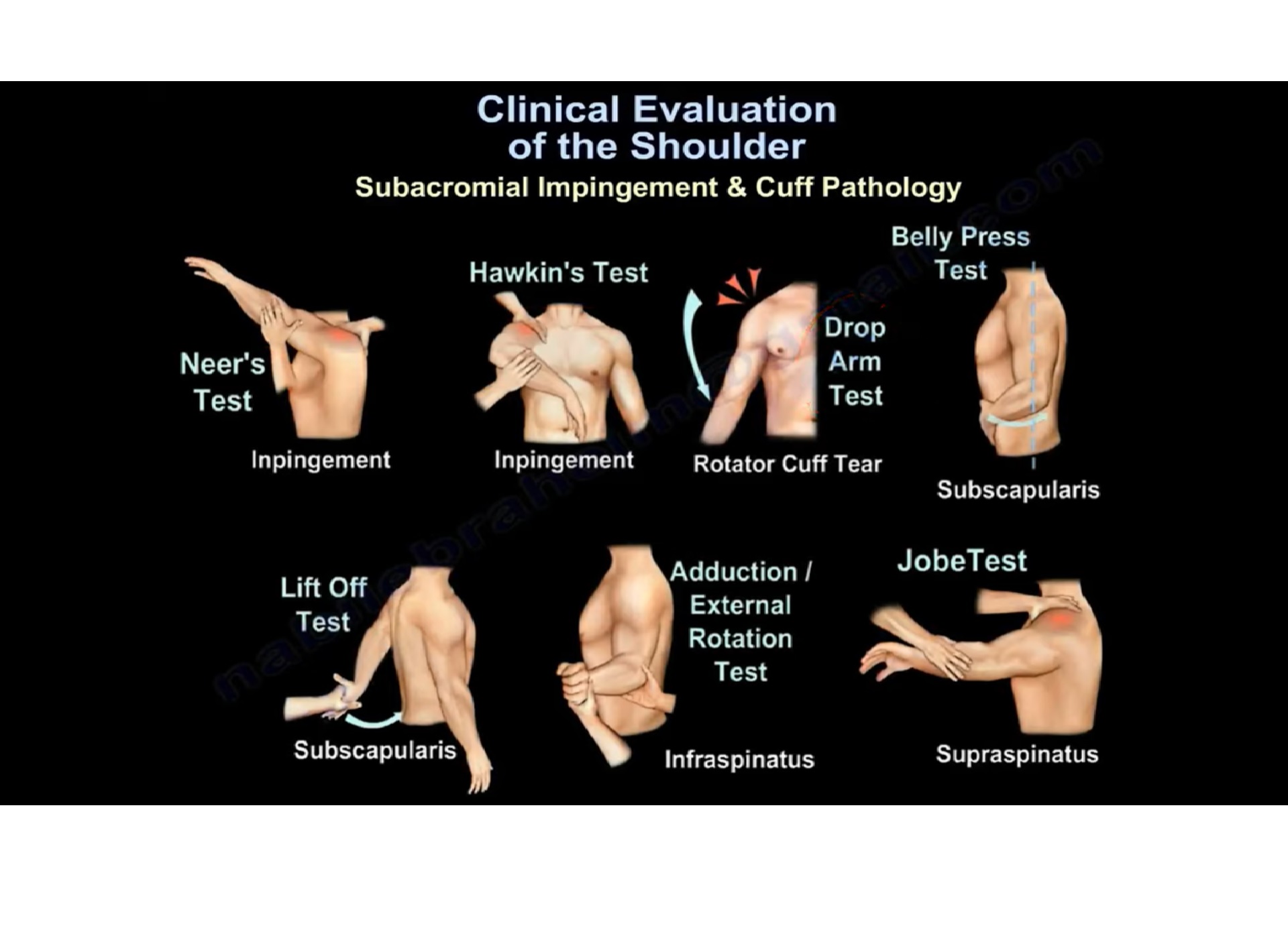
- Subacromial Impingement & Rotator-Cuff Evaluation
tests according to the structure/pathology being evaluated.
| Pathology / Structure | Test mentioned |
| Subacromial impingement | Neer test |
| Subacromial impingement | Hawkins test |
| Rotator cuff tear | Drop-arm test |
| Subscapularis | Belly-press test |
| Subscapularis | Lift-off test |
| Infraspinatus | Abduction–external rotation test |
| Supraspinatus | Jobe test |
- Neer Test
Used for:
Subacromial impingement
- Hawkins test
It is grouped with Neer as a test for subacromial impingement.
- Drop-Arm Test
Used to assess:
Rotator-cuff pathology/tear
- Subscapularis Tests
Belly-Press Test
Used for:
Subscapularis weakness or rupture
Lift-Off Test
Also used for:
Subscapularis weakness or rupture
Subscapularis – Belly press + Lift-off
- Infraspinatus
Abduction–external rotation test
for assessment of the infraspinatus muscle.
- Supraspinatus — Jobe Test
Jobe test
Used for evaluation of the:
Supraspinatus
Jobe – Supraspinatus
- Glenohumeral Joint & Instability
- Glenohumeral joint
- Labral/capsular structures
- Shoulder instability
The tests are organized according to the direction of instability.
| Test | Pathology assessed |
| Load-and-shift test | Glenohumeral instability |
| Anterior apprehension test | Anterior instability |
| Posterior apprehension test | Posterior instability |
| Jerk test | Posterior instability |
| Sulcus test | Multidirectional instability |
- Load-and-Shift Test
Used as a general assessment for:
Glenohumeral instability
- Anterior Apprehension Test
Used for:
Anterior shoulder instability
- Posterior Instability
- Posterior apprehension test
- Jerk test
Both are used to assess:
Posterior instability
- Sulcus Test
The sulcus test is used for:
Multidirectional instability
Sulcus sign – Multidirectional instability
- Biceps Tendon
Speed test
- SLAP Lesion
O’Brien test / active compression test,
High-Yield Shoulder Examination Table
| Area | Test | What it assesses |
| Cervical spine | Spurling | Cervical nerve-root compression |
| AC joint | Cross-body adduction | AC-joint pathology |
| Subacromial space | Neer | Impingement |
| Subacromial space | Hawkins | Impingement |
| Rotator cuff | Drop arm | Rotator-cuff tear |
| Subscapularis | Belly press | Weakness/rupture |
| Subscapularis | Lift off | Weakness/rupture |
| Infraspinatus | Abduction–ER test | Infraspinatus |
| Supraspinatus | Jobe | Supraspinatus |
| GH joint | Load and shift | Instability |
| Anterior instability | Anterior apprehension | Anterior instability |
| Posterior instability | Posterior apprehension | Posterior instability |
| Posterior instability | Jerk | Posterior instability |
| MDI | Sulcus | Multidirectional instability |
| Biceps | Speed | Biceps tendon pathology |
| SLAP | Test name unclear in transcript | SLAP pathology |
Practical Examination Sequence
- History
2. Active and passive ROM + compare opposite side
3. Rule out cervical pathology — Spurling
4. AC joint — Cross-body adduction
5. Impingement — Neer + Hawkins
6. Rotator cuff — Jobe / Drop arm / Belly press / Lift off / ER testing
7. Glenohumeral instability — Load-shift + apprehension tests
8. MDI — Sulcus
9. Biceps — Speed
10. SLAP assessment
- Always assess both active and passive ROM and compare with the opposite shoulder.
- Diabetes and hypothyroidism are specifically associated with adhesive capsulitis in the lecture.
- Shoulder and cervical pathology can coexist.
- Spurling – cervical nerve-root compression.
- Cross-body adduction – AC joint.
- Neer + Hawkins – subacromial impingement.
- Drop arm – rotator-cuff tear.
- Jobe – supraspinatus.
- Belly press + lift off – subscapularis.
- Load and shift – glenohumeral instability.
- Anterior apprehension – anterior instability.
- Jerk + posterior apprehension – posterior instability.
- Sulcus – multidirectional instability.
- Speed – biceps tendon.
Exam Pearls
For rapid recall:
Neck – Spurling
AC joint – Cross-body adduction
Impingement – Neer + Hawkins
Supraspinatus – Jobe
Subscapularis – Belly press + Lift off
Anterior instability – Apprehension
Posterior instability – Jerk
MDI – Sulcus
Biceps – Speed
Leave a Reply